By: Mary Lynch
My great-great-great grandparents left home during the biggest immigration of Czechs to America which occurred around 1870 to the beginning of WWI. Before the war, many left the country due to the lack of economic opportunity and in order to flee from mandated service in the Hungo-Austrian imperial army. The area was also severely under-industrialized, which resulted in plenty of laborers and little availability, let alone options, for work. Czechs mainly filled the peasant class, living off of “starvation pay” as they worked the land endlessly. Considering these circumstances, the idea of prosperity within America seemed promising especially considering the perceived success of the Czechs that left for America earlier, sending letters and checks back home to their families more or less proving the country’s abundance. My family lineage in America began with Albert and Veronica Rajnosek (Rainosek) after they set off for the United States from the Frenstat area of Moravia in 1873. They eventually settled in a predominately Czech community in Hostyn, Texas that was full of fertile land available to be tended by our family. My grandfather was born to Henry and Frances Rainosek shortly after the end of WWII in 1947 in Corpus Christi Texas.
This was a deeply transformative time for the United States, between the Great Depression and the war, culinary practices in America changed to suit the times. This period gave way to canned food and frugality, changing the way generations ate for the years to come. I grew up with a keen awareness of my grandfather’s tastes, as it was a running joke amongst the family. He has a staunch craving for starch, whether that be in the form of bread or potatoes, which must be present at each and every meal. If they aren’t represented on the table he’ll promptly pull out a loaf of white bread to join supper, a behavior that is now expected of him despite my Nona’s occasional protests. He also prefers most, if not everything, to come from a can. Vegetables, soup, sausage, fish, fruit, and so on, all taste better with a hint of tin according to him, which also happens to tick off my Nona. Whether this preference resulted out of my great-grandfather’s profession as a grocery store manager who had a tendency to bring home dented cans not fit for the shelves, or simply as a sign of the times, this class of foods is a great comfort to him and his stomach. Though his family assimilated into a pretty standard American lifestyle they still had a tight grasp on their Czech tastes that eventually gave way to me experiencing the delicacy that is a Kolache.
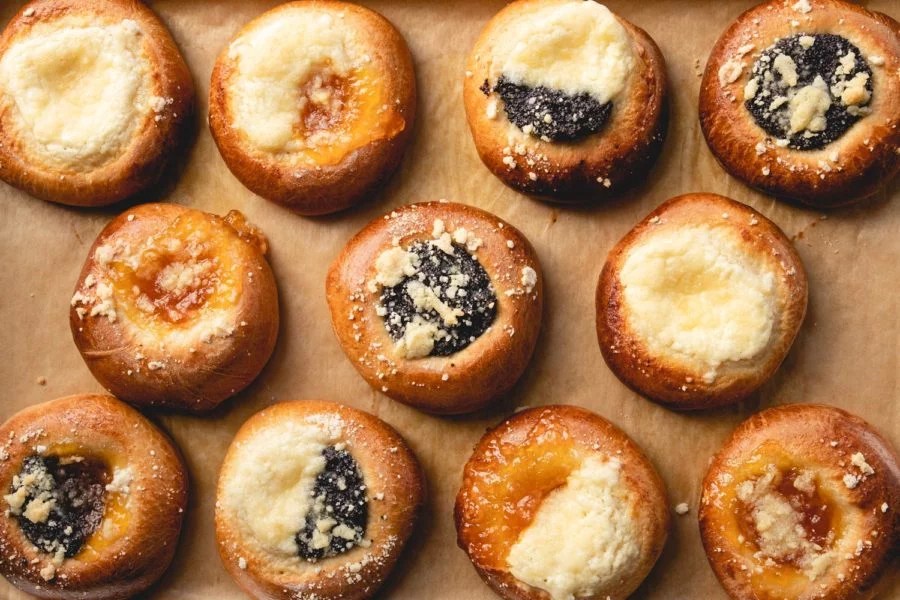
Kolaches by “The Sunday Baker” (https://sundaybaker.co/kolaches-czech-sweet-pastries/)
Growing up I never really paid any special attention to the bags and bags of Kolaches and Klobasniky that my grandparents would bring to our home from Texas. My brother and I would just fight over which flavors we wanted and that would typically be the end of the conversation, but as I got older I realized that this pastry was practically unique to my heritage and anyone outside of the predominantly Czech areas of Texas.
Kolaches aren’t necessarily a special food to this culture considering the places and times in which they are eaten, and they aren’t made with any particularly special ingredients either. Mainly consisting of sugar, flour, yeast, milk, eggs, salt, water, and some sort of oil or shortening, their base is basically just a standard sweet style bread. The real fun of this pastry is the filling, which is traditionally made from fruits like apricots or prunes, a sweet cheese like cream cheese and cottage cheese, or poppy seeds. They are similar to danishes in their versatility but their doughs are pretty different, Kolaches have a “breadier” dough comparable to brioche and danishes have a more flaky base and a more light consistency. Despite there being traditional fillings, you can basically put anything you want into a Kolache. A popular Czech bakery in Texas that my family frequents on road trips called Weikles, has over 20 different varieties of Kolaches to choose from. Flavors like pineapple, coconut, chocolate, lemon, and seasonal flavors like pumpkin would never be considered traditional by any means but that doesn’t make them any less delicious or bought by Weikles frequenters. Kolaches adaptable nature makes them privy to seasonal shifts and the availability of produce giving them space to grow and evolve in an American context.
Our family has 4 distinct ways to make the kolache. Most of the variations occur in the order that the ingredients are all combined, not the ingredients themselves. Two of the recipes in my family cookbook call for the yeast to be risen separately from the rest of the ingredients and two mix the margarine, milk, sugar, salt, eggs, and yeast mixture together. The differences in these recipes may have arisen out of the invention of instant yeast in the 1970s which doesn’t require for the yeast to be rehydrated before interacting with other ingredients. Typically kolache dough is kneaded by hand, but one of the recipes calls for a standing kitchen mixer. Dough based recipes are very finicky and generally are above the skill set of a lot of home cooks as they require a keen awareness of when to stop kneading. Standing mixers are able to reallocate a lot of the physical labor of kneading but still require an experienced baker’s eye. This skill is also required in the actual baking process as each recipe calls for a different oven temperature (between 350-425 degrees) and none of them have a suggested bake time other than “till [golden] brown”. In my immediate family, no one has been able to bake kolaches from scratch other than my late great-grandmother, even my uncle who is a professional chef. And considering how technical these recipes actually are despite their “simple” instructions, it’s no wonder why the only kolache I’ve ever had (and enjoyed) has come from Weikles.
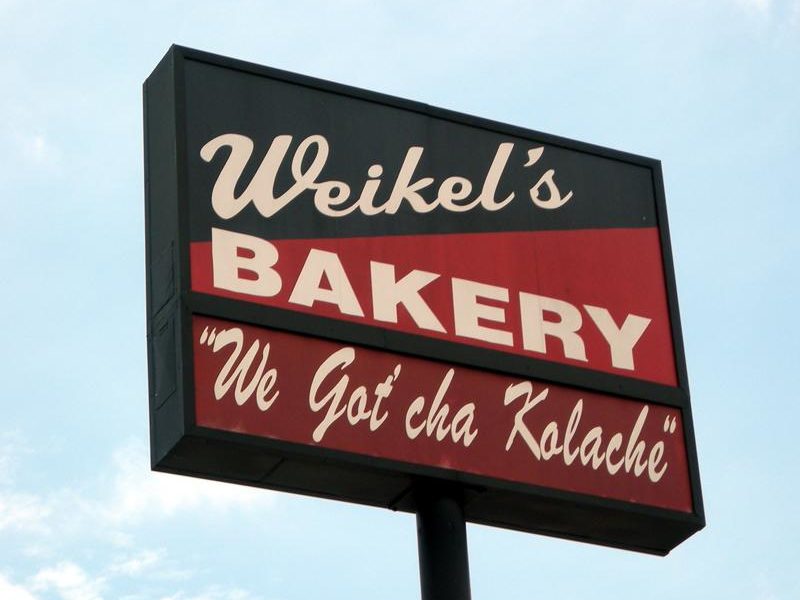
Weikel’s Bakery Sign from Road Food (https://roadfood.com/restaurants/weikels-store-and-bakery/)
This brings us to the microcosm that is the Texas-Czech identity. Czechs were similar to other immigrant groups in that they sought to find solace and comfort among the people that came before them to America. Texas holds the largest number of people that identify as Czech with over 180,000 descendants to call it home. Most Czechs were farmers prior to immigration so it only made sense to fall back on their agrarian roots when trying to settle themselves in the new country. As more people immigrated throughout the late 19th century, really strong communities were solidified in this area, built around their shared pasts and future plans in the United States. Despite the old country being so fragmented in terms of ethnic background, people that identified as German, Austrian, Bohemian, Slovak, or Moravian, all became Czech in these Texas based communities, as “Czech-Moravians brought no sense of nationality to America with them, only local identities and allegiances” (Hannan, 43). This really allowed for this group to immerse themselves in the American identity as well as retaining some aspects of their history through the more concentrated communities they resided in. It was in these localities that they were able to maintain some kind of sense of home through music, dance, art, festivities, folktales, and of course, food.
I didn’t know my great-grandparents personally as my great-grandfather died before I was born and my great-grandmother died shortly after Katrina. All I know about them is from stories reiterated by my family, which honestly isn’t a lot now that I’ve been prompted to reflect on their lives through this project. Over the Thanksgiving holiday, I decided to try and pick my family’s brain about memories surrounding their parents/grandparents and food, in hopes of trying to crack the secret of the Kolache. And to my dismay, no one in my immediate family has been able to make Kolaches that even generally resemble the ones of my great-grandmother Frances. Apparently the whole process was oversimplified by Frances’ perceived ease in making them, so much so to the point that my mother was unconvinced that she even made the dough herself. Frances used a huge clay bowl that was specifically made for making the pastry, she would place the bowl in the crook of her arm and knead it with the other using only a large wooden spoon. From there she would section out the dough into perfect little squares, indent them to make space for the filling, and pop them into her regular 1970s style oven. There was no convection feature, no standing mixer, and absolutely not a sweat broken over these pastries that miraculously came out perfectly every single time. It was clear to me from my Nona’s story that this ritual was essentially buried deep in the very genes of Frances as she made a tricky and methodical process seem like a cake walk.
Diving into my culture like this has led me to come up with a couple of simultaneously disheartening and inspiring conclusions. On the one hand, this exploration has really forced me to confront the fact that over time my family has become disjointed from our ethnic culture in almost all ways besides food. We do not participate in any Czech celebrations, only my grandfather can speak Czech (albeit mostly broken), and this is practically the first time in my life that I’ve really taken the time to look into my background. To some degree it feels like as soon as my great-grandparents left the farm and their community to become “city folk”, the Rainoseks assimilated almost completely into the American identity. Being away from mono-cultural communities has led to a disconnect from our background and history, because as much as I’d like to believe that I have been made privy to the “old” practices of my great-grandparents, there’s a lot of time and energy needed for these practices to be actually passed down from generation to generation. Though the Czech pastry imprint on America is destined to stick around, our family may never be able to reproduce the delicacy that was Frances’ kolaches because we lost the skills to produce them. As discouraging as that may have sounded, this doesn’t necessarily mean that our identity as Czechs is lost forever, because all it really takes is a little bit of passion and love to revive it in a modern context. As much as I wish I could’ve gained my knowledge directly from the source, the pieces of the puzzle are already all here. It’s ultimately just up to me to figure it all out.
Bibliography
Papp, Susan, and Joe Esterhas. “The Great Immigration (1870-1920).” Hungarian Americans and Their Communities of Cleveland, MSL Academic Endeavors, pressbooks.ulib.csuohio.edu/hungarian-americans-and-their-communities-of-cleveland/chapter/the-great-immigration-1870-1920/. Accessed 12 Dec. 2023.
Hannan, Kevin. “Refashioning Ethnicity in Czech-Moravian Texas.” Journal of American Ethnic History, vol. 25, no. 1, 2005, pp. 31–60. JSTOR, http://www.jstor.org/stable/27501662. Accessed 12 Dec. 2023.
SFA. “The Keepers of Kolaches: The Evolutions of Texas-Czech Baking.” Southern Foodways Alliance, 15 Nov. 2023, http://www.southernfoodways.org/oral-history/the-keepers-of-kolaches-the-evolutions-of-texas-czech-baking/.
Czech Population by State 2023, worldpopulationreview.com/state-rankings/czech-population-by-state. Accessed 12 Dec. 2023. Oomman, Sheena. “Texas Czechs – Vìtáme Vás Na Texas.” Cultural Crossroads, http://www.houstonculture.org/cr/czechs.html#:~:text=Czechs%20first%20settled%20in%20Texas,attractive%20compared%20to%20their%20homeland. Accessed 12 Dec. 2023.


One thought