Food or Festive Decor?
The Candy Cane Pie was first mentioned in 1962 and was advertised as a holiday pie for Christmas, containing candy cane as one of the main ingredients. The candy cane has been associated with the Christmas holiday for years, but did you know that candy canes were not always the colors we see today, instead of having a curved hook, the candy was white and straight. The origin of the candy cane is known to be in Germany, but the coloring and shape we see today have many theories. One of the theories as to where the candy got its shape is “that a choirmaster in Germany’s Cologne Cathedral convinced a local candy maker to bend sugar sticks into the shape of a shepherd’s crook so that restless children attending Christmas mass could hold on to the treat as they enjoyed it and remain quiet” (Nelson, 2022). And thus the legend of the candy cane hook began.
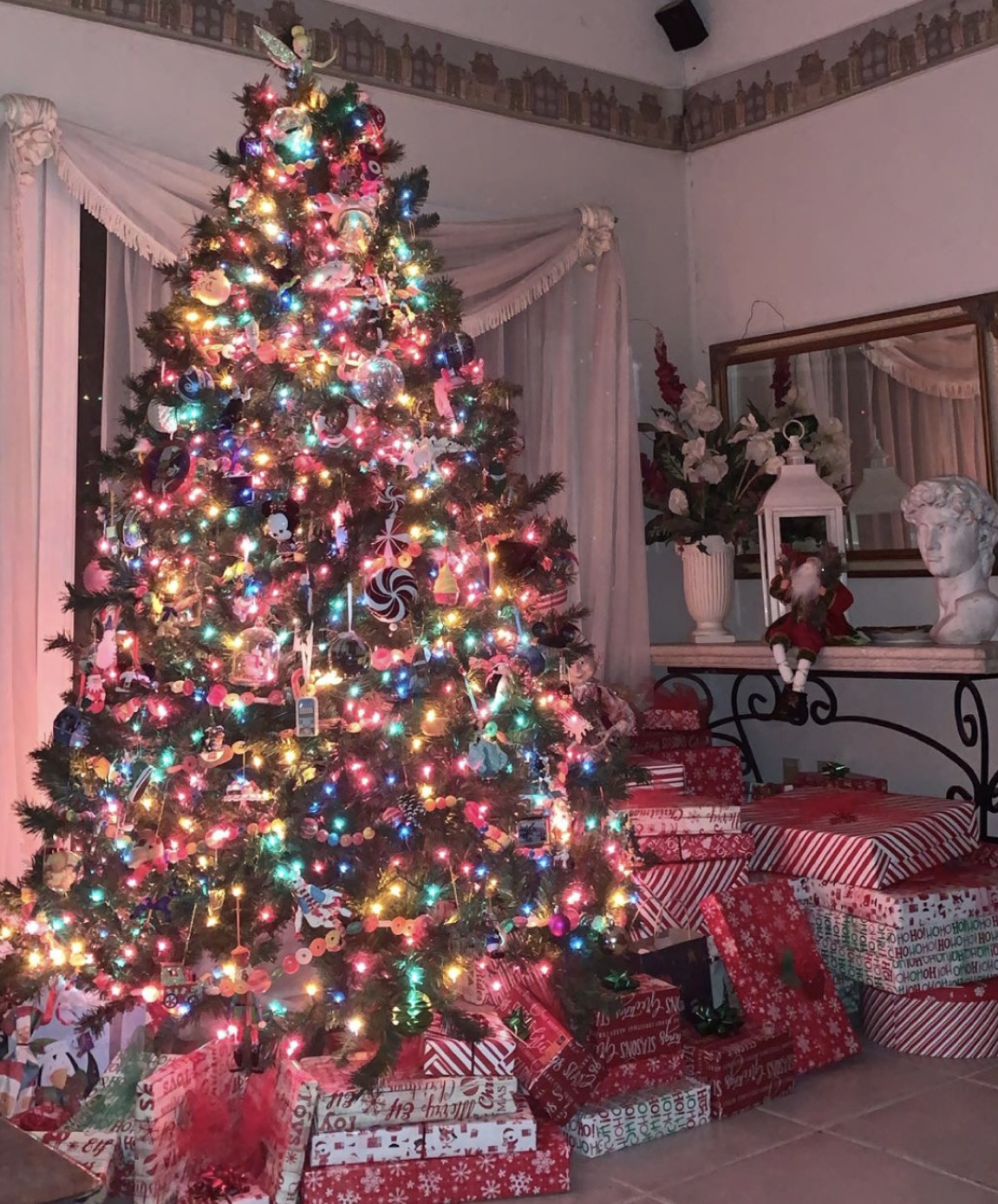
We may never know if that is true, but we do know that “the first documented use of candy canes in Christmas decor dates back to 1847 when August Imgard, a German-Swedish immigrant, adorned a small blue spruce tree with this peppermint treat” (The Sugar Association, 2023). My family started putting candy canes on our Christmas tree a few years ago, and while they do look nice, they make even better quick grabs off the tree to eat as you pass. My mother doesn’t enjoy it very much, but every year there is a decent-sized area where candy canes are missing from the tree.
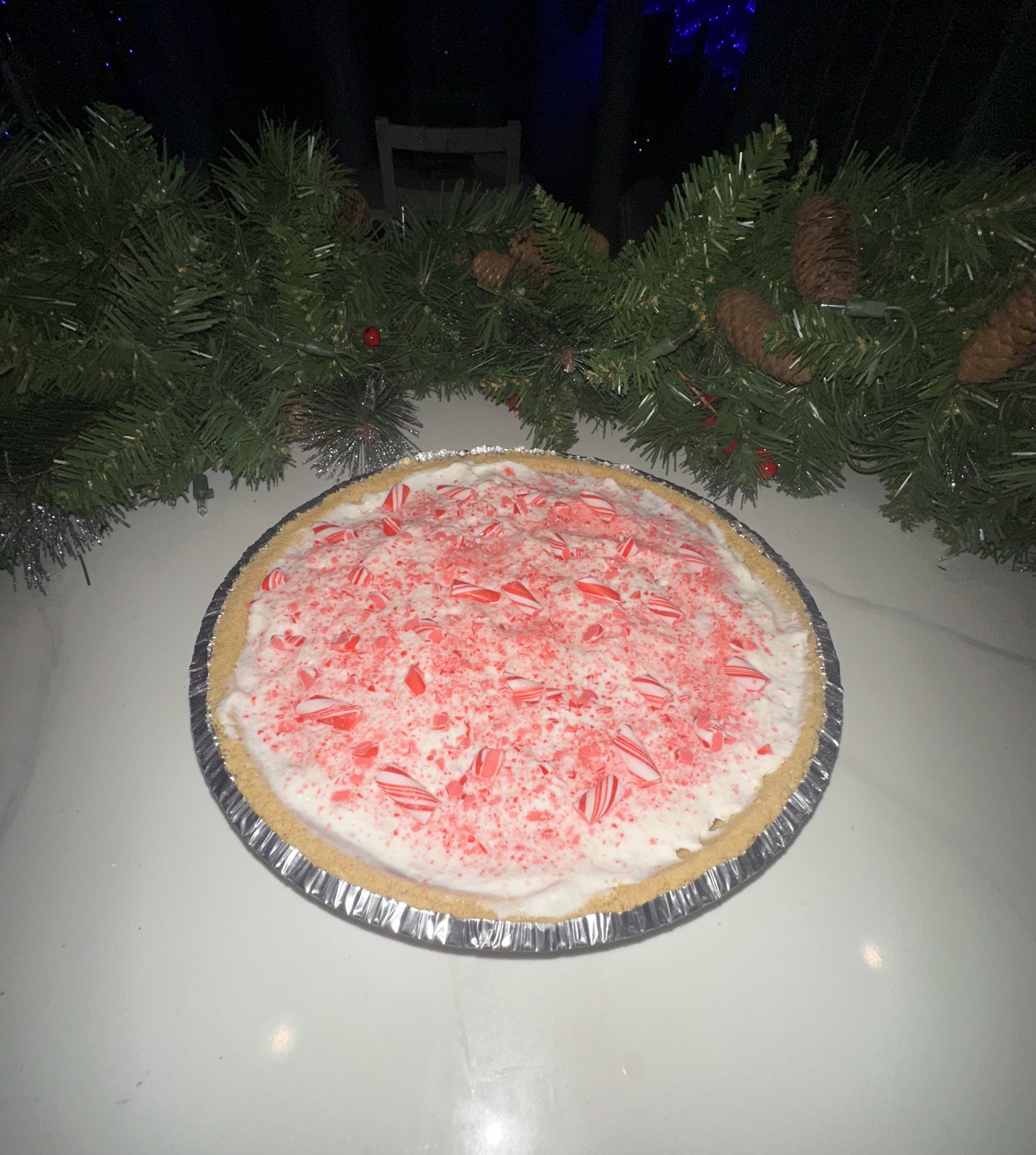
In the spirit of stealing the candies off my mother’s tree, I decided to make a Candy Cane Pie for my family. The reviews were to be expected, as I’m not one to be trusted in the kitchen, but for the most part, I think they enjoyed this festive 1960s holiday dessert. The recipe I made was a recipe published in the Fort Collins Coloradoan, on December 24, 1962. The recipe was part of a holiday-issued letter, describing the pie as a “delicious new idea for a holiday season dessert” and that the recipe was “included in a pamphlet from the files of Mrs. Lucille Payton, county extension home agent” (Fort Collins Coloradoan, 1962). The issued letter also mentions other holiday activities going on in town, as well as people’s plans for the holiday season, which, looking at now, sounds like a terrible idea to announce you will be gone for a week to the public, but I suppose it was a different time. Regardless, I was able to make this tasty dessert with my great-grandmother and was able to share this treat with my family. I recommend the pie for everyone to try, as it is delicious and relatively easy to make. All you need are a few ingredients, an oven, a fridge, a bowl, a spoon, and some measuring cups! The baking process is only 8 minutes long; however, the pie has to chill in the fridge for at least 2 hours before you can start stabbing it with a fork, but it’s worth the wait!
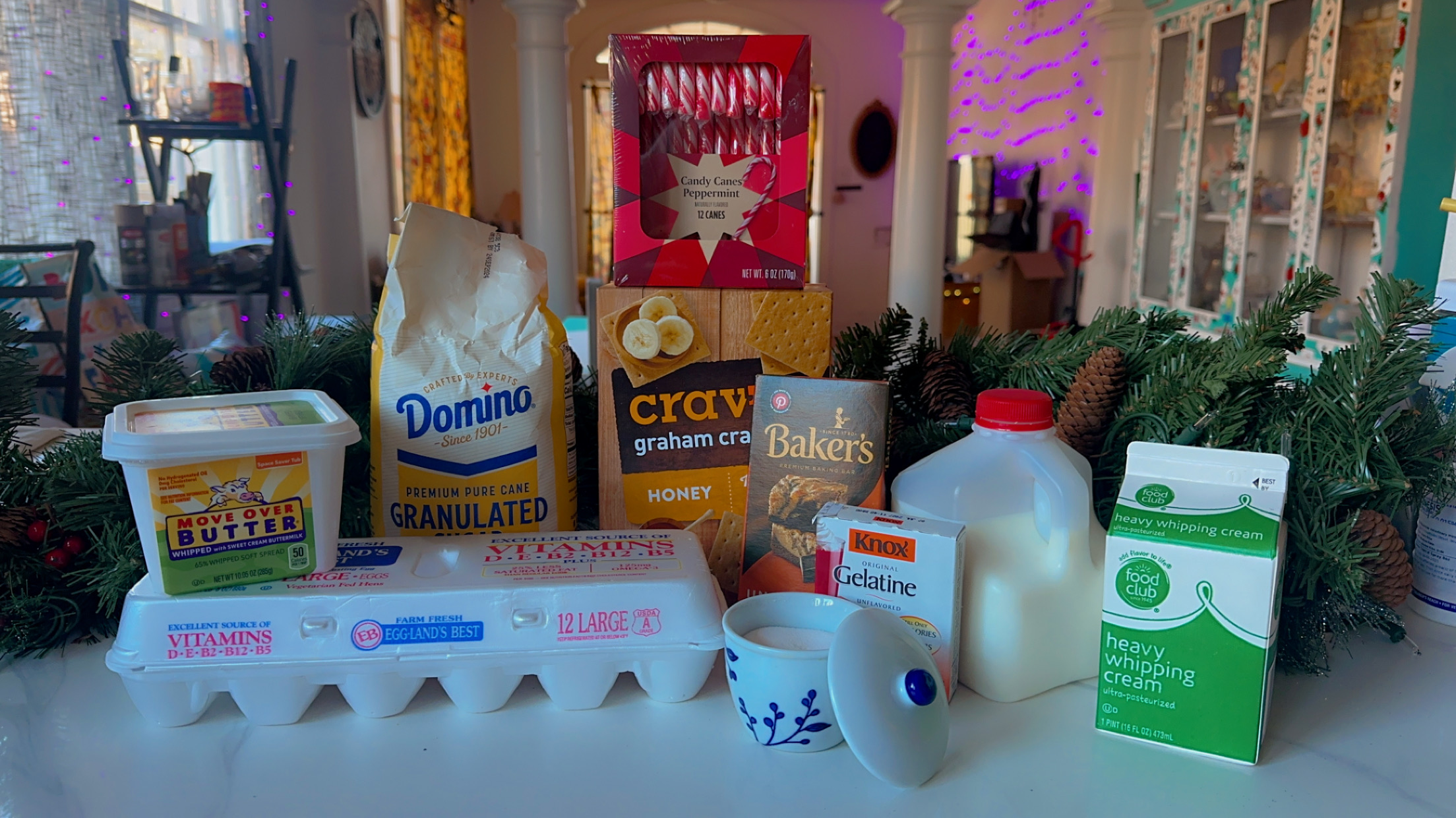
Ingredients
- One envelope unflavored gelatin (1 pouch is about 2 1/2 teaspoons (7g) unflavoured gelatine)
- 1 ⅔ cups graham cracker
- ¼ cup softened butter or margarine
- 1 cup crushed peppermint candy canes
- ½ cup cold water
- 2 squares unsweetened chocolate
- 1 cup sugar (¼, ¼, & ½ cups)
- 1 cup milk
- 2 eggs
- ¼ teaspoon salt
- 1 cup heavy cream
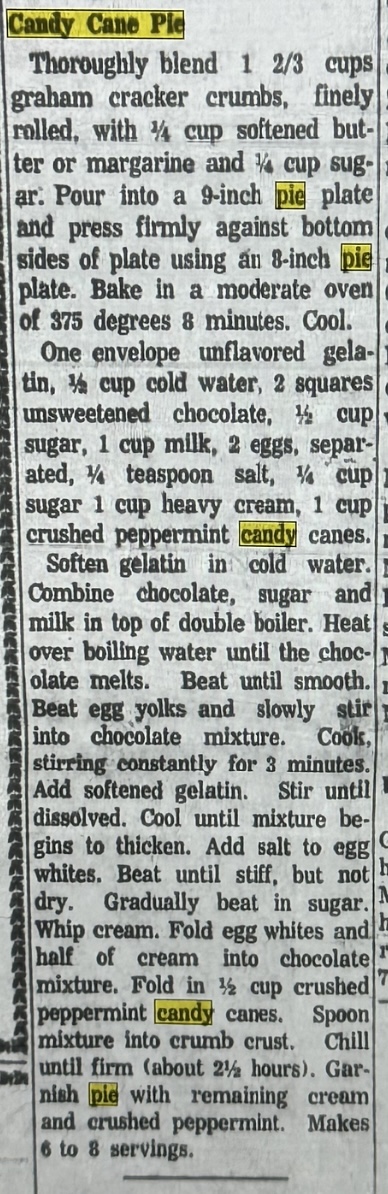
Dec 24, 1962
Recipe
- Thoroughly blend 1 ⅔ cups graham cracker crumbs, finely rolled, with ¼ cup margarine or butter and ¼ cup sugar.
- Pour mixture into a 9-inch pie plate and press firmly against the bottom sides of the plate using an 8-inch pie plate.
- Bake in a moderate oven of 375 degrees for 8 minutes. Cool.
- Soften gelatin in cold water.
- Combine chocolate, ½ cup sugar, and milk on top of a double boiler. Heat over boiling water until the chocolate melts and beat until smooth.
- Beat egg yolks and slowly stir into the chocolate mixture.
- Cook, stirring constantly for 3 minutes.
- Add softened gelatin and stir until dissolved.
- Cool until the mixture begins to thicken.
- Add salt to egg whites and beat until stiff, but not dry.
- Gradually beat in ¼ cup sugar.
- Fold egg whites and half of the cream into the chocolate mixture.
- Fold in ½ cup crushed peppermint candy canes.
- Spoon mixture into crumb crust
- Chill until firm (about 2 ½ hours) and garnish with remaining cream and crushed peppermint.
- Makes 6 to 8 servings
Interesting History of Ingredients
Candy Cane Pie involves many ingredients that have interesting histories about their developments and relations to the United States. One of these ingredients is graham crackers. They were developed in 1829 by a man named Sylvester Graham as a way to supplement his recommended “Graham Diet” (Luebering, 2024). At the time of the graham cracker’s development, “Graham believed that physical lust was harmful to the body, causing a wide variety of maladies such as headaches, indigestion, spinal diseases, epilepsy, and insanity,” and as a way “to combat these sexual urges, Graham advocated a number of lifestyle changes, including eliminating meat, fat, spices, condiments, coffee, tea, and alcoholic beverages from one’s diet, abstaining from using tobacco, exercising regularly, wearing loose-fitting comfortable clothing, and sleeping on hard mattresses with the windows open, even in cold weather” (Luebering, 2024). The foods he believed were suitable for consumption he referred to as the “Graham Diet,” included the tasteless graham crackers. However, these graham crackers were not like the ones seen in grocery stores today, as they were more similar to bran saltine crackers, lacking salt (Luebering, 2024). Though the original graham crackers were definitely lacking in flavor, their use in the peppermint pie is not the case. The graham crackers used in the pie are to help form the crust, adding a pleasantly sweet crunch thanks to the now-added sugar.
The recipe for Candy Cane Pie says you can use butter or margarine, but I feel like they would have used margarine due to its lower price so I used it in my recreation. Margarine has a reputation in the world of food and unfortunately, it has not always been a pleasant one. People used butter until 1869 when a man named Hippolyte Mege-Mouriez, a French chemist, developed margarine, named after the margaric acid used to produce it (Ball and Lily, 1981). The development of margarine in 1869 changed how people cooked, as this new substitute for butter was becoming available for consumers at a lower cost than butter. It did not take long for margarine production to make its way to the United States. The production of margarine in the United States began in 1875 and with the introduction of margarine came questions and regulations of this new product (Riepma, 1970, as cited in Ball and Lily, 1981). Soon after margarine’s debut in the United States, Missouri prohibited the substance in 1881, followed in 1884 by New York, Maine, Minnesota, Wisconsin, Ohio, Pennsylvania, and Michigan in 1885 (Ball and Lily, 1981). Margarine’s reputation continued to decline as states such as “New Jersey outlawed yellow margarine in 1886, and 34 states accounting for nearly 80 percent of the population of the United States followed by 1900-five of them going as far as require that margarine be colored pink (Snodgrass, 1930, as cited in Ball and Lily, 1981). However, margarine’s reputation saw a change in the United States after 1950 when laws regulating the product were repealed, and a yearly increase in consumption was seen at a rate of 8 percent each year (Ball and Lily, 1981). This rise in consumption and reputation continued in the United States as housewives complained of high calories and butter’s association with heart disease in the 1970s, causing margarine to be deemed a better alternative to butter at the time (Ball and Lily, 1981). I grew up in a household that only used stick butter, so using margarine for this pie was new for me and now I have easy, spreadable butter for toast.
Gelatin was used in most foods and desserts during the 1960s and the Candy Cane Pie is not an expectation to the gelatin craze. The history of gelatin is long, dating back to the 10th century B.C., “the book “Kitab al-Tabikh” described the recipe for the preparation of fish jelly, the main component of which is actually one of the varieties of gelatin, by boiling fish heads” (Nasrallah, 2007, as cited in Mikhailov, 2023). Gelatin didn’t make an appearance in the United States until 1842, when a company out of Edinburgh, Scotland, J and G Company began exporting its Cox Gelatin there (Stradley, 2017). This gelatin was flavorless at the time and did not gain flavor until 1895 when Pearl B. Wait experimented with adding fruit syrups (strawberry, raspberry, orange, and lemon) to gelatin (Stradley, 2017). Wait was also the one to name gelatin with the name known today, Jell-O. However, his efforts to get Jell-O off the ground were unsuccessful and Jell-O changed hands for years. When looking at the ingredients for the pie I didn’t know what an “envelope of gelatin” was at first and thankfully had my great-grandmother there to assist me. She told me it was equivalent to a pouch because they should both be about 2 ½ teaspoons. I had just never heard of gelatin referred to as an envelope before.
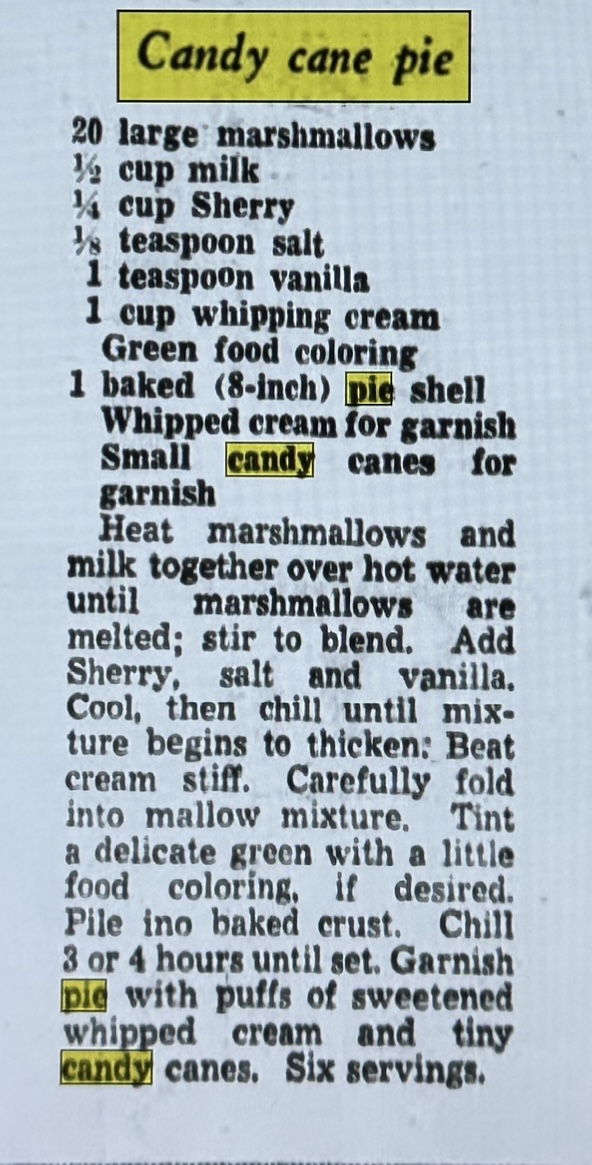
Dec 05, 1967
I was able to make the pie with my great-grandmother and share my fun Christmas pie with her. She wasn’t a huge fan of the pie, but I think her opinion is biased because she doesn’t like candy canes. The rest of the family enjoyed the pie, but there are other versions of the Candy Cane Pie that have emerged over the years. Some recipes I would like to try more so than others. The recipe I made was from 1962, the first time the pie was ever mentioned to the public. However, the pie’s recipe changed in 1967 when the recipe added marshmallows and sherry to the pie. They also decided in this recipe to not crush the peppermint, instead, they garnished it with small candy canes. The recipe also called for an already baked pie crust, unlike in the 1962 recipe that instructed you on how to make your own.
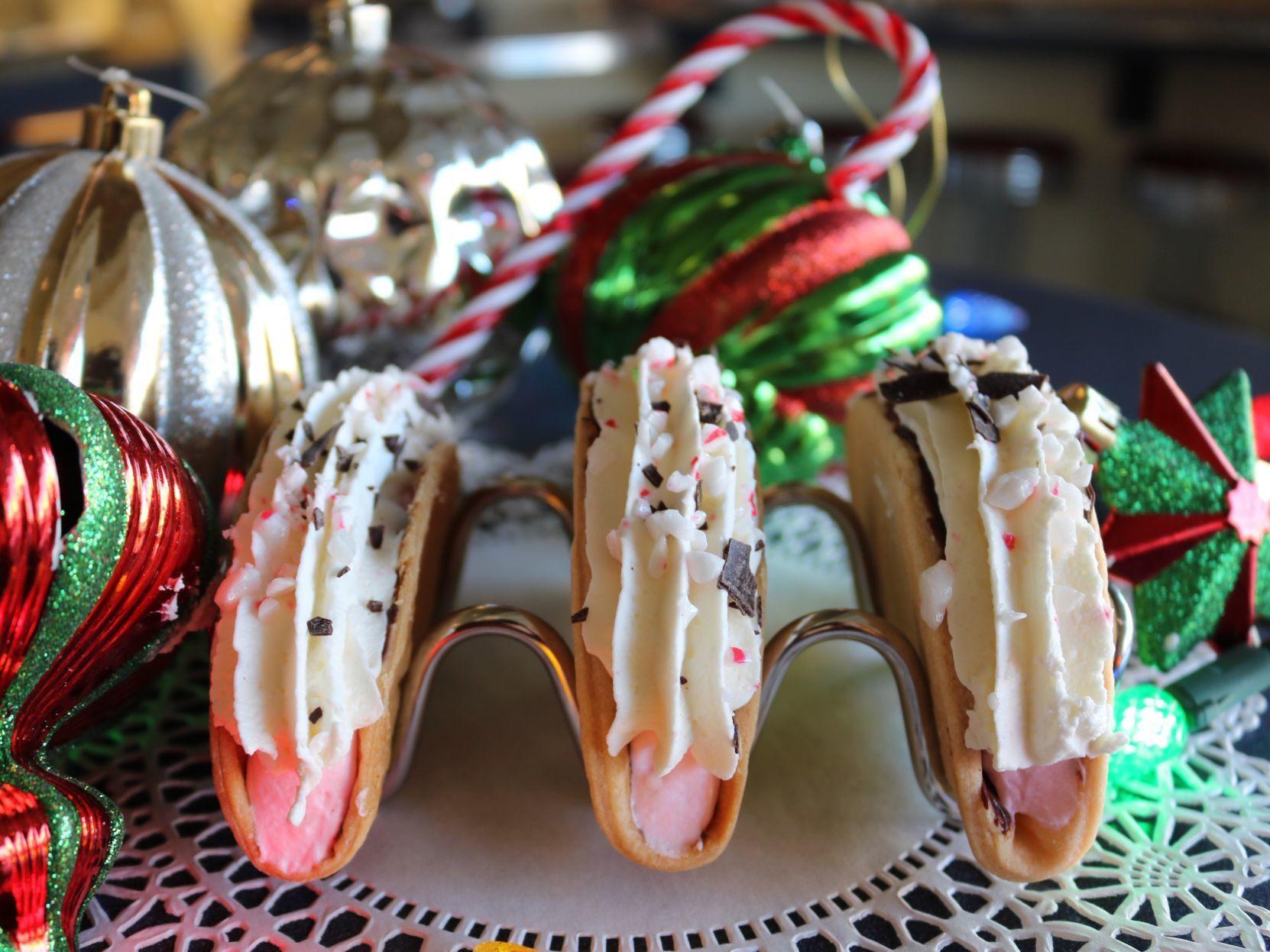
Dec 19, 2018
Photo taken by: Rob Thomas
The recipe then took another turn in 2018 in Middleton Wisconsin. A diner, Hubbard Avenue Diner, made Candy Cane Pie Tacos. Yes, you read that right, a pie in a taco. The diner offers other pies in taco form as well! You can find Pumpkin pie in taco form and other seasonal pies throughout the year. The image to the left is the photo taken by Rob Thomas of the Candy Cane Pie Taco at the Hubbard Avenue Diner. The pie taco while looking delicious, somehow still confuses my brain to look at and comprehend because I like pie and I like tacos separately, but I’m unsure how I feel about the two becoming one. The idea of a dessert combining with something I associate with a meal also disturbs my brain. Maybe one day I will try it, but I don’t know how near in the future that will be. Maybe I will just stick to my traditional Candy Cane Pie for now.
Citations:
Ball, Richard A, and J Robert Lilly. “The Menace of Margarine: The Rise and Fall of a Social Problem.” Social Problems, vol. 29, no. No. 5, June 1981, pp. 488–498.
Fort Collins Coloradoan, 24 Dec. 1962.
Luebering, E.J. “Dessert.” Encyclopædia Britannica, Encyclopædia Britannica, inc., 11 Nov. 2024, http://www.britannica.com/topic/dessert.
Mikhailov, Oleg V. “Gelatin as It Is: History and Modernity.” International Journal of Molecular Sciences, U.S. National Library of Medicine, 10 Feb. 2023, pmc.ncbi.nlm.nih.gov/articles/PMC9963746/#B1-ijms-24-03583.
Nelson, David C. “The Delicious Origins of the Candy Cane.” The Golden Glow of Christmas Past®, 14 Sept. 2022, goldenglow.org/the-delicious-origins-of-the-candy-cane/#:~:text=We%20do%20know%20that%20they,the%201600s%20as%20a%20pacifier.
Stradley, Linda. “History of Gelatin, Gelatine, and Jell-O.” What’s Cooking America, 9 Feb. 2017, whatscookingamerica.net/history/jell-0-history.htm#:~:text=1845%20–%20Unflavored%20dried%20gelatin%20became,Gelatin%20to%20the%20United%20States.
The Boston Globe, 05 Dec. 1967.
“The Candy Cane: A Delectable Dive into History and Production.” The Sugar Association, The Sugar Association, 14 Dec. 2023, http://www.sugar.org/blog/the-candy-cane-an-iconic-treat/.
Thomas, Rob. “Yeah, I Ate That: It’s a Pie! It’s a Taco! It’s Both, and We Deserve It.” The Cap Times, 13 Dec. 2018, captimes.com/entertainment/dining/yeah-i-ate-that-its-a-pie-its-a-taco-its-both-and-we-deserve/article_d3d0eb83-e818-5b95-a0d3-a1a65f2fba0b.html.

