Pumpkin pie is a dessert loved by many in the United States, especially around Thanksgiving. Pumpkin pie has been my family’s favorite Thanksgiving dessert for as long as I can remember. My mom and I are always the first people to grab a piece of pumpkin pie. I thought it would be perfect to research and bake a pumpkin pie recipe for my research project. I am not much of a baker, as I have never baked anything from scratch in my life, but I thought baking my favorite dessert would be a good place to start. When I was deciding what recipe to use, I wanted to use a recipe that was American-made, so I got my recipe from Amelia Simmons 1796 cookbook “American Cookery: The Art of Dressing Viands, Fish, Poultry, and Vegetables.” I also wanted to use Simmons recipe as I thought it would be interesting to understand ingredients from around 200 years ago. I am also going to bake the Libby 2023 pumpkin pie recipe. This will allow me to compare Simmons 1796 recipe to the 2023 recipe I know and love today.
Amelia Simmons Pumpkin Pie Recipe

1796 Recipe Ingredients explained:
In the 18th century, colonists would have gotten their eggs from farm animals, as farming was a large part of their lifestyle. Colonists would either get eggs from their own farms or purchase eggs from other colonists(“Growing Food”). Colonists would either milk the cows they owned, or they would buy milk from other colonists(“Growing Food”). Colonists learned how to plant and eat pumpkins from Native Americans. The colonists began to plant pumpkins in their gardens, so pumpkins were very accessible. Before Simmons recipe, the colonists recipe consisted of cutting the tops off of the pumpkins and putting spices into the pumpkins (Newspapers,2009). Simmons recipe changed the game as she used the pumpkin’s insides for the pie’s filling and made a crust. This is still the way we make pumpkin pies today. Molasses was imported to the United States by the British. The colonists bought their molasses from merchants, and it was the most popular sweetener as it had a natural sweetness and was cheaper than sugar (“The Fascinating Connection between Rum and Molasses and the History”). Allspice and ginger were imported to the colonies from Britain. Colonists could make trades and buy these spices from merchants, so these spices were readily available to most middle-class colonists(Terrell,2017). Colonists had to make the pie crust themselves, and the ingredients were flour, water, and butter. The colonists grew grains such as wheat or rye and made their own flour. Colonists went to wells nearby and collected water. Women colonists specialized in butter churning, so colonists could churn their own butter or buy it from other colonists (“Why the Saying Should Be “as American as Pumpkin Pie,” Not Apple”). Colonists would then use Dutch ovens or cook over the hearth to bake the pumkin pie (Ken,2015). Pumpkin pies were mainly cooked around Thanksgiving, and based on most of the ingredients, it seems like mainly middle-class colonists would be able to cook this dessert. Overall Amelia Simmons recipe paved the way for the pumpkin pie we know and love today.
Making Amelia Simmon’s Pumpkin Pie Recipe:
My first step was cutting the sugar pie pumpkins I bought in half and scooping the insides out. I cooked the pumpkins in the oven at 350 degrees for one hour. Once the pumpkins were done baking, they were soft, and I carved out the inside of the pumpkins and put 1 pint of pumpkin into a bowl.
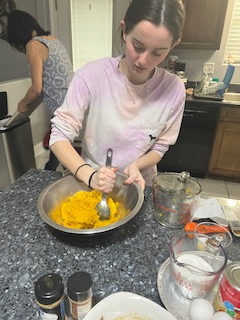
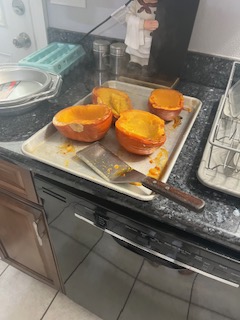
Next, I added 1 quart of milk, and 4 eggs, and mixed it with the pumpkin. Next, the recipe did not give measurements for the molasses, allspice, and ginger, so I did some estimating. I added 1/2 cup of molasses, 1 teaspoon of allspice, and 1 teaspoon of ginger into the mixture. The mixture was now done, and it was very watery like a custard.
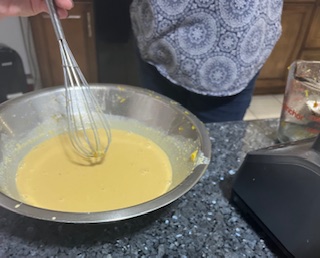
Next, I made the crust for the pie. I was not sure how to make a pie crust, so I went to the YouTube channel “Townsends,” which specializes in 18th-century recipes, and I used their recipe. I added 2 cups of flour in a bowl, 2 pinches of salt, and 6 cups of butter and mixed with my hands. I added 7 teaspoons of water to the mixture while I kept mixing with my hands. I added flour onto the counter, put the dough on the counter, and rolled out the dough with a rolling pin. I found it very difficult to get the dough smooth and fully rolled out. I put the crust into a tin mold, and added my pumpkin pie filling to the crust. I found out I made too much filling, as only one-half of the filling fit into the crust. I wanted to bake both pies at the same time, so I let this mixture sit while I made the mixture for the Libby 2023 recipe.


Making Libby’s 2023 Recipe:
Libby’s Recipe:
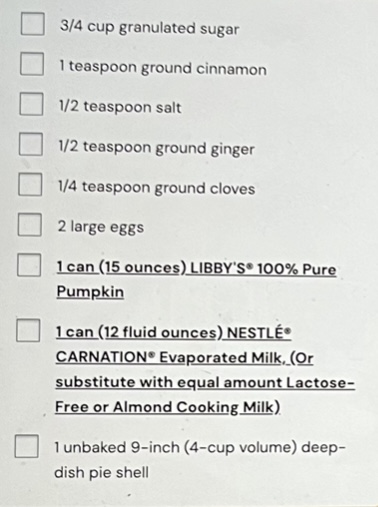
I mixed 3/4 cup of sugar, 1 teaspoon of cinnamon, 1/2 teaspoon of salt, 1/2 teaspoon of ginger, 1/4 teaspoon of cloves, and 2 eggs into a bowl. Instead of adding a can of pumpkin (15 ounces), I added 15 ounces of the sugar pumpkin that I baked previously. Next, I stirred in a can of evaporated milk, and the mixture was done. I made this pie crust the same the way I made Simmon’s pie crust and added my mixture to the crust. Now both pies were ready to be put in the oven.

Baking Times:
Amelia Simmons 1796 recipe said to bake the pie for 1 hour, so I decided to put the oven on 350° F and start at 1 hour. However, the pie ended up taking 1 hour and 20 minutes to fully bake. I followed the Libby 2023 recipe exactly by “preheating the oven to 425° F for 15 minutes and reducing the temperature to 350° F; and baking for 40 minutes.” When both pies were done, the 1796 pie was a darker orange than the 2023 pie. The 2023 pie looked like the lighter orange-colored pumpkin pie I know today, even though I partially burnt the top of it.
1796 Pumpkin Pie :
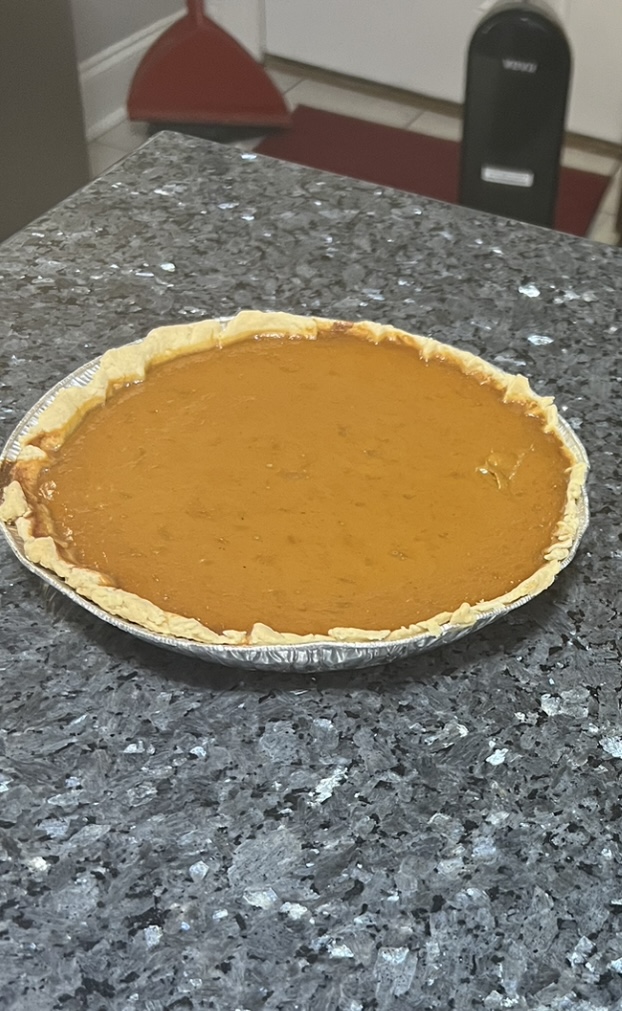
2023 Pumpkin Pie:

Taste:
When I cut into both pies, they both had a jiggly consistency, and both crusts were flaky. The 1796 pumpkin pie had the taste of raw pumpkin, and it tasted very bitter. I could taste the pumkin and biterness in each bite. I might have estimated the molasses wrong, which could be why it tasted so bitter. The 2023 pie tasted a little burnt becuase I burnt the top, but other than that it tasted like the pumkin pie I know today. It was very sweet when you first bit into it, and I got a pumpkin aftertaste as I swallowed each bite. The pumpkin flavor was definetely stronger in the 1796 pie, however, the sweetness of the 2023 pie balanced out the pumpkin flavor much better. Both pumpkin pies were very soft and easy to chew. I think both pumpkin pies came out pretty good based on the fact that I have never baked anything from scratch before.
Key Takeaways:
I found this research project very fun and interesting. It was fun to get into the mindset of Amelia Simmons and bake the 1796 pie from scratch. It was interesting to see how colonists mainly got their ingredients from farming and merchants while today everything is readily available at grocery stores. It was fun to look at how the 1796 recipe used very natural ingredients such as molasses that gave the pie a strong pumpkin and bitter taste. It was also fun to see how over time the pumpkin pie recipe has adapted to the sweetness that 21st century Americans love. I appreciate Simmon’s 1796 recipe, but I would choose the 2023 recipe as it has the sweetness and aftertaste of pumpkin I know and love today.
Bibliography:
“Growing Food.” Plimoth Patuxet Museums, plimoth.org/for-students/homework-help/growing-food#:~:text=The%20Pilgrims%20also%20brought%20farm.
Ken, Historical. “Passion for the Past: Cooking on the Hearth – the Colonial Kitchen.” Passion for the Past, 9 Sept. 2015, passionforthepast.blogspot.com/2015/09/cooking-on-hearth-colonial-kitchen.html#:~:text=Piles%20of%20live%20embers%20on. Accessed 4 Dec. 2023.
“LIBBY’S® Famous Pumpkin Pie.” LIBBY’S®, http://www.verybestbaking.com/libbys/recipes/libby-s-famous-pumpkin-pie/.
Newspapers, Charlotte Weick | Advance. “A Brief History of the Pumpkin, from Pilgrim Poems to Present.” Mlive, 26 Oct. 2009, http://www.mlive.com/penaseeglobe/2009/10/a_brief_history_of_the_pumpkin.html#:~:text=The%20Pilgrims%20learned%20about%20the. Accessed 4 Dec. 2023.
Simmons, Amelia. American Cookery, or the Art of Dressing Viands, Fish, Poultry, and Vegetables, and the Best Modes of Making Pastes, Puffs, Pies, Tarts, Puddings, Custards and Preserves, and All Kinds of Cakes, from the Imperial Plumb to Plain Cake. Adapted to This Country, and All Grades of Life. / by Amelia Simmons, an American Orphan. ; Published according to Act of Congress. 1 Dec. 2005, quod.lib.umich.edu/e/evans/N23574.0001.001/1:5.18?rgn=div2. Accessed 4 Dec. 2023.
Terrell, Ellen. “A Brief History of Pumpkin Pie in America | Inside Adams: Science, Technology & Business.” Blogs.loc.gov, 20 Nov. 2017, blogs.loc.gov/inside_adams/2017/11/a-brief-history-of-pumpkin-pie-in-america/.
“The Fascinating Connection between Rum and Molasses and the History.” The Spruce Eats, http://www.thespruceeats.com/history-of-molasses-1807630.
“Why the Saying Should Be “as American as Pumpkin Pie,” Not Apple.” Matador Network, matadornetwork.com/read/american-pumpkin-pie-history/#:~:text=New%20England%27s%20early%20settlers%20called. Accessed 4 Dec. 2023.
 digital Humanities studio