Within the first two decades of the 20th century, over 4 million Italians had crossed the Atlantic Ocean and landed on Ellis Island, New York in hopes of finding a safer and more prosperous home compared to their newly ‘unified’ motherland. Like many immigrants coming to the United States, they sought refuge from their untrustworthy government, natural disasters bringing famine, widespread disease, and high poverty/ violence rates. This new wave of 20th century Italian Americans not only brought their boisterous culture and garlic infused recipes, but also their tireless work ethic and adaptable lifestyles, so that their loved ones back in Italy could benefit and have a better life. The socioeconomic backgrounds of Italian Americans varied greatly, as regions in Italy were distinctly separate based on dialect, customs, and culinary traditions, but they were all driven to succeed by the same financial hardships. In the early 1900’s, a skilled Italian could find work similar to their ‘past life’ as a fisherman in an overcrowded port, coal/ ore miner in the Appalachians, or even as a stonemason in the quarries of the northeastern United States. However, one thing every Italian- American had in common, despite their region of birth, socioeconomic background, or new American job, was their usage of food as a direct connection to their roots and ability to dominate the culinary scene in American homes/ restaurants. Their contribution to the American kitchen table was undeniable, from entrepreneurship by Andrea Sbarbaro in the Californian wine industry and Contadina’s infamous canned tomatoes and breadcrumbs, as well as the numerous farmers who provided produce nationwide. According to the Library of Congress’ digital archives on Italian immigration, “Italians labored on farms and ranches in every corner of the country, from the cranberry bogs of the northeast to the strawberry beds of Louisiana to the bean fields of California”, yet they were also “among the lowest-paid workers in the United States” (Tenements). Despite the discrimination most early 20th century Italians faced with adversities such as child labor, unsafe working conditions, and America’s literal distaste of Italian culture; the community used their cuisine, such as the dish chicken cacciatore, to transcend these stereotypes/misfortunes to eventually be highly valued in the American eye.

New York. Ellis Island. [Between 1909 and 1932] Photograph. Retrieved from the Library of Congress, <www.loc.gov/item/91482188/>.
Originally a Piedmontes (northwestern Italy) cuisine, pollo al cacciatore or chicken cacciatore, was first widely introduced to the U.S. in the early 1920’s and can be seen in early ‘cookbooks’ such as “Unknown Italy ” (1927) which aims to introduce specific Italian culture to the American public. In the first chapter of the book, people of Piedmont are described as lower class and nothing like the stereotypical Italian. The book adds that, “the peasants are sober, industrious and thrifty. They have not the gay and insouciant disposition of Italians of the south but are more serious and unemotional” (Reynolds p.242). The dish is a perfect reflection of this Italian region’s people, as cacciatore translates to ‘hunter’, meaning this dish was valued for its ability to taste delicious despite what meat was available (variations include chicken, veal, rabbit, duck, goose, and salami). Also known as ‘peasant’ or ‘country-style’ chicken, the dish’s’ traditional components included garlic, onions, red wine, spices (oregano, rosemary, basil), and stewed tomatoes. Throughout the centuries, many variations (white wine cacciatore) and ingredients like mushrooms, celery, bell peppers, and black olives have been added to suit the taste buds of whoever’s dining. It was also traditionally cooked in an earthenware marmite, which was commonly owned by Italians who hunted and foraged their own food. Just like the people of Piedmontes intended, this dish served its purpose of simplicity and adaptability in times of difficulty and rationing in the ‘New World’, more specifically for Americans facing World War 2 beef rationings. To paint a better picture of this notion, let’s take a close look at a recipe by 1950’s Garibaldi Marto Lapolla, who paved the way for future Italian American authors that struggled to accurately write about the topics of acculturation and adapting to the processes of American cooking. Although his work titled; “Italian Cooking for the American Kitchen”, published in 1953, follows a more Southern Italian/ Sicilian approach, the chicken cacciatore recipe (page 136-137) is very similar to 1920’s descriptions and even offers amusing explanations to the different variations of the dish. He even attributes American restaurant’s confusion of cacciatore style cooking with Creole cooking, hence the addition of copious amounts of ‘exotic’ vegetables and the “holy trinity” of bell peppers, celery, and onions. In reality, this simple, yet flavorful recipe has always been valued for its convenience, elegance, and enhancement of a variety of ingredients, yet requiring key Italian components like tomatoes, garlic, and red wine.
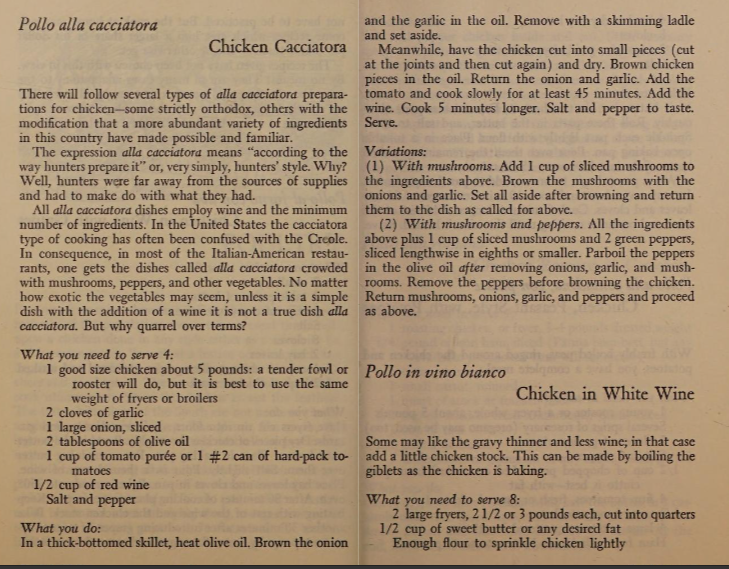
Lapolla, Garibaldi Marto. Italian Cooking for the American Kitchen. p.136-137. W. Funk, 1953
https://archive.org/details/italiancookingfo0000gari/page/136/mode/2up
During the early 20th century, Italian American immigrants faced major changes in the way they obtained their ingredients as well as the intentions for making the meal. For example, Italians once used locally grown sun-dried tomatoes or homemade tomato paste to make the recipe’s stew- like sauce to simmer their poultry of choice in. However, American agriculture reduced the seasonality of fresh tomatoes, forcing Italian Americans to surrender to the industrialization of canned produce and utilize either canned tomatoes or canned tomato paste. Americans had begun adopting recipes and making variations of this tomato sauce with, “Worcestershire sauce, beef suet, and horseradish-but no garlic” (Garbaccia), since the 1920’s. This type of culinary appropriation does not surprise me, as Americans tend to target foreign, aromatic ingredients as ‘pungent’ and ”overbearing’ and replace it with something of their liking while still calling it ‘authentic. Similarly, red wine underwent a major transformation from regional Italian or homemade wine to whatever generic brand was offered in the American market/grocer since grapes weren’t grown year-round and Italian wine wasn’t commonly harvested. Although some richness is still present within American wines, it loses depth and shows how Italian- Americans were forced to change nearly every ingredient. Another major ingredient of this Americanized dish was chicken; its beneficial use to the American military skyrocketed its popularity in the 1930’s. From the book chapter, ‘Italian American Cookbooks: From Oral to Print Culture’ author Donna Gabaccia writes, “…from World War 1 to World War 2, women’s magazines and home economists urged economizing housewives to view Italian recipes as important resources in times of depression and war” (Gabaccia). Tomatoes and ‘cacciatore-style’ vegetables could now be potential produce for victory gardens and using chicken to save beef rations for the military made chicken cacciatore the perfect recipe for American patriotism during these couple decades of world war. An article in the Detroit Evening Times newspaper titled ‘Low Point Italian Dinner’ (published May 13,1945), is a direct product of this way of thinking. The article celebrates Italian food as an American familial necessity as well as a perfect way to save points during the rationing period. It’s told from the narrative of Italian housewives who offer a variety of recipes to American readers such as different “antipasto’s, braised broccoli, chicken cacciatore, macaroni casserole, and spaghetti and sauce” (Brobeck). This recipe only became more convenient and reasonable as the years progressed; cacciatore could entirely benefit the overseas American soldier fighting Hitler’s socialist regimes to the domestic housewife and kids in need of a quick and sustainable meal.
After World War 2, chicken wasn’t necessary for any specific consumption reason, so one might think the trend of chicken cacciatore recipes would falter. However, from the previously mentioned book, ‘Italian American Cookbooks: From Oral to Print Culture’ Gabaccia explains, “… cookbook writers introduced Italian and other foreign cuisines to encourage middleclass housewives to bring cosmopolitan flair and diversity to their dinner parties” (Gabaccia). Suddenly, Italian food and restaurants represented a sophistication and its presence in American households could be indicatory of an ‘upper’ middle class lifestyle. This is evident in an ad in ‘The Waterbury Democrat’, for Borrelli’s Restaurant and Cocktail Room. This 1946 restaurant ad boasts the best Italian dishes such as the chicken cacciatore en casserole, a postwar Italian American fusion recipe, easy and elegant enough to replicate for the next housewife’s family dinner. By the 1960’s, with numerous scientific breakthroughs and technological innovations came better environmental manipulation, disease management through antibiotics, understanding of chicken genetics/ nutrition, and the highly researched broiler chicken-factory farming. According to William Boyd’s journal article titled, ‘Making Meat: Science, Technology, and American Poultry Production’, he believes these innovations caused, “…increases in productivity and efficiency led to falling real prices, despite growing demand, and successfully brought chicken to the center of the plate for many Americans” (Boyd). Chicken cacciatore was not only cooked for the rationing benefits to serve American forefronts and a stronger military, but as well as the most logical economic consumer response to the growing demand of cheap, yet large cuts of fowl in American grocery stores This makes total sense, even through a 21st century lense, as serving consumers various styles of cheap, chicken entrees in an Italian- American restaurant is something I did for three years. Even today’s ‘Italian’ restaurants, from Olive Garden to Biba’s Restaurant (my old job), mostly sport a hefty list of chicken options for a reasonable price. Chicken cacciatore is just one of many ways of preparation, from parmigiana, marsala, puttanesca, carbonara, etc.; the profitable possibilities are endless when it comes to Italian- American restaurants. The amount of revenue that Italian chicken dishes, including chicken cacciatore, have made for the American economy thus far, is unimaginable to the early 20th century Piedmontes immigrant. The simplicity (yet unique Italian flavors), adaptability to American markets, patriotic intention, and economic convenience allowed this recipe to flourish as an unshakeable legacy to the long-lasting history of Italian immigration and their massive effect on American gastronomy.
Works Cited
Bentley, Amy Lynn. “Eating for Victory: United States Food Rationing and the Politics of Domesticity during World War Two.” Order No. 9235109 University of Pennsylvania, 1992. United States — Pennsylvania: ProQuest. Web. 3 Dec. 2023.
“Borrelli’s Restaurant and Cocktail Room.” The Waterbury Democrat, 19 Dec. 1946.
Boyd, William. “Making Meat: Science, Technology, and American Poultry Production.” Technology and Culture, vol. 42, no. 4, 2001, pp. 631–64. JSTOR, http://www.jstor.org/stable/25147798. Accessed 4 Dec. 2023
Brobeck, Florence. “Low Point Italian Dinner.” Detroit Evening Times, 13 May 1945, pp. 82–82.
Gabaccia, Donna. “Italian-American Cookbooks: From Oral to Print Culture.” American Woman, Italian Style: Italian Americana’s Best Writings on Women, edited by Carol Bonomo Albright and Christine Palamidessi Moore, Fordham University Press, 2011, pp. 133–41. JSTOR, http://www.jstor.org/stable/j.ctt13wzxj1.15. Accessed 4 Dec. 2023.
“The Land of Tomatos .” The Evening Standard , 28 Apr. 1933, pp. 10–10.
Lapolla, Garibaldi Marto. Italian Cooking for the American Kitchen. W. Funk, 1953.
Reynolds-Ball, Eustace Alfred. Unknown Italy. Black, 1927.
“Tenements and Toil : Italian : Immigration and Relocation in U.S. History : Classroom Materials at the Library of Congress : Library of Congress.” The Library of Congress, www.loc.gov/classroom-materials/immigration/italian/tenements-and-toil/. Accessed 4 Dec. 2023.
 digital Humanities studio