For this research project, I decided to research rice cakes. Boring, bland, and not very filling as they are, I eat them regularly as someone with digestive issues, where bland and boring is needed. Being a former athlete, I’m all too familiar with the wide variety of less-than-appetizing snacks marketed as healthy, low-calorie, and slimming. Rice cakes in particular, however, interested me because of how crazy I remember the craze behind them being. Like they would magically make you skinny by eating them. It was interesting and relevant enough to me for a final project,
First and foremost, the history of rice cakes in the United States is important. Puffed rice (the rice cakes in question are just a disk of puffed rice) originated when Alexander P. Anderson discovered that rice can be made into an airy puffed form through high heat and pressure. As a result, puffed rice began to flood the cereal industry. After debuting it at the World’s Fair in 1904, Anderson’s new discovery was picked up by the brands Kellogg and Quaker. Marketing for rice cakes centered around the idea that they were a healthy snack that would promote weight loss.
The idea that rice cakes inherently promote weight loss is incorrect. Rice cakes are low-calorie, low-fat, low-sugar, and lightweight, yes. But no part of the rice cake itself causes weight loss, the assumption is that it will replace other foods. If anything, using rice cakes as a substitute for actual nutritious food all the time could easily lead to deficiencies and malnutrition. Many foods, such as protein bars and meal replacement shakes, during this time, had that same sentiment in common with rice cakes, the idea was that these foods should be substituted for other, usually more nutritious foods. That itself is bad, but when looking at how the marketing portrayed the benefit as thinness rather than health, the cost of nutrition for the gain is even worse.


The above image is an actual frame from a 1986 Quaker Rice Cake commercial. The commercial shows an attractive, very skinny woman sensually moving on a workout bench. Only around half of the commercial even has a rice cake in frame, mostly variations of the picture above. Why is this needed for a rice cake commercial?

The above commercial is from 1987, and again, it is another weirdly sexual Quaker commercial. They’re the main culprits of the sexual advertising from what I’ve found, and in this commercial, the actress’s body is panned over slowly from feet to head with brief flashes of rice cakes in between cuts. And again, what does this have to do with rice cakes? The messaging in both of these commercials is the same. To the women, you can have this body if you eat our rice cakes. To the men, your wives can have this body if you buy her these rice cakes. Nothing about nutrition, nothing about health benefits, the entire commercial focuses solely on aesthetic benefits. As was the case with many foods during this time, marketing was focused on how it would aesthetically affect a woman’s body. Obviously, men can eat rice cakes too, but it was mainly marketed to be eaten by women. Even the one commercial I was able to find with muscled, shirtless men in it had the message that hot men want women who are thin and eat rice cakes. This was also by Quaker.
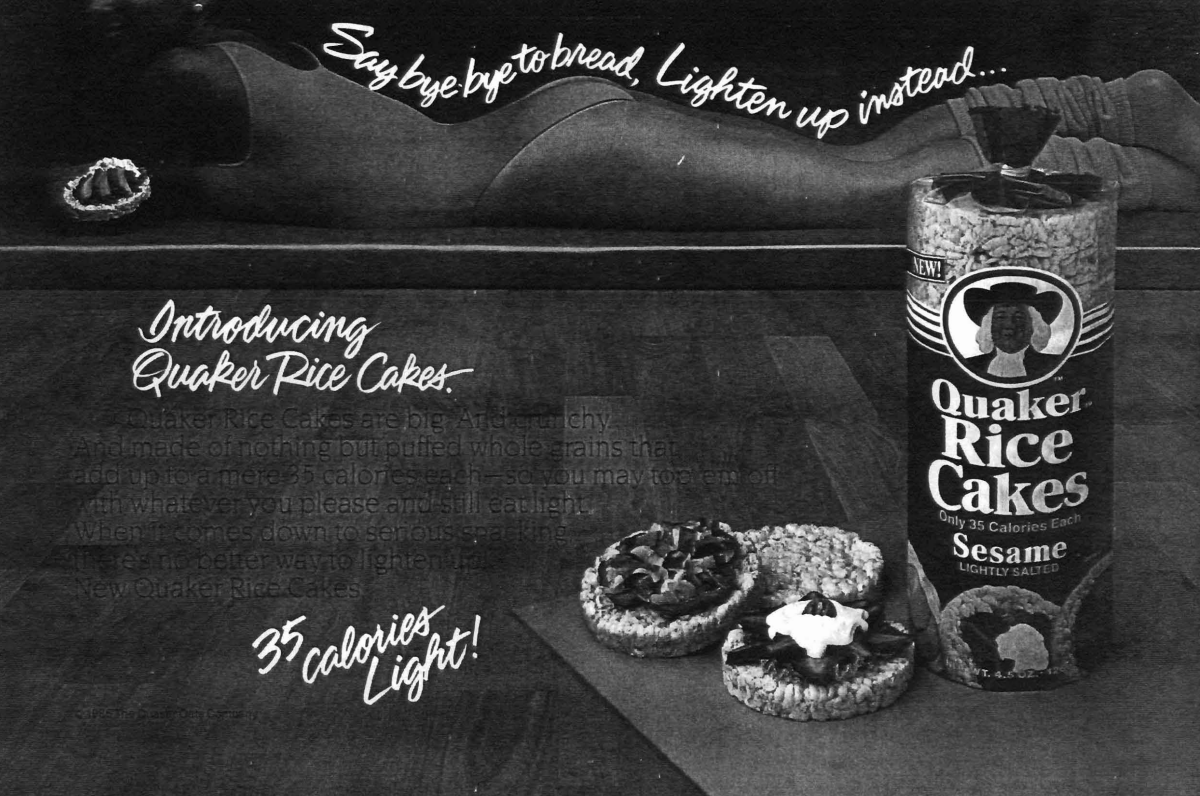
Lastly, the above ad again focuses on looks, showing a slim-figured woman with the phrase “say bye to bread, lighten up instead”. Commercials like these that target a woman’s self-image were and still are common, especially when food is the product being marketed. There are so many foods on the market that gain their popularity from how low-calorie they are, and nearly all of these advertisements include very skinny women consuming the product. Mentally, this messes with a person, especially young, impressionable girls. Personally, I spent many of my early years as a young female athlete, and I can attest to the effect these advertisements have on young girls. These foods, like rice cakes, meal replacement protein bars, and other barely nutritious foods, were a staple of the teams I was on. You would assume that for a sport like soccer, you would want to be eating something more nutritious than a rice cake, wouldn’t you? I know firsthand that the priority isn’t nutrition, it’s to look like the women in the commercials. Not even for any personal preference, but to avoid the negativity that comes with having any other body type.
When you look at actual Rice Cake nutrition facts, almost every daily value percent is zero. As a small snack, this is fine, but when the intention is to replace other, more nutritious food, this becomes a problem. Like any food, rice cakes can be consumed in moderation. As I said in the beginning, I find them a safe and enjoyable alternative as someone with gastric issues. And if someone is trying to safely cut calories for whatever reason, they are a good option to provide the crunching sensation and some kind of flavor, should they be seasoned. The problem arises when rice cakes are used as a substitute for healthy, nutritious foods. You can’t stay healthy only eating pizza, but you also can’t stay healthy only eating rice cakes.
 digital Humanities studio