Gallo en Chicha is a traditional dish from El Salvador. “Gallo” means rooster, and “chicha” is an alcoholic drink made from fermented corn, with each Latin American country having its version. Due to its complex preparation, this dish is typically enjoyed only on special occasions such as New Year’s, birthdays, or family reunions. It is enjoyed across both rural and urban areas, though its popularity has significantly decreased over the years.
With this essay, I would like to bring attention to the dish and share my personal experience with it. Eating Gallo en Chicha has become a tradition for my family on my mom’s side enjoyed on my grandfather’s birthday. This is a special moment for all of us to gather as this is something we don’t do often. Through this essay, I want to teach my fellow Salvadorans and peers about the power of food and how it can foster connections and create lasting memories. Sharing a meal is one of the purest forms of love, made richer with the warmth of a home cooked meal.
Gallo en Chicha is reminiscent of the French dish Coq au Vin, a chicken stew made with marinated chicken in wine, which made its way to El Salvador through the colonization of the Americas and many adaptations sprouting from it. To prepare Salvadoran Gallo en Chicha, the rooster (“aliñado”—ready to eat, head removed, and feathered) and its organs are cut into small pieces and marinated in chicha with garlic, onion, and other spices the day or days before cooking. Once marinated, the rooster is removed, and the marinade is reserved. Cook the rooster in a saucepan before transferring it to a large pot with the marinade and dulce de panela (unrefined whole cane sugar), bringing it to a slow boil. While it cooks, add “relajo” (a mix of spices such as pumpkin seeds, oregano, and bay leaves) along with common vegetables like tomatoes, potatoes, and carrots, simmering until both the rooster and veggies are tender, which can take several hours. In rural areas, people often use roosters from their farms, but you can also visit your local market and ask for a rooster specifically for this dish.
Recipes for Gallo en Chicha vary between families and even across regions of the country. While I am not too familiar in the various interpretations of this meal throughout El Salvador, I do know that this is not a recipe you simply Google. Every family matriarch has their own cherished recipe, passed down to daughters and granddaughters. I appreciate that this dish is personalized to each family, with each ingredient carrying its own story about how it became part of the recipe. Each family gives their own meaning to the meal based on who cooks it (most likely their grandmother), when it is prepared, and who they share it with.
When I think about Gallo en Chicha, I think of my grandfather. Although we didn’t have a close relationship, we bonded over food. Every Tuesday after school, my cousins and I would visit my grandparents’ house to eat and play. There was lunch prepared for us, separate from my grandfather’s meal. Though similar, I remember thinking his food was gross. He noticed. Eventually he began offering me bites of his dishes, and as a picky eater, I would often grimace at the texture or flavor. Most of the time I had no idea what I was eating, only to then find out it was a weird animal part but I had already eaten it so the damage was done. The dish we shared the most was Gallo en Chicha, his favorite. My grandmother cooked this meal for him every year on his birthday for as long as she could remember, and even after his passing in 2021, she continued this tradition.
I never realized until recently that this was the dish we had been enjoying each year at my grandparents’ house; it honestly never occurred to me to ask. Being the youngest in the family, I often felt out of the loop and followed traditions without fully understanding their significance. I remember dressing up for my grandparents’ gatherings every November 14. While the family chatted, my grandma was more focused on the food than accommodating us. She would then alert us the food was ready and bring it out with the proudest smile as she walked towards my grandfather exited to show him. And then, it was time to eat.
Here is Mama Norita’s (my grandmother) recipe:
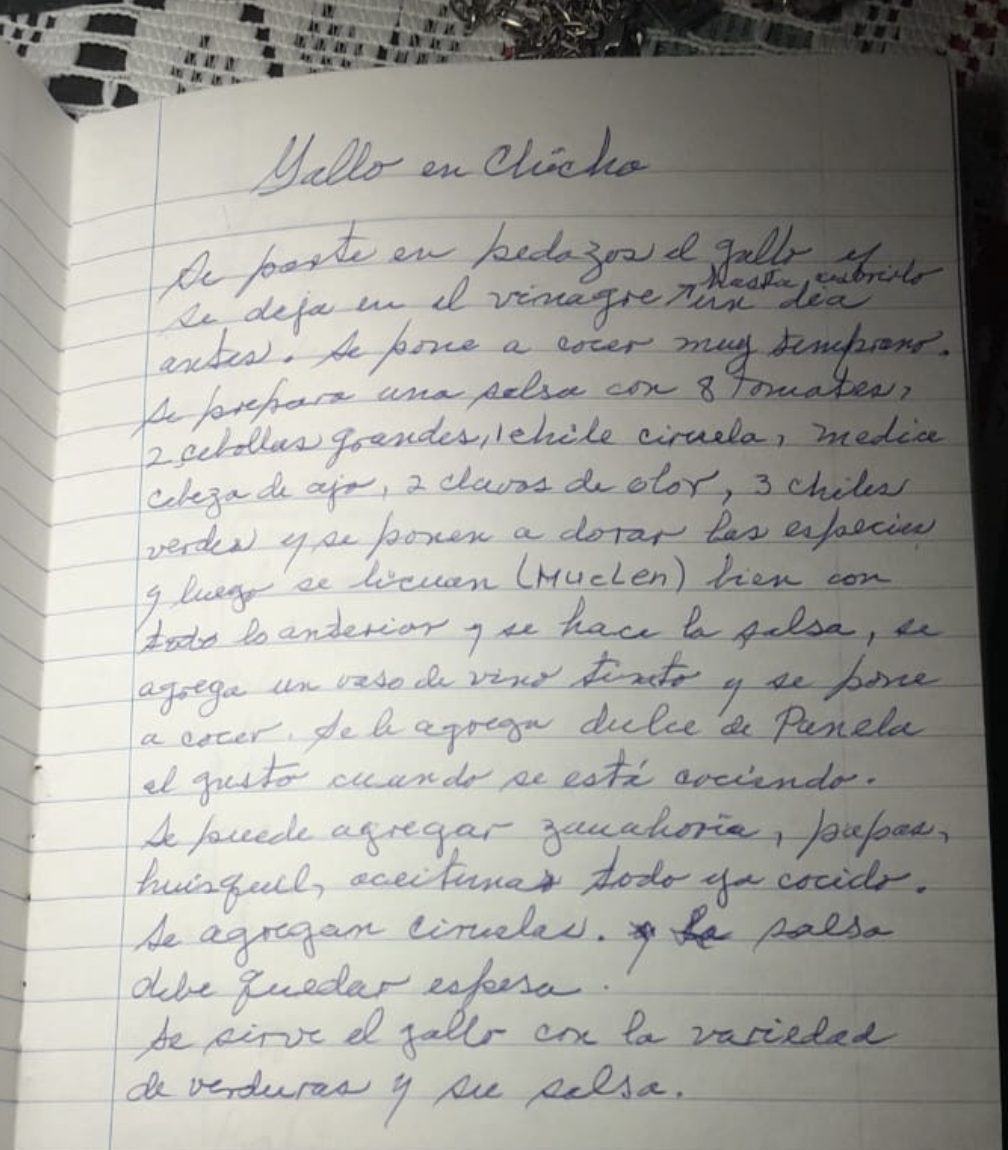
Translation:
Gallo en Chicha
Cut the rooster in pieces and marinate in vinegar one day prior. Start cooking early in the day. Prepare the sauce with 8 tomatoes, 2 large onions, 1 dried chile, half a garlic head, 2 whole cloves, 3 green peppers, saute with relajo and blend, it has to have a thick consistency. Add a glass of red wine and cook. Once it’s boiling, add dulce de panela to taste. You can add cooked carrots, potatoes, chayote and olives. Add prunes and prepared sauce, and combine.
Serve the rooster in the sauce.
She was introduced to this meal by her grandmother at a young age and eventually learned how to prepare it from her mother. Each time she prepared it, she made slight changes to the recipe, putting her own spin on it while perfecting it for when it was her time to become a grandmother and have the duty to share it with younger generations. One of her main adaptations was the addition of prunes, which her grandfather loved, and now she enjoys them too. She also often includes “lo haya” (whatever is available), which might consist of olives and capers, though she admits these are more for looks rather than flavor.
The roosters she cooked were sourced from my grandfather’s farm, where they were killed and transported home. Of course, she didn’t partake in the killing, as that was purely a man’s job. Her preparation of the dish began by substituting chicha with homemade vinegar made from pineapple skins. It’s common for people to use substitutes for chicha due to its historical legality issues stemming from its high alcohol content. Alternatives can include wine, beer, vinegar, or even Coca-Cola!
Gallo en Chicha is not typically found in restaurants, yet it is served at one of the most famous traditional eateries in El Salvador, El Basurero (The Trash Can). Established in 1976, with two locations. It got its name due to its first location being close to a dumpster and to locate its customers would refer to it as the restaurant close to the dumpster. El Basurero is primarily famous for its chicken soup but offers nearly every traditional dish from the country, including Gallo en Chicha. This was not a dish that was included in the original menu but it was added roughly 5 to 10 years after opening due to the high demand of frequent eaters asking for more traditional food options. It is prepared and served only on the weekends. Notably, most patrons ordering this dish are aged 45 and up, while younger customers tend to stick to more popular plates.
El Basurero has a distinctive approach to preparing its dishes and is known for its unique flavors. All recipes are crafted by two chefs based on the originals written by the restaurant’s founder, Ana María Chávez. However, these chefs still personalize the dishes by adding their own flavors as interpretations of the recipes.
To complete this research, my grandma and I visited El Basurero to try their Gallo en Chicha. It was a delightful experience where we compared flavors, serving styles, and our overall impressions, all while reminiscing about the memories associated with this dish.
Here are my grandma’s thoughts: the rooster and vegetables were perfectly tender, but she found the marinade too watery, describing its consistency as “ralo” and a bit too sweet for her liking. She also compared it to another Gallo en Chicha she recently had at her 65th high school reunion, noting similar observations. Sampling different versions of the same dish highlights the various ways it can be prepared, largely influenced by personal preferences and the people for whom we are cooking. Her final words in our discussion were, “Uno defiende su casa aunque se esté derrumbando,” meaning one will always protect their home even when it’s falling apart.


Overall, Gallo en Chicha is a dish that reunites families during special moments. Regardless of how you prepare it, what truly matters is who you share it with. This dish encompasses more than just the food; it represents the experience and the understanding of the hard work that goes into its preparation. For me, Gallo en Chicha signifies honoring my grandfather’s life and cherishing the memories I have created through it.
I encourage younger generations to ask their grandmothers about traditional dishes, not only to learn how they’re made, but to understand where they come from. These recipes often carry more than ingredients; they hold family stories, cultural roots, and memories that might otherwise fade. Food holds history and with a little curiosity, what begins as a simple conversation can revive lost traditions and spark new ones for the future.
Acknowledgments
I want to thank my grandmother and Paul Palacios owner of El Basurero for the information that built this paper.
I also want to thank my grandfather, José Atilio Campos, for inspiring the idea to write this. His lasting memory will always remain in my heart and in the gallo en chicha!
Un abrazo hasta el cielo Papá Tilo ¡Te quiero mucho!

José Atilio Campos November 1938 – September 2021
 digital Humanities studio