Maine Lobster, Boston Scallops, Atlantic Striped Bass. The Northeast is home to some of the world’s best seafood. It’s also where the most important city both culturally and economically is located. The French were pioneers of both the modern restaurant format, and the modern fine dining system. So if the question of what seafood is most desired is asked, then what seafood is being served in French restaurants leads to the answer. The evolution of seafood in New York City’s French restaurants offers a compelling reflection of shifting culinary tastes, socioeconomic changes, and global influences. From the early opulence of Delmonico’s and Grand Central Oyster House to the precision-driven luxury of Per Se, the transformation of seafood on French menus illustrates larger cultural and economic trends. This analysis examines four key time periods; 1880-1919, 1920-1949, 1950-1989, and 1990-Present, highlighting the changes in seafood availability, preparation methods, and consumer preferences.
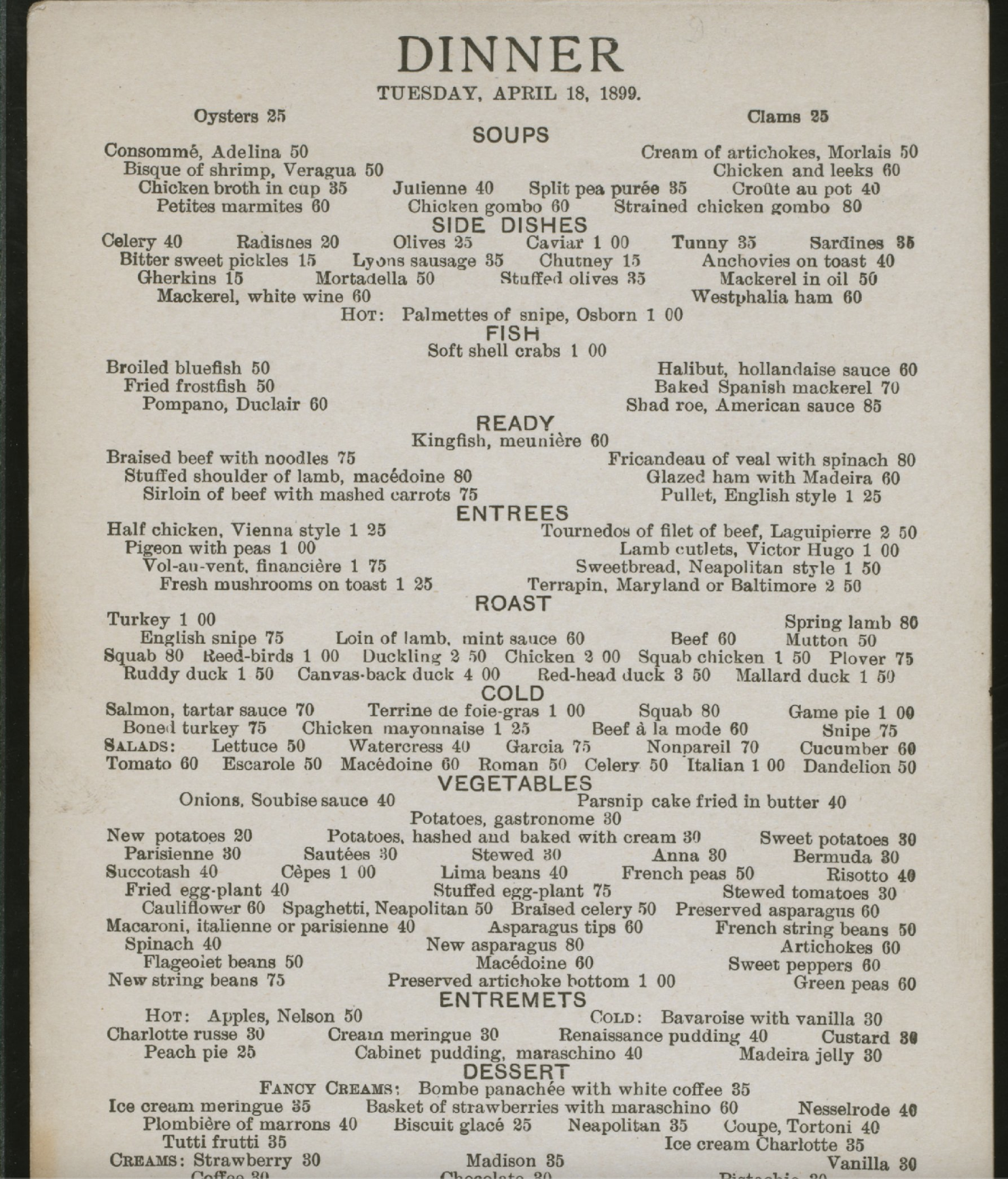
A Delmonico’s menu, 1899
1880-1919: The Gilded Age and Early 20th Century
By the late 19th century, the seafood seen in NYC French restaurants was extremely varied, with just a few dishes that are almost a must have on any given menu. Some of the heaviest hitters in seafood are Sole, Salmon, Halibut, and Sea bass. These fish seem to be everlasting on French Menus in NYC, never seeing too much of a dip in popularity. Kingfish appeared often, but Kingfish, or King Mackerel is rarely seen on the fine dining menus of today, with Spanish Mackerel being far more common. Kingfish Caviar today often appears on the menus of places such as Le Bernardin, much more often than Kingfish itself. One of the biggest changes from then to now is not necessarily what we eat, but what we call it. This was best highlighted in analyzing the menus from the late 19th century. ‘Frostfish’ was common on menus that feature seafood, and likely refers to Tomcod, a type of cod found in the American Northeast. Delmonico’s, Grand Central Oyster, and Mouquin Restaurant are all either French, or restaurants with French dishes on their menu that serve seafood and were analyzed for this time period. Often these menus would feature the same fish multiple times with slight variations, for example; Mackerel with White Wine, Mackerel in Oil, and Baked Mackerel all appear on the same Delmonico’s menu.
Pompano is another fish that has stood the test of time and featured often. Shad Roe rose to popularity and began appearing on menus. Bluefish has fallen out of style, and is often thought of as undesirable today but it could be found on menus of this time. Halibut with Hollandaise, Crab and Sole Au Gratin was common. Meuniere was far and away the most common descriptor for fish dishes at this time. Meuniere refers to both the method of cooking by lightly flouring and pan-frying the fish, and the lemon butter parsley sauce that is served with it. Some dishes that sound like they came from the 80s, like scallops wrapped in bacon, are found in menus from this time. Trout, Clams, Soft Shell Crabs, Lobster, Sardines, and Cod, all are common menu items of the time. Canape Lorenzo, which Galatoire’s diners might recognize, originated at this time. The simple dish consists of toast circles which have been spread with seasoned crabmeat, then sprinkled with parmesan cheese.

A Café Chambord menu, 1940’s
1920-1949: Prohibition, Depression, and War
The restaurants looked at for this time period are Voisin, and Café Chambord. Voisin was opened in 1913 and lasted more than six decades. This period is marked by economic upheaval, but French dining culture remained a haven for luxury and indulgence. With the advent of Prohibition (1920-1933), upscale dining became a form of escapism, and the popularity of seafood dishes like crabmeat au gratin and lobster mornay increased as indulgent replacements for wine and spirits. Sole maintained its status as a refined choice. At this time many restaurants go from listing just Sole, to specifying ‘English’ Sole. Dover Sole is rarely featured. Maine Lobster becomes more common as well, where the same restaurants would have just listed Lobster in previous decades. Salmon keeps its popularity, as well as Cod. Gratinéed dishes like crabmeat au gratin became symbols of luxury. Lobster became more expensive and fluctuations in availability of imported seafood required chefs to adapt menus with more local catches, such as pompano and scallops. By this time, we see less oysters on the menu. In fact. New Yorkers in the 1800s ate an average of 600 oysters per year, whereas today Americans eat an average of fewer than three oysters per year.

A Lutèce menu, date unknown
1950-1989: Post-War Modernization and Nouvelle Cuisine
In the post-war era, French restaurants like Lutèce and La Côte Basque embraced nouvelle cuisine principles, emphasizing lightness, freshness, and artistic presentation. The era saw an influx of luxury imports and global seafood trade, making items like striped bass and swordfish more accessible to American chefs. Dishes like raw marinated salmon reflected an increasing willingness to experiment with flavor and presentation. Caviar had long been a symbol of luxury, but during this period, it became more accessible to wealthy diners as trade routes increased availability. While cod faced declines due to overfishing and environmental degradation. This period also saw the growth of chef-driven restaurants and the influence of culinary icons like André Soltner of Lutèce, who redefined the concept of luxury dining in New York. Ultimately, It’s Salmon and Sole that appear the most often at this time, with striped bass coming in third.
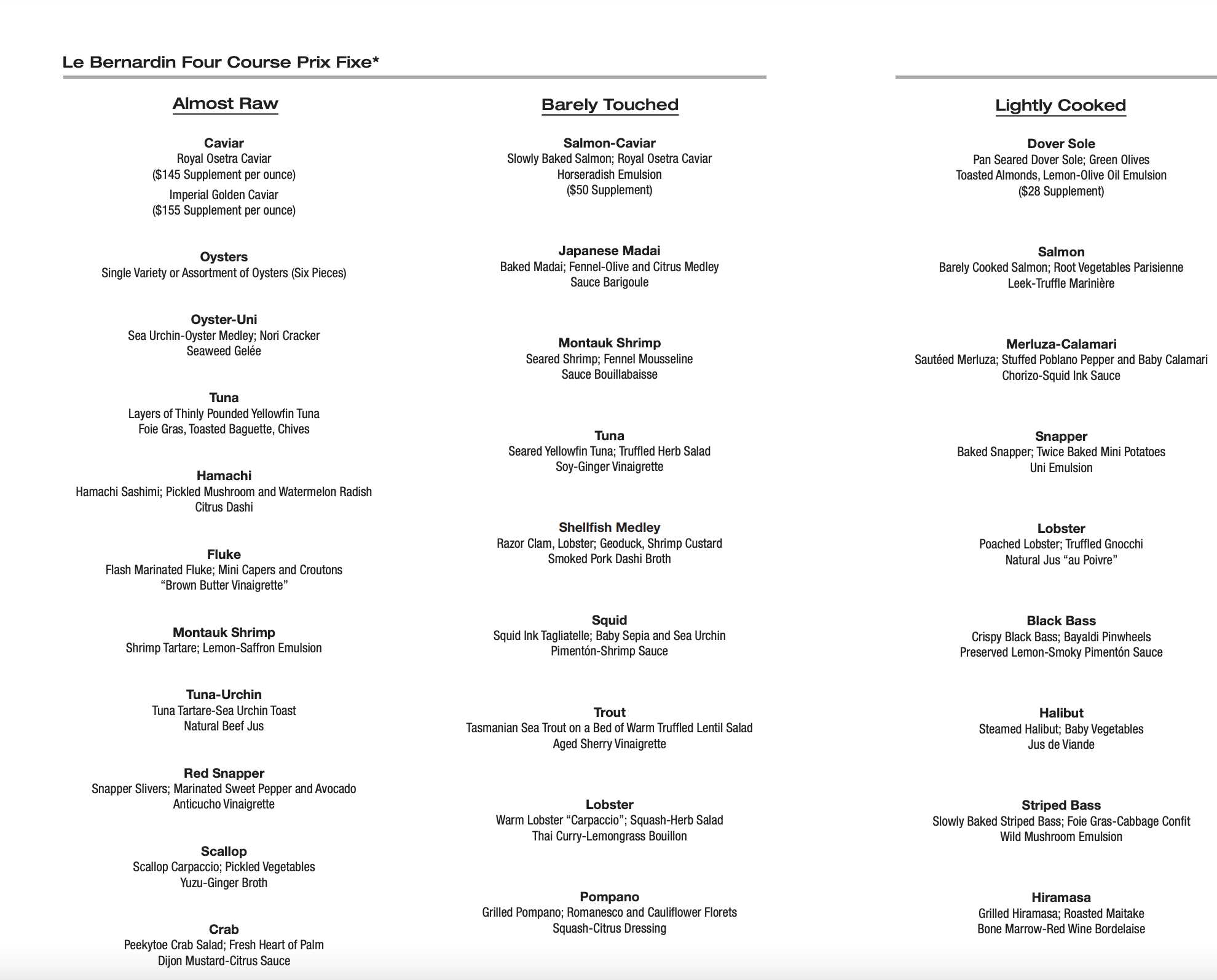
A Le Bernardin menu, 2024
1990-Present: Contemporary and Sustainable Dining
From the 1990s onward, everything imaginable was not just possible but actively taking place. Sous vide cooking and molecular gastronomy also became more prevalent, allowing chefs to cook seafood with unparalleled precision and creativity. Diners often come expecting the unexpected; the classical French dishes haven’t yet gone anywhere, but they have had to make space for newcomers. Dishes like Per Se’s iconic Oysters and Pearls represent the new paradigm: technique-driven, hyper-local, and globally influenced. French restaurants now often serve seafood dishes with complex inspiration, usually not French, with Japanese and other East Asian flavors and methods used. sustainability became a central theme in fine dining. Modern French fine dining restaurants are often committed to sourcing seafood ethically and sustainably, guided by certifications like MSC (Marine Stewardship Council). Still, the environmental cost of imports of the most sought-after ingredients raises questions about just how sustainable almost any restaurant that chases Michelin stars can be. Same-day imports of the finest and freshest seafood have allowed practically anything to make its way to the menu today. Tiger shrimp, Branzino, Skate, Monkfish, Bluefin Tuna, Scallops, Mussels, Langoustine, Tilefish, Octopus, Striped Bass, Swordfish, Dover Sole, Black Bass, Rainbow Trout, Oysters, Madai, Salmon, King Crab, Halibut, Sablefish, Snapper, Mackerel, are just some examples that you will see on the menu today at modern French eateries in the city.
Khabiri, L. (2015, January 27). Comparing nine vintage restaurant menus to their 2015 counterparts. Eater NY. https://ny.eater.com/2015/1/27/7879183/vintage-menus-delmonicos-keens-carnegie-deli?utm_source=chatgpt.com
http://ciadigitalcollections.culinary.edu/digital/collection/p16940coll1/id/5198. (n.d.).
Menus.nypl.org. (n.d.). https://menus.nypl.org/menus/32525
Sanders, R. (2021, March 8). What NYC restaurant menus looked like 100 years ago vs. Today. tasty.co. https://tasty.co/article/rachelysanders/nyc-restaurant-menus-100-years-ago
Says:, V., & says:, M. I. (2021, December 17). The Great Oyster Craze: Why 19th century Americans loved oysters. MSU Campus Archaeology Program. https://campusarch.msu.edu
Morabito, G. (2011, January 18). Remembering voisin, the always-moving French restaurant. Eater NY. https://ny.eater.com/2011/1/18/6701489/remembering-voisin-the-always-moving-french-restaurant
 digital Humanities studio