In the religion Islam, Ramadan is believed to be one of the holiest months observed by the muslim followers worldwide. It is held on the ninth month in the islamic lunar calendar and regarded as the time when the revelation from God was revealed, the Quran. During this time many muslims engaged in spiritual reflection and acts of worship, trying to increase their connection to God by purifying their soul. Muslims practice fasting in this month to expand their self discipline mentally, physically, and spiritually refraining from negative behaviors and food supply for a limited time. With this also feeling empathic for the less fortunate. As a muslim myself, my family and I also practice fasting during Ramadan. We fast from sunrise to sunset, following the sun’s path. After waiting till sunset, my family and I break our fast with a medjool date before we begin indulging in the variation of dinner choices prepared earlier. Occasionally, many extended family members and relatives also join our Ramadan nights, celebrating the holiday and breaking their fast with us. After eating we’ll rest for a few before we offer desserts to the special guests.
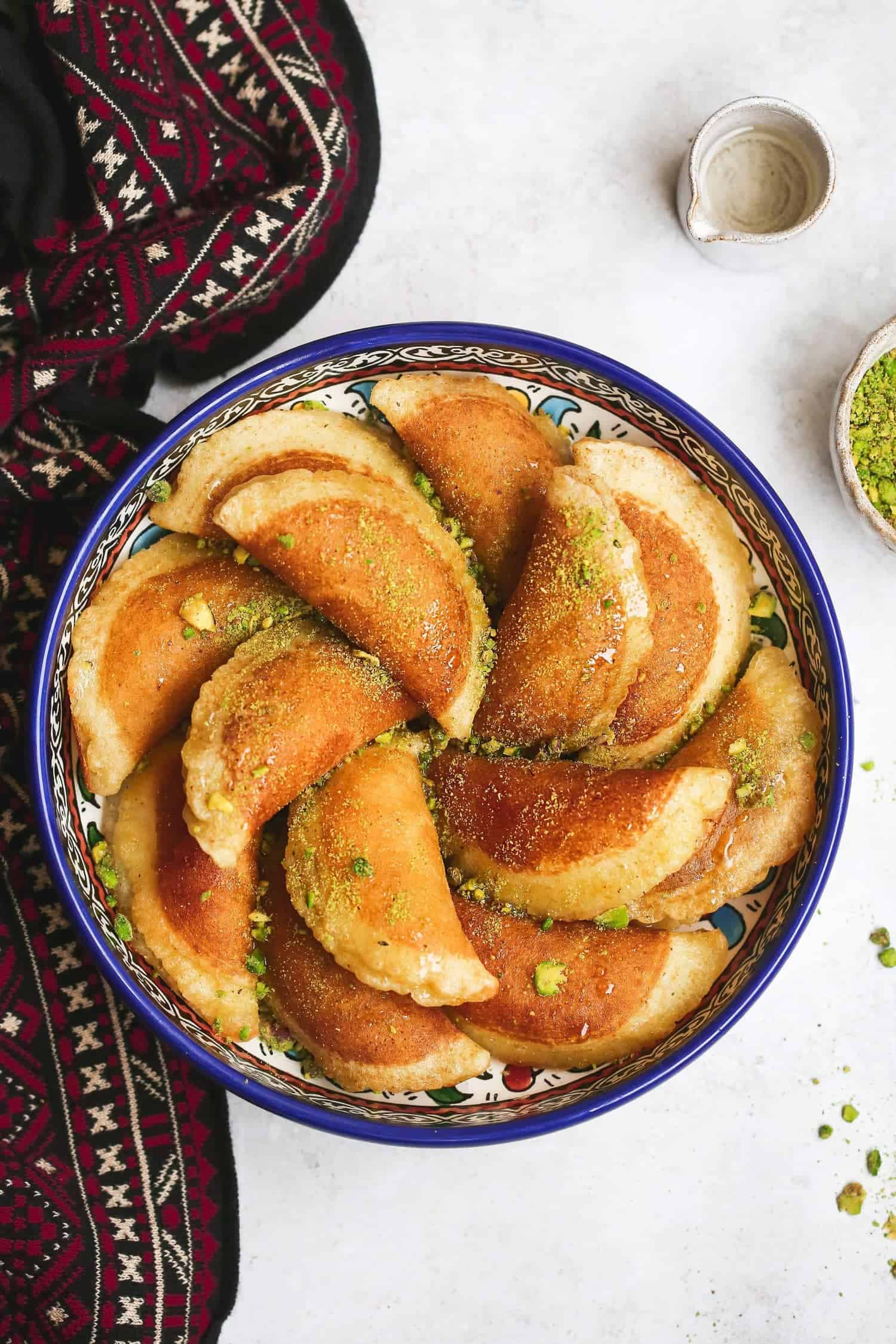
A traditional middle eastern desert that my mom makes annually during Ramadan is Qatayef or in other words Atayef. Atayef is a pancake folded dessert that is shaped into a crescent that is stuffed with savory fillings like nuts or cheese then fried and served already immersed in a rose flavored sugary syrup. Alternatively they are also made baked instead of frying. Atayef originated from the levant area, middle east to the east, including countries like Palestine, Jordan, Lebanon and many more. The desert is commonly made in gatherings as a celebratory dish to end the day of fasting. Atayef can be found pre-made at many middle eastern stores but usually sold in the season holiday of the Ramadan especially at restaurants. In my home, my mom learned her Atayef recipe from her mother, my grandma. My grandma had a huge love for cooking in my family, learning all the possible traditional methods of culture cooking which she later on passed down the passion to my mother.
In the Atayef recipe, Atayef is composed of the pancake crust and preferred filling. For my family and I, we prefer walnut mix or mozzarella cheese inside the Atayef’s filling. For the batter (the pancake crust), you’ll need the ingredients: 1 cup of all purpose flour, 1 cup of room temperature water, ½ cup of semolina, ½ cup of warm milk, 2 tbsp of white granulated sugar, 1 tsp of baking powder, ½ tsp yeast, 2 tsp vanilla extract. As for the walnut mix filling, 2 cups of finely chopped walnuts, ½ cup shredded coconut, 1/2 cup of white granulated sugar, 2 tsp of grounded cinnamon.
In a large bowl, mix the batter ingredients together then set aside in a warm place for half an hour until the batter ferments. Heat up the stove on medium high then using a non-stick frying pan, place the pan on the stove to preheat. Once the batter has fermented begin using it by adding a full spoonful of the mixture onto the pan slowly. The batter should cook, creating small circles with bubbles forming on top. Once the bubbles stop forming, scoop the pancake onto a clean piece of cloth sheet until it cools, this is to keep its soft texture and shape (Don’t leave the pancake drying too much or it wouldn’t seal efficiently together when trying to close with filling inside). After the pancake crusts have been made, prepare the Atayef filling. In the filling, mix the listed ingredients together in a small bowl and then begin filling the pancake crusts. Place 2 teaspoons of the walnut mixture in the middle of the pancake then fold in half, pinch the edges together then around the almond shaped dessert to seal the filling inside. After creating the Atayefs, fill a small pot with an appropriate size of vegetable oil for the frying and let boil on high. Place in the Atayefs slowly, make sure the oil level soaks it completely while it’s frying. Once done, take out the Atayef and drain the oils when the color of the pancake crust becomes a golden color then dip it into the cooled rose sugar flavored syrup. To create the Atayef’s coated rose sugar syrup, attar, the ingredients needed are 1 cup of water, 2 cups of white granulated sugar, 1 tsp of rose water and then a squeeze of lemon juice. Mix the dessert’s coating ingredients together then put on high heat in a small pot pan. After the coating liquid boils with bubbles it should turn into a thick syrup and then leave aside for cooling.
For variation in the Atayef, my mom will sometimes substitute Belgioioso’s fresh mozzarella slices inside of the pancake crust instead of the walnuts mixture. An alternative common way of making Atayef is by baking the desserts in the oven. Preheating the oven to 375 degrees, apply parchment paper on the baking tray the desserts will be baked on. Arrange the Atayef on the tray and brush them with a coating of ghee (this is to help create the golden and crisp crust of the pancake in the oven). Bake the Atayef for 15 to 20 minutes depending on how crunchy it is desired and make sure to flip mid way for the even bake. Lastly you could soak or drizzle the attar onto the Atayef. Onced the Atayaf are complete, they are then served on a platter with any desired nut toppings but my family and I prefer the crushed pistachio topping.
In an effort to connect to my roots, I tried making Atayef by myself for the very first time. I began by gathering the ingredients from around the kitchen, mixing them all in their desired separate bowls. In my batter bowl after complete mixing, I covered the batter in a thick cloth and waited for it to ferment. This is when I moved to working on the favored walnut mix. Still waiting on the batter I preheated the stove and prepared the non-stick pan waiting for it to heat up also. During this downtime I prepared working on attar for the dessert, the attar did come as a little struggle for me because for every 2 cups of sugar, 1 cup of water is needed but I wasn’t sure if the adding the rose water or lemon juice would unbalance the mixture. The mixture became more runny but eventually thickened with heat. After the attar started changing into a light brown tint I removed it to cool off on the side. The bubbles that were forming while boiling the sugar eventually started to defloat back in. I came back to the fermented batter that had risen a little and it was ready to use. I then grabbed the heated pan and began pouring my batter and scooping it onto a clean fabric sheet. This process was really interesting to me as I watched my mother make it look so easy before. I struggled trying to make the pancake crusts look similarly uniform but I still knew to take them off the heat after the bubbles stopped popping. After I made my 10 small crusts, I started filling them in with the walnuts mix and pinching them to close around. This part was satisfying to me seeing the crust slowly close holding the filling inside of it. I tried to be attentive here because I didn’t want the crust to open while frying it so I made sure I did another round of closing without not accidentally squeezing the crust too hard, ripping it. Next, I moved on to trying to fry the Atayef, this part was tricky. I filled the small pot up midway with the vegetable oil and began frying at the boiling point. I placed one Atayef at a time trying not to splash any oils back onto myself. Eventually each Atayef was fried and looked close to the light brown goal color. I then drizzled the rose syrup onto my Atayef instead of soaking it then served it. The dessert tasted similar to the way my mom makes hers but the texture of it wasn’t exactly perfect which made me realize that I probably didn’t perfect a step like I should have.
This experience has taught me a lot about myself regarding my skills and baking middle eastern desserts. I enjoyed asking my mother for tips on the procedures I struggled with but with the mistakes I made my mother constantly reminded me that practice makes perfect, that I was going to perfect a recipe on my first try. This process interested me in trying to pick up baking in the kitchen as a way to become more confident in my cooking skills and learn more of my mother’s recipes. Usually a norm in middle eastern culture is that the mothers are the main cooks who teach their children to pass on their recipes to future generations. I hopefully aspire to also carry the passion of cooking like my mother to my future generation. Being able to cook during holidays is very important especially during Ramadan.
 digital Humanities studio