Food is a very important factor when it comes to Cuban culture. Cuban families for generations across the globe come together to celebrate their rich culture with the food they make. Cuban food is a mixture of many different cultures and areas. They take inspiration from places like the Caribbean to blend their own style and make something new and amazing! This is why so many people around the world enjoy Cuban cuisine, and if you have ever been anywhere in Florida, but more specifically the Tampa and Miami areas, you would be familiar with the popular Cuban sandwich. While typically made with Cuban bread, seasoned pork roast, sliced ham and swiss cheese, yellow mustard, and pickles (rivera), this sandwich has many different variants, for example, the medianoche (a smaller version of the popular Cuban sandwiches with some differentiation on ingredients). Miami and Tampa sandwiches differ too. For example, in Tampa, Cubans put salami on the sandwich, but don’t tell that to a Cuban in Miami, who will claim that that is the wrong way to make one and will scoff at anyone who says that this is the right way. The Cuban sandwich is very interesting due to the semi-unknown origin; while some things are known about it, a lot of its history is oral. Given this, many people claim they invented it, like the ongoing feud with Miami and Tampa. This article will educate the reader on the known origins of the Cuban sandwich, its beginnings in America, the rise in popularity of the sandwich, as well as how it’s typically made, including a recipe to take part in making a famous sandwich at home!
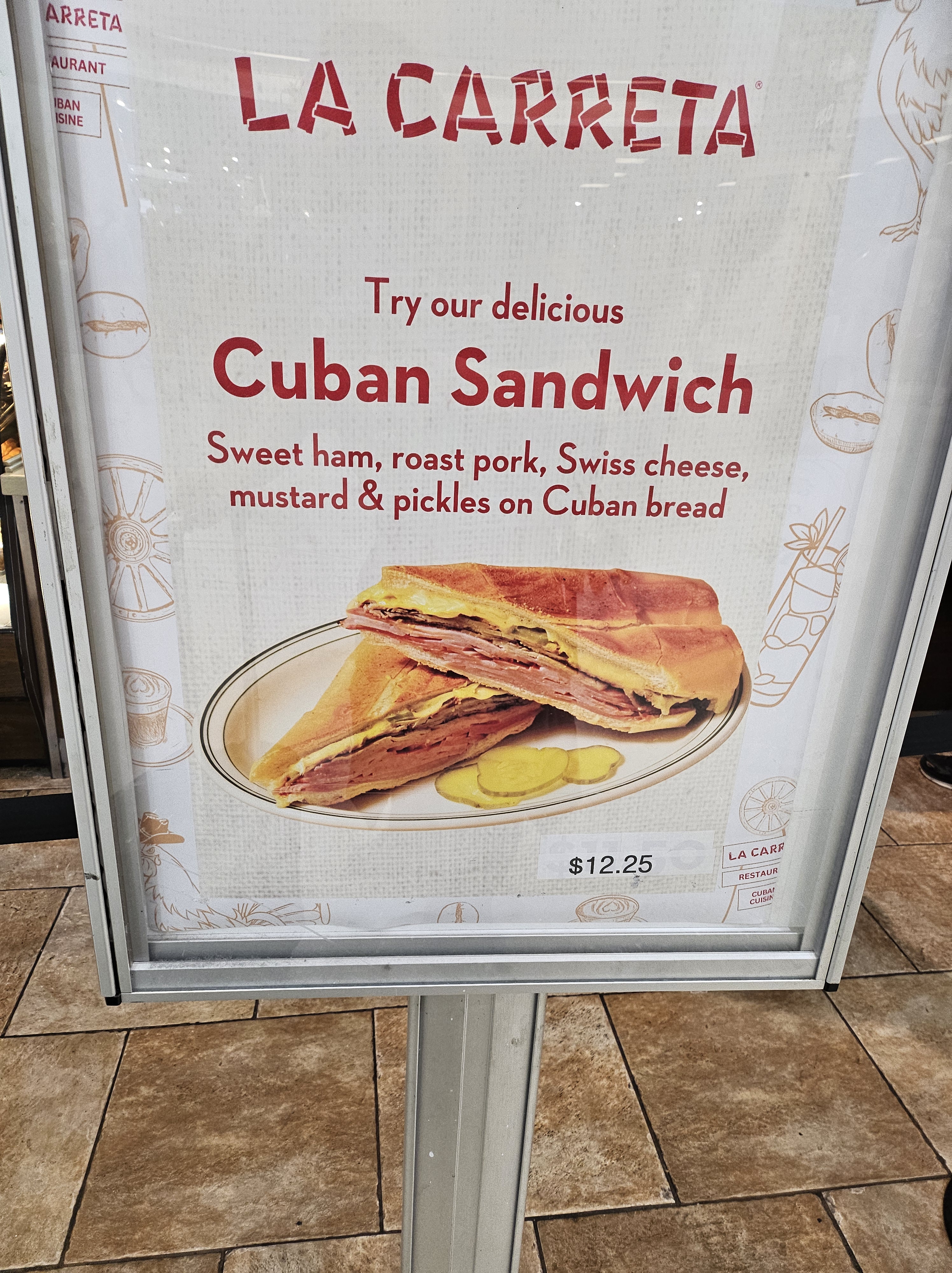
The Cuban sandwich’s origin is a very interesting tale. Many claim to have invented the sandwich. “Miami, Key West, and Tampa have wrangled over the claim to be the cuban sandwiches true hometown for years” (Huse et al. 1). This is very true. While all three cities in Florida have fought over whether they invented the sandwich, the true origin lies in Cuba itself, but due to a lot of it not being written down, we really only have it through word of mouth and a few documents written years after the true invention of the sandwich. Many scholars have claimed to have found evidence linking the Cuban sandwich directly to Cuba, but this dates all the way back to the 1500s when Cuba was taken over by the Spanish empire (Huse et al. 5). This all led to a huge chain of events involving sugar being a common export of Cuba, as well as Cuba relying on imports. This reliance would lead Cuba to strike trade deals with New Orleans around the 18th century; this would go on until the embargo during the Cuban revolution. “About a third of all exports leaving the Port of New Orleans were destined for Cuba, mainly flour, rice, and other foodstuffs. Likewise, New Orleans handled more than 1.2 million tons of Cuban imports, mostly unrefined sugar and molasses.” (Goodman) These trades are very important to the history of Cuban food. Imports in general from Cuba to the US would later help Cubans get a foothold in the food industry. By the 1830s Cuban immigrants came en masse to the US, many of them staying in Key West, Florida. In 1898 Cubans finally became independent from Spain. Many Americans came to Cuba, as well as other immigrants from other countries. This heavily influenced the way Cuba started to change into the modern Cuba we know now! “A new vibrant Cuba was emerging from out of the shadows of Spanish rule. The people longed for modernity and independence, for baseball instead of bullfights” (Huse et al. 11). During the time of independence is where the history of sandwiches in Cuba gets confusing. Around the 1870s Cuba, because of American influence – due to the sandwich’s popularity and easy travel size – used imported ingredients to host sandwiches in their cafes and restaurants. Before the term “sandwich” was used, there was no proper word to refer to them, so they were called Bocadillo (“small bite,” take into consideration that this term could mean any snack food) or even “emparedados” (“walled in”) (Huse et al. 30). There was even the Mixto, the closest origin of the Cuban sandwich, meaning “mixed.” This sandwich could be one of the earliest forms of the Cuban sandwich. The sandwich in general became immensely popular all over Cuba, though it is unknown exactly when Cubans made the “Cuban” sandwich and took the name for themselves. The idea of the sandwich became very popular, but even then sandwiches in Cuba were never the lunchtime meal they were in the US. “But sandwiches never took the place of Almuerzo, our full course midday meal.”(O’Higgins, 93). Eventually Cubans immigrated to Key West, where the true known modern Cuban sandwich is made. Influences of the sandwich would go back and forth between Cuba and the US, but the Cuban sandwich we know and love, while starting in Cuba, would become the most popular in the United States.

It’s heavily debated across Tampa and Miami that the Cuban sandwich was made and popularized there, and while it became its most popular in Tampa, we have Key West to thank as well!
Before Tampa, Vicente Martinez Ybor from Spain, who moved to Cuba, developed cigar factories in Havana. They became insanely popular and to this day cigars are very common in Cuba. Vicente had to flee to Key West due to his pro-Cuba political views (Huse et al. 45). Because of his moving to Key West, he started to develop cigar factories in the city, which resulted in others moving to Key West to work in the cigar industry in cigar factories. Eventually, cigar factories and Ybor started to move over to Tampa. “Ybor City saw a huge influx of immigrants from Cuba. They came to work in the cigar factories and a vibrant Cuban community formed in Ybor City. The Cuban sandwich became popular among working-class residents in Tampa. Since it was so affordable and delicious, it became a favorite meal for many.” (THE STORY OF THE CUBAN SANDWICH). Once immigrants came over to Tampa and Key West a lot of the culture from Cuba took over those areas in Florida. Along with the culture, of course, came the food! Cubans started setting up restaurants celebrating the food they and generations before them made.

The Cuban sandwich we know in modern times is mostly credited to Casimiro Hernandez, Sr. in 1915, a bit after the opening of the Columbia restaurant in 1905 in Ybor city. This finally made the Cuban sandwich a staple in the Cuban food world. While it became popular in places outside of Cuba, it was the Cubans who made it and the idea of the Cuban sandwich first being introduced outside of America. Once the Cuban sandwich became popular many people started messing around with the recipe. In Tampa they started adding salami to it, which is theorised to be because Italians started to introduce the sandwich (Huse et al. 49), though many people (at least from Miami and Key West) will disagree about salami being added on the Cuban sandwich, as they claim it’s not a true Cuban sandwich. “Tampa’s version of the Cuban has genoa salami and mayo! Huh? Tampa has a large Italian population as well as a large Cuban population. Could their version of the “authentic Cuban” really just be a manifestation of the melting pot that our cities have become?” (Quincoeces, Valls, 125). While yes, this could be the case, we also have to remember that the Cuban sandwich itself is a mix of different cultures. The idea of the sandwich is heavily European as well as American due to its popularity in America. Eventually, in the late 1950s – early 1960s, Cuban refugees started to come to Miami to flee Cuba and Fidel Castro’s rule over Cuba. The sandwich again rose to popularity, becoming a huge staple in Miami. Though the sandwich became popular in Miami in the 1960s due to the large number of Cubans moving over from Cuba, there is some evidence showing that the Cuban sandwich already made it over to Miami in the form of newspaper advertisements, even then the popularity rose once Cubans started calling Miami a home. Many restaurants and cafes and corner stores, which started to form in Miami, hosted its version of the famous Cuban sandwich. People over the years would flock to markets and restaurants to try Cuban food and while everyone has their favorites, the Cuban sandwich rose above. It’s incredible to see that while Cubans had traditional food for ages, a relatively new innovation rose above and stapled itself into Cuban culture, more so in America than even in Cuba itself.
Now, here is a Cuban sandwich recipe (with some brief history) from a cookbook for you to try at home yourself!
If you find yourself in Miami, the Versailles restaurant is a very historic and famous spot. “Opened in 1971 by Felipe Valls in an area that would come to be known as Calle Ocho, Versailles has long been a political hub: Presidential candidates such as John McCain, Mitt Romney and Bill Clinton have campaigned in there for Cuban American votes.” (Versailles). This restaurant is known for its exquisite food. They are also well known for their Cuban sandwich.
The cookbook titled The Versailles Restaurant Cookbook by Ana Quincoces and Nicole Valls has in detail the recipe used by the restaurant. The recipe goes as follows:
1 (2-foot) loaf Cuban bread
Mustard
Butter, at room temperature
7 ounces Swiss cheese, thinly sliced
12 ounces sweet ham, thinly sliced
7 ounces lean pork, thinly sliced
Thin dill pickle slices
Preheat a large frying pan or cast iron skillet over medium-low heat or a sandwich press to 300°F.
Cut the loaf of bread in half, horizontally. Spread a thin layer of mustard evenly on one side of the bread and a thin layer of butter on the other. Layer the cheese on the bottom half of the bread, followed by the ham and pork. Top with the top half of the bread, and press the sandwich down a little.
Cut the sandwich into the desired portions and brush the outside crusts with butter. Place the sandwiches on the preheated pan or sandwich press and press down on the sandwich with the top of the sandwich press or a heavy cast-iron pan. Cook for about 5 minutes, until the sandwich is heated through and the cheese is melted. (Quincoces, Valls, 122).
All in all, the history of the Cuban sandwich is a very mysterious one. With so many different tales and people claiming their hometown made the true sandwich, it’s hard to find which one is the closest to true. This sandwich has been a personal comfort food for me since I was a kid. Growing up in a Cuban family means I’ve gotten to try so many different exquisite foods, but the Cuban sandwich always stood out to me! Being able to take a deep dive into the origins of this sandwich was very intriguing, as it made me think about how something as simple as a sandwich could have one of the most interesting histories I’ve personally learned abou. I’m hoping you as a reader were also able to enjoy a brief history of the Cuban sandwich, but this also wouldn’t have been possible without the help of the book “The Cuban Sandwich A History In Layers” by Andrew T. Huse Barbara C. Cruz and Jeff Houck. This book has so much information about the Cuban sandwich and Cuban history that I unfortunately had to leave out, so if you want to know more about the Cuban sandwich, Cuban history, or other Cuban sandwich recipes I would recommend it!
Sources cited
Goodman, Joshua. “A Friendship Interrupted.” 64 Parishes, 13 May 2019.
Huse, Andrew T., et al. The Cuban Sandwich: A History in Layers. University Press of Florida, 2022.
“Landmark Miami Restaurant Celebrates 40th Anniversary.” Versailles, Accessed 2 Dec. 2024.
O’Higgins, Maria Josefa Lluria De. A Taste of Old Cuba: More than 150 Recipes for Delicious, Authentic, and Traditional Dishes Highlighted with Reflections and Reminiscences. HarperCollins, 1994.
Quincoces, Ana, et al. The Versailles Restaurant Cookbook. University Press of Florida, 2014.
 digital Humanities studio