Dairy free milk alternatives have had a huge rise in popularity in recent years. One might choose to switch from drinking cow’s milk to drinking dairy free milk alternatives for various reasons. There is a huge variety of different dairy free milk alternatives. Why might someone choose to switch to drinking a dairy free milk alternative? What are different dairy free milk alternative options? Why has there been a rise in dairy free milk consumption recently? What are the environmental impacts, both positive and negative, of both dairy and dairy free milk production? Overall, are dairy free milk alternatives a better option than dairy milk?
There are a variety of options when it comes to dairy free milk alternatives, most of which come from plant sources. A few of the many types are almond, soy, rice, oat, cashew, coconut, wheat, quinoa, maize, and sorghum. Soy milk is the most common dairy free milk alternative (Cardello et al., 1.1). These plant-sourced dairy free milk alternatives are filled with nutrients and protein elements; they also have lower cholesterol levels than cow’s milk (Ramsing et al., 2023).
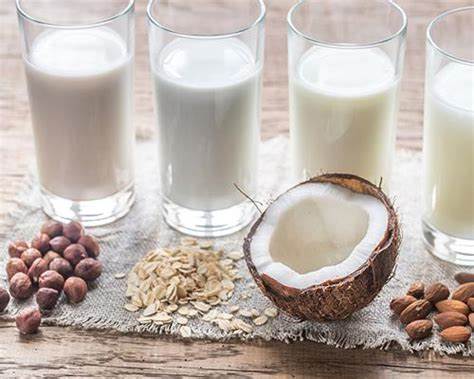
There are many reasons why individuals are switching from dairy milk to dairy free milk alternatives. A few of the reasons are due to health, sustainability, taste, ethicality, intolerances, allergies, dietary restrictions, efficiency reasons, and even due to mass media and marketing strategies (Pritulska et al., 16). Health concerns and sustainability issues have been some of the biggest motivations consumers have been switching over, mainly because of the intake of animal fat that has a great impact on an individual (Cardello et al., 1.1). Animal welfare also plays a role in why an individual might choose to switch milk, as not all dairy production systems treat their animals in humane and ethical ways (Cardello et al., 1.3). This recent trend of changing food lifestyles has, and will continue, to influence consumers to switch to an alternative (Haas et al., 2019). Dairy free milk alternative brands also use different branding and marketing strategies to try to influence consumers to switch to their milk alternatives. Some of these strategies include trying to convince consumers to switch to a plant-based diet for many of the reasons previously mentioned. These companies also brand themselves in such a way that even appeal to those who already drink an alternative to dairy milk in order to influence them to switch over to their brand (Vessela et al., 2023).
Dairy products in general, but especially milk, have a huge negative impact on the environment due to their production. Unsustainability is a big factor when it comes to food production systems for multiple reasons. One main reason these systems are unsustainable is because of the emission of greenhouse gases due to producing foods from animals. This greatly impacts global warming, especially as the demand for milk products is growing at a huge rate (Gross, et al., 1.1). While dairy farming can be more efficient in some cases, it produces more pollution, which in turn contributes to global warming. There is also an inefficiency factor with producing foods from animals due to the amount of products needed, such as the land, the feed, water, and housing and processing. Because of this, it has been found that the production of dairy products are some of the biggest sources of greenhouse gases (Cardello et al., 1.1). It will be very hard to make changes to these production systems to decrease the emissions of greenhouse gases and decrease the overall carbon footprint of cow’s milk, as so much goes into the process (Gross, et al., 1.1).
As these dairy free milk alternatives grow in popularity, a big factor is that they are environmentally sustainable compared to cow’s milk. Making these plant-based alternatives are relatively easy and a simpler process than cow’s milk. Either extracting water from these plants or fermentation is all that is needed to produce these milk products. While there are not drastically different health benefits between cow’s milk and dairy free milk alternatives, there are some differences. Cow’s milk contains high cholesterol levels. Plant sources can provide high fiber and low cholesterol but lack the amount of protein in cow’s milk. Soy milk is one of the only dairy free milk alternatives with a high protein content (Cardello et al., 1.1). Soy milk was the first dairy free milk alternative to be sold in grocery stores (Craig et al., 1). While many of these plant-sourced dairy free milk alternatives are produced to have similar nutrients to cow’s milk, many times they surpass cow’s milk nutrient levels (Ramsing et al., 2023).
On the other hand, there is evidence that indicates that dairy milk, more specifically cow’s milk, is better than dairy free milk alternatives. A few reasons are that cow’s milk is healthier and a more natural option, as well as good for bones. While this could sometimes be the case, there are still studies being done to prove that dairy free milk alternatives are actually the better option for various reasons (Hass et al., 2019).
Another important reason consumers are switching from cow’s milk to dairy free milk alternatives is for health reasons: lactose intolerance, milk allergies, high cholesterol levels in milk, and for better nutritional values. All milk products contain lactose, which is a type of sugar. However, not everyone is able to properly digest lactose. Being unable to digest this sugar causes lactose intolerance, which is why many people drink dairy free milk alternatives (Pritulska et al., 14).
This huge rise in popularity with dairy free milk alternatives is also having a negative effect on the dairy industry. Consumers have been switching to more plant-based food products in recent years. As more consumers have been switching to a healthier lifestyle, there has been a decrease in the sales of dairy products, especially milk. Those with plant-based diets, like individuals who are vegan or vegetarian, heavily promote this plant-based diet to get others to switch over. This has definitely contributed to this downward trend in the dairy industry (Park, 2021).
Individuals may also switch to drinking dairy free milk alternatives for ethical reasons, as they do not agree with how the cows are treated during the milk production process. Many dairy producers treat their cows poorly to benefit themselves by getting a greater yield of milk. Unfortunately, the dairy producers prioritize their gain over the health and happiness of their cows who produce the milk for them (Pascal et al., 312). Promoting animal welfare is extremely important, and cows should be treated in a humane way throughout the whole milk production process. If cows are treated poorly by dairy producers with the sole purpose of producing greater milk, then these processes should be stopped. Fairlife milk is one dairy milk producer in particular that has been found to treat their cows very poorly. All dairy producers should make their cows their priority (Pascal et al., 314).
I surveyed twenty college-aged students (19–21-year-olds) to inquire if they drink a dairy free milk alternative. I also asked when they switched to the alternative, why they did so, and what their favorite alternative milk is. Ten of the participants stated they drink an alternative, and the other ten stated they do not. Seven of the participants were female, and the other thirteen were male. Out of the seven females, six of them drink an alternative. Out of the thirteen males, only four of them drink an alternative. Most of the participants who drink an alternative do so because of either taste, health reasons, or even due to marketing strategies. One person even stated they drink an alternative to dairy milk because it has a longer expiration date. Most of the participants stated almond milk is their favorite dairy free milk alternative due to the sweeter taste almond milk has compared to the other dairy free milk alternatives.
Overall, whether cow’s milk or dairy free milk alternatives is the better option depends on various factors. There are many factors that contribute to whether dairy free milk alternatives are truly a better option. Dairy free milk alternatives are much better for the environment to produce than cow’s milk. With the rise in popularity of these dairy free milk alternatives recently, more consumers will be influenced to switch over to the alternative from dairy milk. At the end of the day, it truly depends on the individual and their reasons for choosing to drink the specific milk.
References
Cardello, Armand V., et al. “Plant-Based Alternatives vs Dairy Milk: Consumer Segments and Their Sensory, Emotional, Cognitive and Situational Use Responses to Tasted Products.” Food Quality and Preference, vol. 100, Sept. 2022. EBSCOhost, https://doi.org/10.1016/j.foodqual.2022.104599.
Craig, Winston J., and Ujué Fresán. “International Analysis of the Nutritional Content and a Review of Health Benefits of Non-Dairy Plant-Based Beverages.” Nutrients, vol. 13, no. 3, Jan 2021. EBSCOhost, https://doi-org.loyno.idm.oclc.org/10.3390/nu13030842.
Gross, Arthur, et al. “The Carbon Footprint of Milk during the Conversion from Conventional to Organic Production on a Dairy Farm in Central Germany.” Agronomy for Sustainable Development (Springer Science & Business Media B.V.), vol. 42, no. 3, June 2022, pp. 1–17. EBSCOhost, https://doi.org/10.1007/s13593-022-00775-7.
Haas R, Schnepps A, Pichler A, Meixner O. Cow Milk versus Plant-Based Milk Substitutes: A Comparison of Product Image and Motivational Structure of Consumption. Sustainability. 2019; 11(18):5046. https://doi.org/10.3390/su11185046.
Park, Young Woo. “The Impact of Plant-Based Non-Dairy Alternative Milk on the Dairy Industry.” Food science of animal resources vol. 41, 1 (2021): 8-15. doi:10.5851/kosfa.2020.e82.
Pascal A. Oltenacu, and Bo Algers. “Selection for Increased Production and the Welfare of Dairy Cows: Are New Breeding Goals Needed?” Ambio, vol. 34, no. 4/5, 2005, pp. 311-15. JSTOR, https://www.jstor.org/stable/4315607.
Pritulska, N., et al. “Plant-Based Milk Analogues in the Nutrition of People with Nutrition- Dependent Non-Infectious Diseases.” Food Science & Technology (2073-8684), vol. 14, no. 2, Apr. 2020, pp. 11-24. EBSCOhost, https://doi-org.loyno.idm.oclc.org/10.15673/fst.v14i2.1722.
Ramsing, Rebecca, et al. “Dairy and Plant-Based Milks: Implications for Nutrition and Planetary Health.” Current Environmental Health Reports, vol. 10, no. 3, Sept. 2023, pp. 291-302. EBSCOhost, https://doi-org.loyno.idm.oclc.org/10.1007/s40572-023-00400-z.
Vessela, V., Bell, R. & Bruning-Mescher, S. (2023) Plant-based milk alternatives: Consumer needs and marketing strategies, in Bertella, G. & Santini, C. (Eds.), Plant-Based Food Consumption Products, Consumers and Strategies, London, pp. 153-178.
 digital Humanities studio