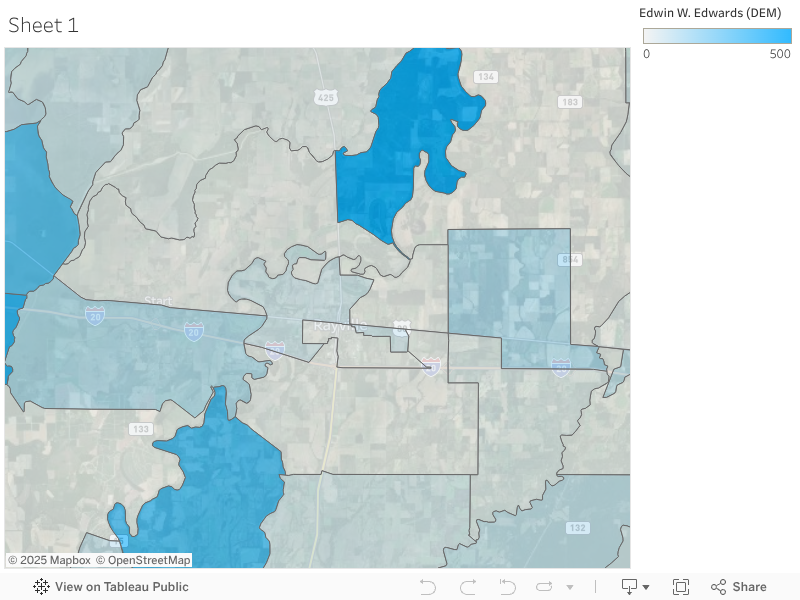
“Welcome to Duke Country.” That was the first thing that the former grand wizard of the Ku Klux Klan, president of the National Association for the Advancement of White People, founder of the Louisiana State University National Socialist Club, and then Louisiana State Representative David Duke said to incumbent governor Buddy Romer during their mutual attendance of the Rayville Pickin’ and Ginnin’ Festival celebrating the small Northeastern Louisiana town’s cotton industry. And Duke was right.1 In both the general and runoff election Duke outperformed the incumbent Roemer and former governor Edwin Edwards.
Rayville, General Election, Duke:

Rayville, General Election, Roemer:

Rayville, General Election, Edwards:
The 1991 Louisiana gubernatorial elections were wild, to put things kindly. Others might call it a race from hell. It might sound strange to describe the elections of a small, rural state such as Louisiana this way, but these elections were electric. This was primarily a result of the characters who ran. Louisiana has always had its fair share of larger-than-life political characters. As far back as the 1920s, Huey Long ran Louisiana with an iron fist—using patronage, voter fraud, gerrymandering, bullying of legislators, and at least one alleged kidnapping—to enact an anti-business, pro-worker legislative policy which he monikered “Every Man a King.”2 Following his assassination, Huey’s less witty, more pugnacious younger brother Earl continued his brother’s legacy of economic progressivism through state power before being involuntarily confined to a mental asylum for violently cursing out legislators when they refused to pass his legislation limiting the purging of Blacks from voter rolls.3
But even by Louisiana standards, 1991 was a hectic year. In many ways, the men who ran were archetypical of Louisiana politics. One was Edwin Washington Edwards. Edwards, a smooth-talking Cajun, grew up wherever you did, prayed to whomever you did, spoke like a preacher, and lived like a profligate. Edwards was renowned for his wittiness. In his third run for governor, he quipped his opponent took “an hour and a half to watch 60 Minutes.” So confident was he of that 1983 race that, on the eve of the election, he said “I could not lose unless I was caught in bed with a dead girl or a live boy.”4 Politically, Edwards was somewhere between a New Deal democrat and a Longist populist, mixing leftwing economic policy with populist rhetoric. He also faced continuous corruption allegations throughout his four terms in office, eventually being sent to jail in 2000 for his role in selling riverboat casino licenses.5
Buddy Roemer, the incumbent governor who beat Edwards in 1987, was a Reaganesque political figure, toting reduced taxes (at least for businesses), reduced expenditure, and good governance. Elected in 1987 as a Democrat, Roemer swamped parties mid-term and ran in 1991 as Republican, but without the support of the state GOP. He entered Baton Rouge with a religious anti-Edwards zeal but by 1991 had grown disenchanted with the office and was openly soliloquizing about his ennui: “It’s tougher. The last time I had the anger. Since then, I’ve been through eleven sessions of the Legislature. No one should have to go through what I’ve been through. It changes you.”6
David Duke stands in a league of his own. Founder and Grand Wizard of the modern Knights of the Ku Klux Klan, Duke brought a new aesthetic of youthfulness, approachability, and antisemitism to his Klan with well-pressed suits, TV-ready looks from his plastic surgery, and Nazi literature. Besides the Klan, Duke ran various racist and anti-Semitic organizations including a National Socialist club while a student at the Louisiana State University and the National Association for the Advancement of White People (no, really). Duke ran for office on several occasions before getting elected to District 81 of the Louisiana House of Representatives as a Republican representing the suburban New Orleans community of Metairie. Duke was still selling Nazi literature such as The Myth of Six Million and Mein Kampf from his representative’s office as late as 1989.7
The election itself began as a slow, unassuming race that most pundits predicted would end up in a close, uninspiring runoff between an unpopular incumbent and an unpopular former governor. Instead, Roemer came in third in the first round and the runoff fell to Edwards and Duke. Roemer had alienated poor and working-class white voters who had formed a sizable portion of his 1987 coalition through his proposed tax reform that would have abolished property tax exemptions for middle-class homeowners.8 Edwards—who was one of the first Louisiana politicians to court the Black vote, who desegregated state government, and who worked closely with Black political organizations—won the vast majority of the Black vote. And Duke, with his racially charged rhetoric and well-known past as a Klansman and anti-Semite, tapped into racial animosity and populist rhetoric that won him the poor, White vote. In the end, the influx of rich, White voters to Edwards over economic fears of the implication of a Duke governorship gave him the runoff election.9
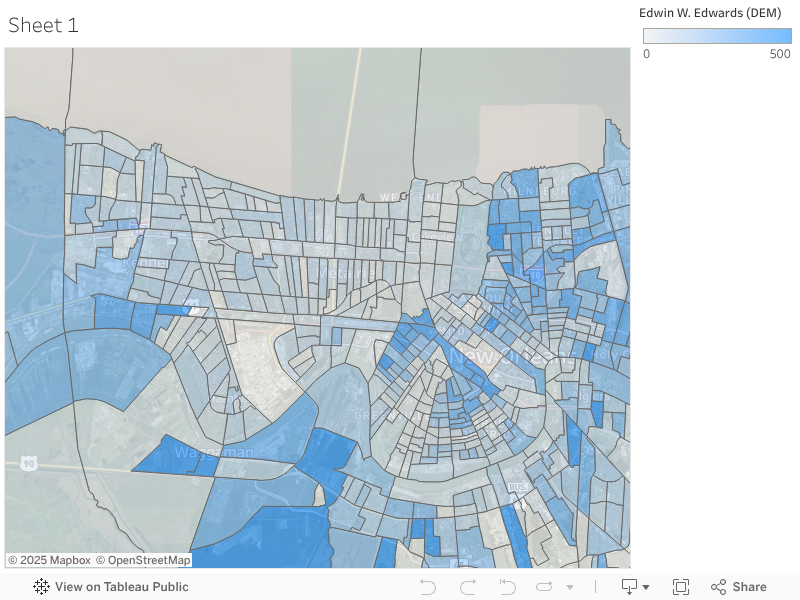
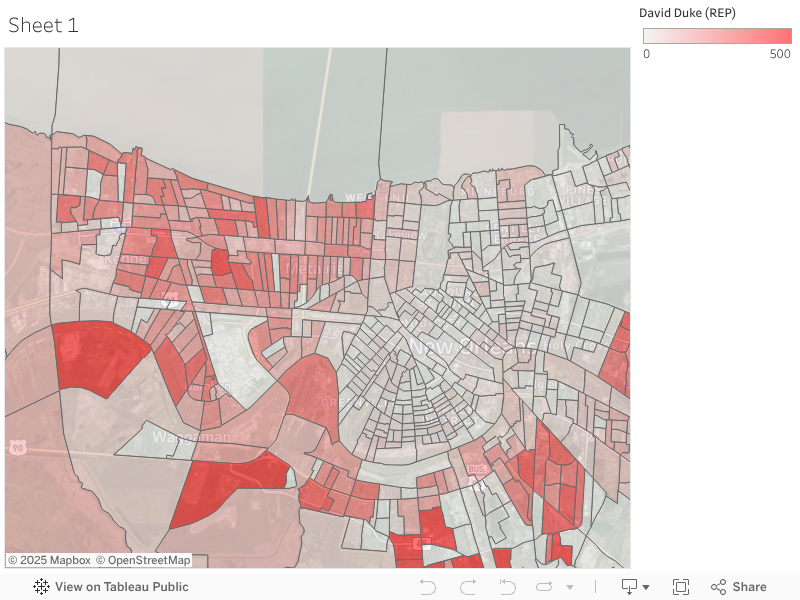
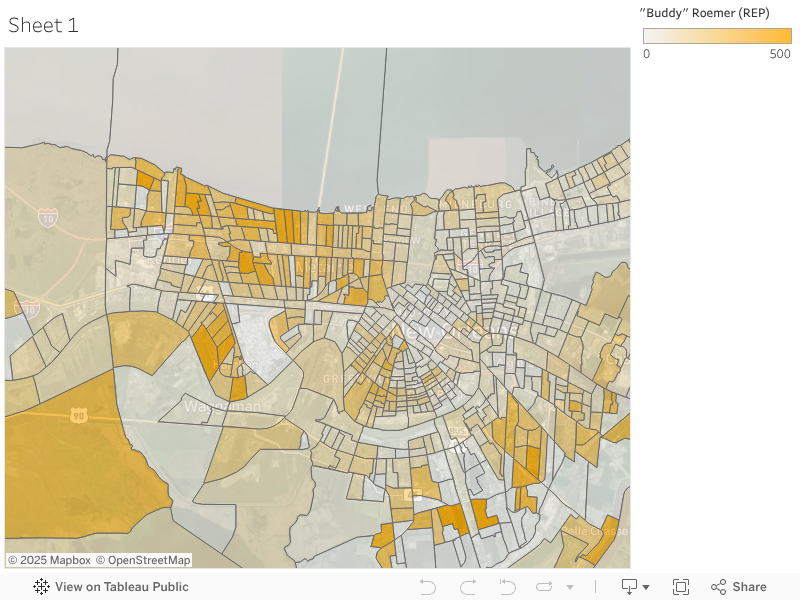
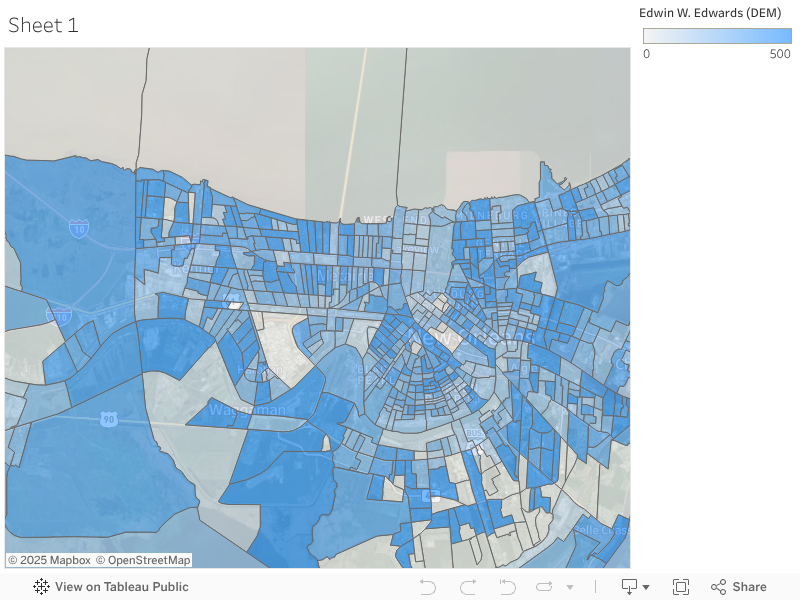
The maps of Rayville that opened the article demonstrate how racial and class polarization divided Louisiana. Rayville—a poor, white, rural town in Northeast Louisiana—rejected both the Reganesque Roemer and the New Dealing Edwin Edwards; it truly was “Duke Country.” Not all of Louisiana looked like Rayville, however. Looking at different parts of Louisiana, with different racial and class demography, we can see how voters shifted from Roemer to Edwards and how the old “Cajun King” managed to cobble together a truly unprecedented political coalition to defeat Duke. Metairie, for example, with its overwhelmingly White but economically mixed population was split between Roemer and Duke in the general election, with little in the Way of Edwards support. In the runoff, however, Metairie moved significantly towards Edwards.
Metairie, General Election, Edwards:
Metairie, General Election, Duke:
Metairie, General Election, Roemer:
Metairie, Runoff Election, Edwards:
Metairie, Runoff Election, Duke:

These maps show how Duke managed to achieve the success that he did, cleaving poor White voters away from Roemer. They also show how Edwards was ultimately able to win, pulling former Roemer voters into his coalition an driving up turnout with his core demographics. And finally, these maps also highlight the geography of voters of different races and classes lived (or did not live) near by (or far from) one another. Take a look at your hometown or parish, and see just how much, and in what ways, these elections motivated your community.
Map Links:
October Election Precinct Maps:
Edwards, Duke, Roemer
November Election Precinct Maps:
Edwards, Duke
Methodology and Error:
The precinct-level election result data for this project were taken from the Louisiana Secretary of State’s Live Election Results website voterportal.sos.la.gov. The spatial data for this project was taken from the United States Census Bureau and consists of the 2020 precinct boundaries for the state of Louisiana. These are not the same as the 1990 precinct boundaries used in 1991 and, therefore, the data represented in the map is not completely accurate. Precincts in some Parishes have since been added, and therefore the current boundaries may have since been shrunk. Other parishes have lost precincts, and the maps simply do not contain all of the recorded voters from these (typically rural) parishes.
The different data sources were brought together using the free version of Tableau. Initially, the application could not identify the special data with the corresponding precinct. To fix this, I had to copy the identification number for each of the spatial precincts into voting results for roughly 3,000 precincts. There remains the possibility of labeling errors in this process, but I did review the labeling multiple times after the initial transcription and hopefully removed most if not all such errors.
Despite not perfectly capturing the precinct data for the 1991 election due to changing precinct maps and potential transcription errors, the overall map conveys the general results of the election with a level of detail unavailable, to my knowledge, anywhere else.
Footnotes:
- Maginnis, John, “The Hazards of Duke,” in The New Republic, November 25, 1991. ↩︎
- T. Harry Williams, Huey Long, [1st ed.] (Knopf, 1969). ↩︎
- A. J. Liebling, The Earl of Louisiana: The Liberal Long (New York: Simon and Schuster, 1960). pp. 7-103. ↩︎
- Capitol news bureau, “22 Edwin Edwards Quotes That Capture His Self-Confidence and Sharp Wit,” The Advocate, July 12, 2021, https://www.theadvocate.com/baton_rouge/news/politics/22-edwin-edwards-quotes-that-capture-his-self-confidence-and-sharp-wit/article_d0c60dce-e361-11eb-892c-bb2d8b75db9d.html. ↩︎
- Tyler Bridges, Bad Bet on the Bayou : The Rise of Gambling in Louisiana and the Fall of Governor Edwin Edwards, 1st ed. (Farrar, Straus, and Giroux, 2001). ↩︎
- John Maginnis, Cross to Bear: America’s Most Dangerous Politics (Ann Arbor: Darkhorse Press, 1992). pp. 200-226. ↩︎
- Tyler Bridges, The Rise of David Duke (Jackson: University Press of Mississippi, 1994). ↩︎
- Thomas A. Becnel, “The Frustrations of Property Tax Reform in Louisiana: Bussie v. Long (1966) to ‘CC ’73’ and Buddy Roemer’s Industrial Tax Exemption Scorecard and the 1991 Gubernatorial Election,” Louisiana History: The Journal of the Louisiana Historical Association 42, no. 2 (2001): 133–62. ↩︎
- Peter Applebome, “Blacks and Affluent Whites Give Edwards Victory,” The New York Times, November 18, 1991, sec. U.S., https://www.nytimes.com/1991/11/18/us/blacks-and-affluent-whites-give-edwards-victory.html; Powell Lawrence, “Slouching to Baton Rouge,” in The Emergence of David Duke (Ann Arbor: Darkhorse Press, 1992). ↩︎
Bibliography:
Applebome, Peter. “Blacks and Affluent Whites Give Edwards Victory.” The New York Times, November 18, 1991, sec. U.S. https://www.nytimes.com/1991/11/18/us/blacks-and-affluent-whites-give-edwards-victory.html.
Becnel, Thomas A. “The Frustrations of Property Tax Reform in Louisiana: Bussie v. Long (1966) to ‘CC ’73’ and Buddy Roemer’s Industrial Tax Exemption Scorecard and the 1991 Gubernatorial Election.” Louisiana History: The Journal of the Louisiana Historical Association 42, no. 2 (2001): 133–62.
Bridges, Tyler. Bad Bet on the Bayou : The Rise of Gambling in Louisiana and the Fall of Governor Edwin Edwards. 1st ed. Farrar, Straus, and Giroux, 2001.
———. The Rise of David Duke. Jackson: University Press of Mississippi, 1994.
bureau, Capitol news. “22 Edwin Edwards Quotes That Capture His Self-Confidence and Sharp Wit.” The Advocate, July 12, 2021. https://www.theadvocate.com/baton_rouge/news/politics/22-edwin-edwards-quotes-that-capture-his-self-confidence-and-sharp-wit/article_d0c60dce-e361-11eb-892c-bb2d8b75db9d.html.
Lawrence, Powell. “Slouching to Baton Rouge.” In The Emergence of David Duke. Ann Arbor: Darkhorse Press, 1992.
Liebling, A. J. The Earl of Louisiana: The Liberal Long. New York: Simon and Schuster, 1960.
Louisiana Department of State. “Louisiana Secretary of State – Live Election Results.” Accessed March 22, 2024. https://voterportal.sos.la.gov/graphical.
Maginnis, John. Cross to Bear: America’s Most Dangerous Politics. Ann Arbor: Darkhorse Press, 1992.
“TIGER/Line Shapefile, 2020, State, Louisiana, Voting Districts.” U.S. Department of Commerce, U.S. Census Bureau, Geography Division, Spatial Data Collection and Products Branch (Publisher). Accessed May 5, 2024. https://catalog.data.gov/dataset/tiger-line-shapefile-2020-state-louisiana-voting-districts.
Williams, T. Harry. Huey Long. [1st ed.]. Knopf, 1969.
 digital Humanities studio