By: Matthew Levin

For my final project I have decided to roughly follow the happenings of a hypothetical late 17th century family during winter sometime around 1799. Lets set the stage and meet our family:
Meet Neil Cambell and his wife Clementine they are age 27 and 26 respectively. They have been married for 9 years and have 2 children a boy Glen who just turned 8 and a girl Miranda who is 7. They own a reasonably large sized farm of about 400 acres combined in Orange County New York. The farm was partially given to them by Clementines father as dowry and partially willed to Neil following his father’s death due to chronic injuries he suffered while serving in the continental army. They have hired another man Joseph McClellan and his family to help work their farm. They both take what they need sell the rest splitting the profit 60-40. The McClellan’s mostly focus on raising the animals while the Cambells mostly focus on the crops.
One early winter’s morning Neil saw one of his farm’s calves limping through the snow-covered wheat fields. He recognized this calf, it had once again been abandoned by the heard despite Joseph and Neil’s best efforts. They decided that the best course of action was to just put it out of it’s misery. Unfortunately, they would be unable to sell it due to poor recent weather and the calf’s poor condition, so they decided to slaughter it that afternoon and use the veal from it to make something Clementine had saw in her new cookbook by Amelia Simmons called a “stew pie” which went as follows:
“Boil a shoulder of Veal, and cut up, salt, pepper, and butter half pound, and slices of raw salt pork, make a layer of meat, and a layer of biscuit, or biscuit dough into a pot, cover close and stew half an hour in three quarts of water only.” (Simmons 1796)
This lead them to pull out and soak the salt pork they would have packed in the fall. Because this calf was from the spring calving season the previous year both families would be able to eat off of this calf for quite some time. The ladies decided to start the biscuit dough which they then handed off to the kids to knead, then moving their focus to churning the butter that they would need. Meanwhile the men worked on butchering the calf and storing the meat they wouldn’t be using for later. They then boiled the veal and after preparing all the meat the ladies added it to the pot layering it with the biscuit dough, adding butter, and seasoning it as they went. After that they set it on the fire to stew and they feasted the whole evening.
Many years later I Matthew Levin decided to recreate the previous events despite having just made them up. I decided to make salt pork like Neil and Clementine would have and I decided to make the Stew Pie as mentioned in Amelia Simmons’ cook book as close to the original recipe as I could with the time I had
I began by making the salt pork. I followed the instructions given in a video from the Townsends YouTube channel. However I found that the following recipe in Mary McKelvey’s cookbook is very similar.
“Sprinkle salt in the bottom of the barrel, and take care to sprinkle the same plentifully between each layer afterwards. Let the layers be packed very snug by having the pork cut as large as can be handled conveniently, and laid in rind downwards, and the interstices snugly filled up with smaller pieces. Pork will only take a proper quantity of salt, be there ever so much in the barrel. The surplus answers for another time.” (McKelvey 1831)
Salt pork was very important in the 18th century and before as refrigeration and freezing did not exist yet. Before refrigeration the only way you could make your food last longer was to salt it, pickle it, or if it is fruit put it in. a sugary preserve.
I started by getting a sealable container to put everything in and covering the bottom with salt. I then laid the porkchops I had bought on the salt and added a layer of salt on top of that and repeated this twice. I then started preparing the brine by boiling some water and adding salt until an egg would float. I then covered the container and stuck it in the refrigerator. I used the refrigerator to emulate doing the preservation in the winter and fall which is when it would actually be done. I then waited about a week and a half for it to cure and then began working on making my stew pie.
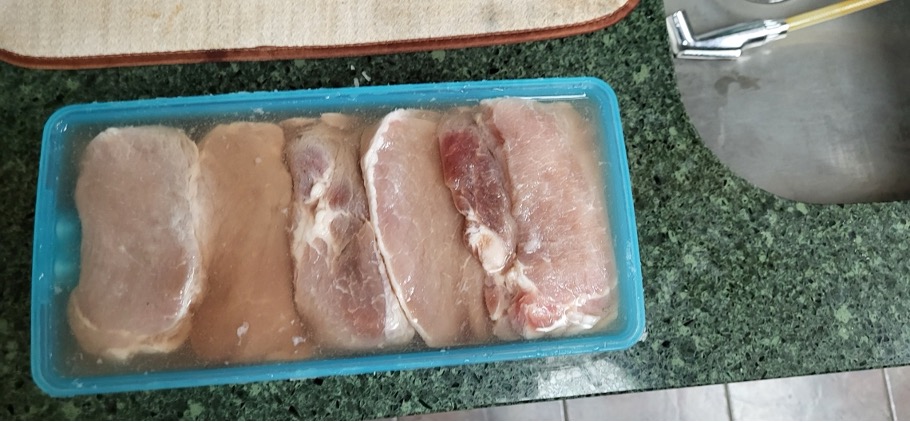
I began by soaking my salt pork for about 3-4 hours in water to get rid of any excess salt and to partially rehydrate the meat. I noticed that when I removed the salt from the original brine that it was stiff, almost rigid unlike regular fresh meat which is flaccid. After about an hour of soaking it began to become less rigid and by the end of the soaking it was completely flaccid and behaved like normal fresh bought pork.

During this I also ran out to grab some fresh beef from the local grocery store. I’m a broke college student so I can’t afford a shoulder of veal so I settled for the biggest quantity of regular beef that I could afford. Plus this likely would have been fine as modern beef is typically much more tender than what they had in the 1700s. (Townsends 1:20)


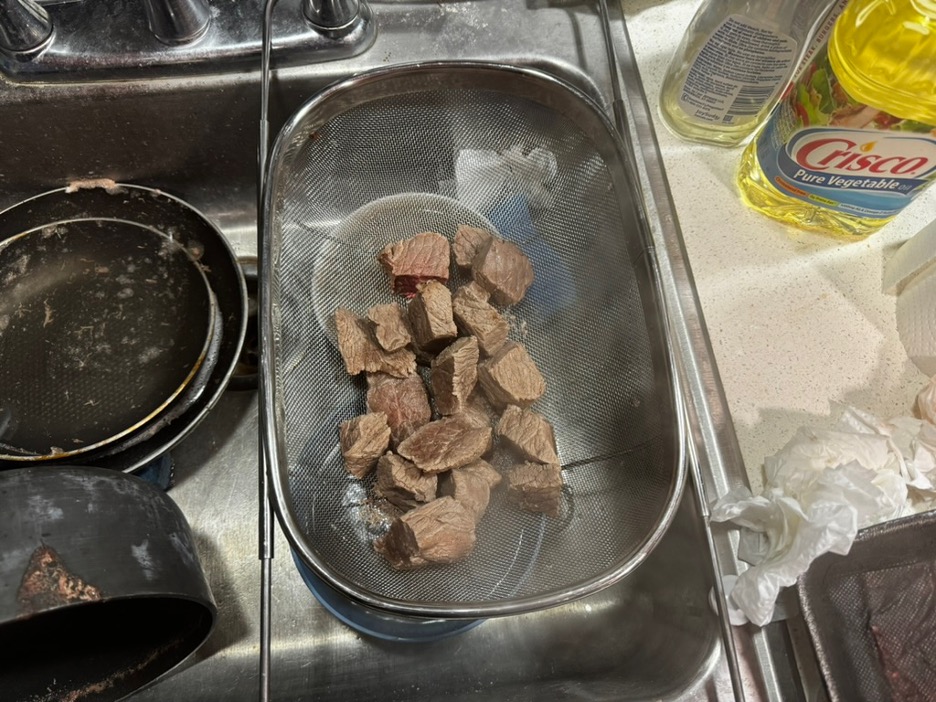
So I cut up my beef to make it cook faster (and also because I was worried that it wouldn’t fit in the pot I was cooking it in) and set it to boil. I then foolishly decided to eyeball boiling the beef while watching a movie leading to it boiling over and being a bit tougher than I intended. But we’re going say that was intentional and that I was emulating an 18th century mother having to cook dinner while nursing their child with pneumonia and or dysentery. After boiling the beef I separated it and stored the broth in some bowls
I then flattened out a few cans of biscuit dough that I bought. I was going to use the biscuit recipe that was in Amelia Simmons cookbook but I did not have the time to knead the dough when cooking this. I then cut it up into strips to make the dough act almost like noodles so that the whole thing was easier to eat. The recipe for biscuits in Amelia Simmons cook book went as such:
“One pound flour, one ounce butter, one egg, wet with milk and break while oven is heating, and in the same proportion.” (Simmons 1796).

After this I began putting the meat in the pot. I put the beef in first then put strips of the salt pork, then unsalted butter, then seasoned with pepper. I then layer the biscuit dough on top of it all and added more pepper and foolishly: some salt.
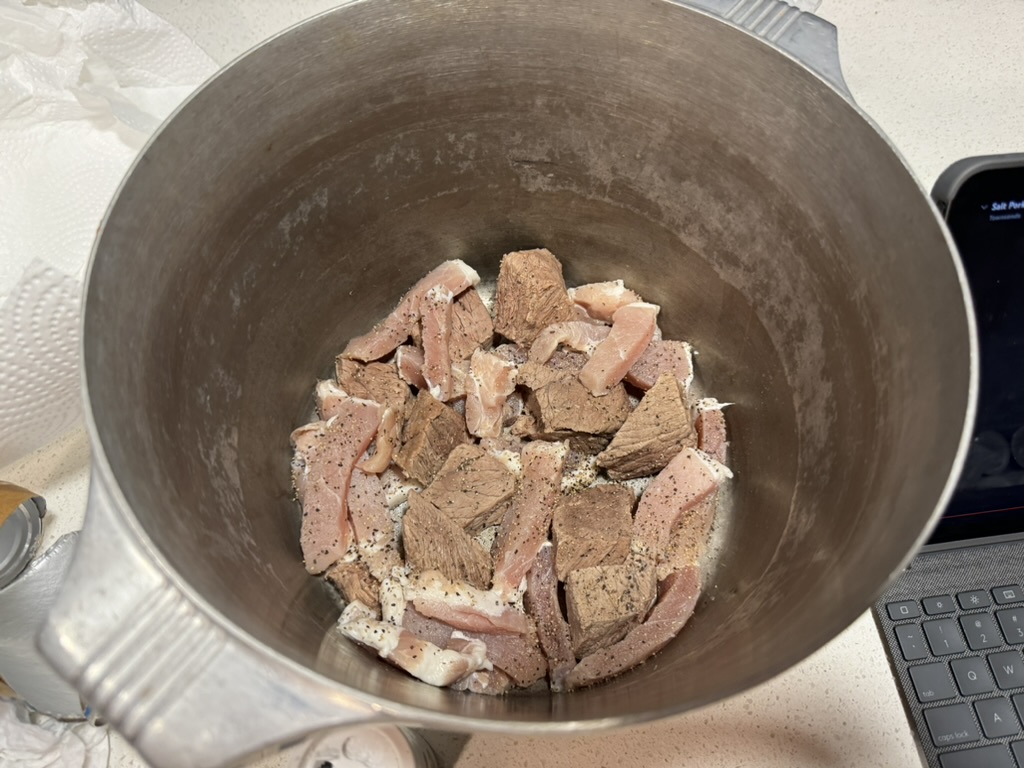
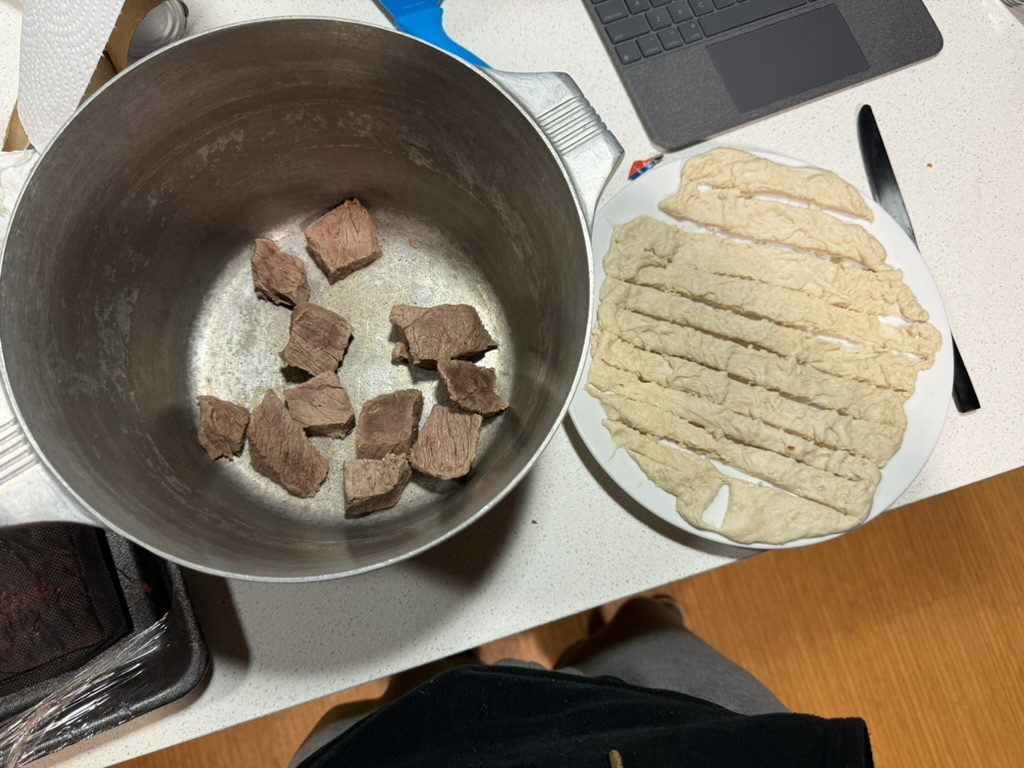
I then added another layer of meat dough and seasoning then re-added the broth from when I boiled the beef.

I then put the lid on the pot and let it stew for about 40 minutes, and I made sure to wait until the pork was cooked through. After I took the lid off I noticed that the biscuit dough had raised a bit, indicating it may have had some yeast in it. But the final product looked like this:
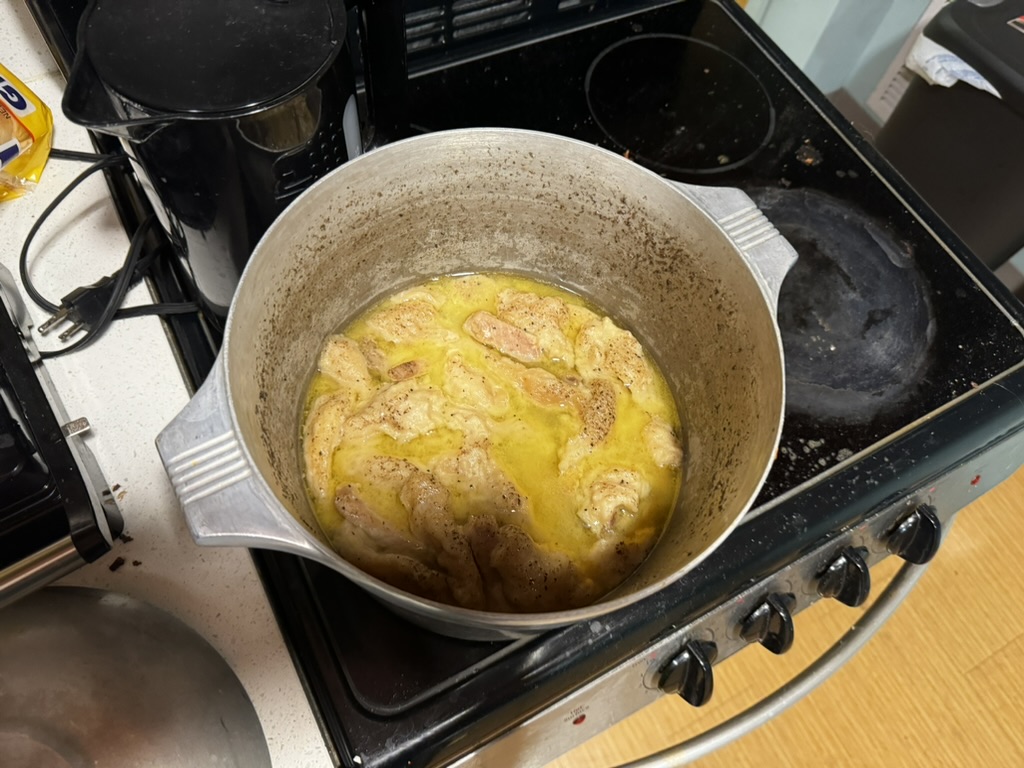

It was very salty, indicating that I should not have put any salt in and that I probably did not soak the pork in freshwater long enough, and the meat was a little tough, which was partially to be expected. But overall the flavors of the beef broth, salt pork and butter blended very well. One interesting thing is that the noodles were very potent and must have absorbed a lot of the salt and pepper.
Prior to the invention of refrigeration something like this that uses preservation methods like salting would have been very commonplace especially during the winter when there aren’t many fresh foods to be had. (Huntington Historical Society) ingredients like salt pork would also be crucial for overland explorers like Lewis and Clark so they would have reliable (more or less) shelf stable food supplies. Salt pork and similar preserved ingredients were very important to sailors of the time as well. Trans-Atlantic shipping would not have been possible if not for methods like salting and pickling. Before there were modern preservation methods like canning, and freeze drying, salting was one of the only ways you could make meat last for any substantial length of time. (Norman 2023) The only substantial reason that salt pork fell out of use was better supply chains and refrigeration leading to a lack of need for salting meat to keep from going bad. After all why bother when you can just run to the supermarket and get some fresh meat that you don’t have to worry about soaking, possibly causing your food to be too salty, or having to pay for all that salt.
Bibliography
Norman, Wilfred Desrosier. 2023. Encyclopedia Britannica. October 16. Accessed December 5, 2023. https://www.britannica.com/topic/food-preservation.
McKelvey, Mary. 1831. THE COOK NOT MAD, OR RATIONAL COOKERY. WATERTOWN: KNOWLTON. https://d.lib.msu.edu/fa/55?q=Mary%20McKelvey.
Simmons, Amelia. 1796. American cookery, or The art of dressing viands, fish, poultry and vegetables, and the best modes of making pastes, puffs, pies, tarts, puddings, custards and preserves, and all kinds of cakes, from the imperial plumb to plain cake. Adapted to this countr. Washington DC: Library of Congress. http://name.umdl.umich.edu/N23574.0001.001.
Townsends. 2011. YouTube. Nov 21. Accessed Nov 19, 2023. https://www.youtube.com/watch?v=ZdmPIpQZPRg.
Do you want to eat like a colonist? Accessed December 13, 2023. https://www.huntingtonhistoricalsociety.org/uploads/1/2/4/8/124874245/what_did_colonists_eat.pdf.
Salt Pork and Beef Pie – 18th Century Cooking. YouTube. YouTube, 2023. https://www.youtube.com/watch?v=Z9kGSeBefvM.
 digital Humanities studio