Ding-dong. You open the front door and are greeted by your neighbor’s endearing smile, holding a homemade tuna fish casserole in a deep glass dish. She heard about your loss and brought a fresh homemade casserole to comfort you.
This exact scenario is replicated in movies all the time. For example, you could’ve been promoted at work and it became a sign of congratulating you. However, I never saw these scenarios replicated in real life. As someone who is from Nevada, this was quite bewildering. In Las Vegas, it was considered respectful to not talk to your neighbors, let alone make food out of kindness for them. That was until I moved across the country to the South in Louisiana and saw a casserole in my neighbor’s hands with my own eyes. And not just any casserole, a tuna fish casserole. It was wrapped up neatly in a heavy glass deep dish. I was truly captivated. And it wasn’t only because of the disgusting, ugly tuna fish casserole. But also because of the woman who rang my doorbell. I wanted to know what compelled this woman to make food for someone she had never met. And out of all foods why a casserole?
Origin
Casseroles started their journey in America in the late nineteenth century and have evolved since. This is due to immigrants coming to America and bringing their culture, which commonly used a casserole, “an earthen cooking utensil.” (Hill and Boston Cooking School 308) This means that casseroles existed long before the late nineteenth century, earliest casserole recipe and dish(tool) dates to 1250. (Fine Dining Lovers Editorial Staff) The culture I am focusing on is the French, who had a significant impact on the food world in America. Most of the French immigrated to French colonies, essentially the Midwest. However, they mainly immigrated to Louisiana due to France purchasing the Louisiana Territory in 1803. Despite immigrating to Louisiana, the French spread their culture and traditions all over the South in areas like New Orleans, Mississippi, and Kentucky. (Haines 82-87)

Cooking is an art that is essential to learn in order to nourish our bodies to survive. The French believed that it was a “minor morality of the household” (Lincoln 1) to prioritize the health and comfort of not just ourselves but society. This is mainly because of religious influence on Christians who adhered to charity, compassion, and comforting others, especially in times of need. Therefore, providing food for others became a moral duty. Heavy emphasis on community and hospitality soon became engrained in Southern culture.
The Earthen Casserole
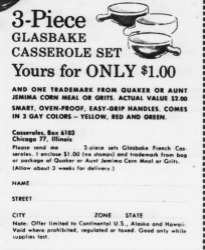
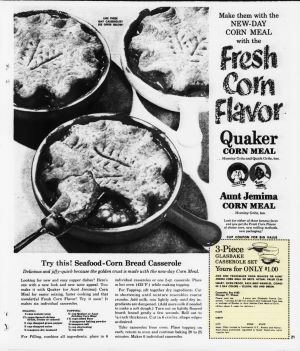
A Casserole refers to both the physical dishware and the food cooked inside the dish. Both definitions contributed to the reason why casseroles appeared in America. During the late nineteenth and early twentieth century gas stoves became widely adopted in all households and classes. However, they were difficult and expensive to maintain because you had to clean them very well and haul fuel over which was expensive. People who didn’t have the means to afford this lifestyle regressed to cooking by traditional methods such as slow-cooking or boiling. Additionally, mass production of “formerly expensive items like ceramic dishes and pressed glassware were now mass-produced, and this sold more cheaply.” (Turner 45) This benefitted Southerners because the French had a “fascination for earthen pots, pans, and casseroles that lies partly in the romance that clusters around everything connected with the dim past we call the childhood of the world.” (Hill 1) Meaning that people in the South who could only afford to slow-cook food with their oven could use earthen casserole.
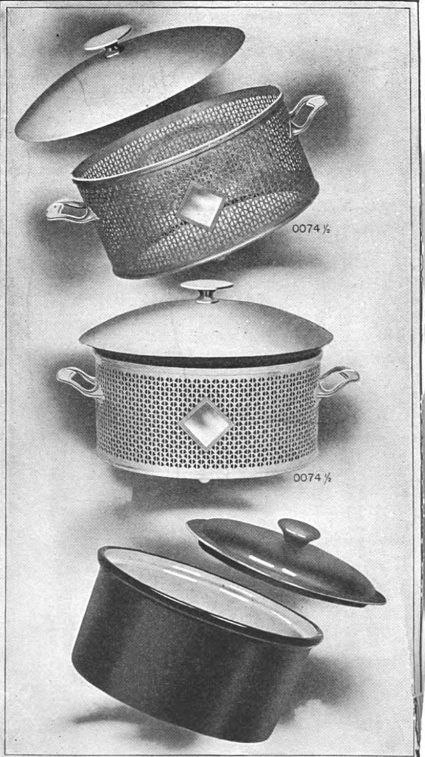
Interestingly enough, the cover of the casserole had physical benefits and social meaning. Furthermore, “The cover, also, prevents the dissipation of dedication and volatile savors.” (Hill and Boston Cooking School 309) In other words, the cover allowed the casserole to retain heat for a long time, which was important for many reasons. One is because “there is no uncertainty about compliance with the old maxim: “Let hot foods be served hot…” (Hill and Boston Cooking School 309) Secondly, the cover allows the food to be in good condition for the people who showed up late to an event or for a tardy dinner. Thirdly, the cover keeps the “highly seasoned” odor contained and it is seen as “quite perceptible.” (Hill and Boston Cooking School 309) So it was an unspoken rule to not uncover the casserole unless it “has been set upon the table.” (Hill 6) This rule is connected to French culture and traditions, which believe that eating at the table brings togetherness and connectivity. It was French etiquette to wait till all guests came to the table and eat at the same time. (Alexia) On top of waiting to open the casserole until it has been placed on the table, “the cover is removed with a napkin…” (Hill 6) This also has a lot to do with French culture and etiquette because it was hygienic for the waitress/waiter or other person to use a napkin. On top of that, they would serve casseroles “on a folded napkin” (Lincoln 167) Which ties to the trend of having one dish on your table as “simplicity is allied with good taste” (Hulse xi) because it was old-fashioned to have “a simple garnished and well-served casserole.” (Hulse xi) Many Southerners felt that preparing a “daintiness” meal was desirous because you could still show you cared with the casserole savoriness “without an undue expenditure of time or money.” (Hill 6)
The food inside the casserole varied tremendously. You could have a tuna fish noodle casserole, tuna fish casserole, tuna fish casserole with potato border, etc. And you didn’t necessarily have to use tuna fish, you could use anything like veal, chicken, pasta, beef, etc. The possibilities were truly endless “because the housewife learns to use ingredients that may suit she has on hand.” (Hulse xi)
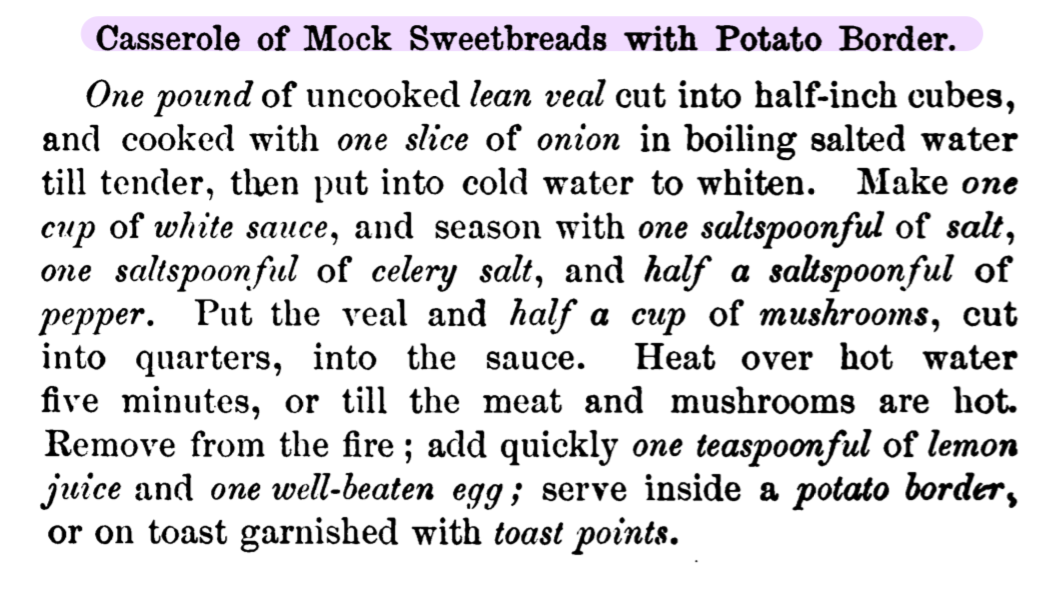
It is important to note that during this period, America was advancing in technology that allowed mass production of produce so items became more available through markets. So many core items in a casserole dish are inexpensive and readily available to all classes such as onions, butter, carrots, rice, etc. Fish was especially inexpensive because “of its abundance, cheapness, and wholesomeness…” (Lincoln 159) However, those who could afford other fulfilling meats were seen as “wealthier.” Specifically, veal was seen completely differently compared to fish. Veal was expensive even if it were out of season or poor cuts. (Lincoln 239) The sweetbreads of veal were considered a luxury item, a sign of wealth if you could afford to have the pleasure of eating it. Despite it being cooked in a casserole the same way as a fish casserole, it became a symbolic class distinction. There were recipes created that were meant for people who couldn’t afford veal to be able to enjoy. An example is seen below:
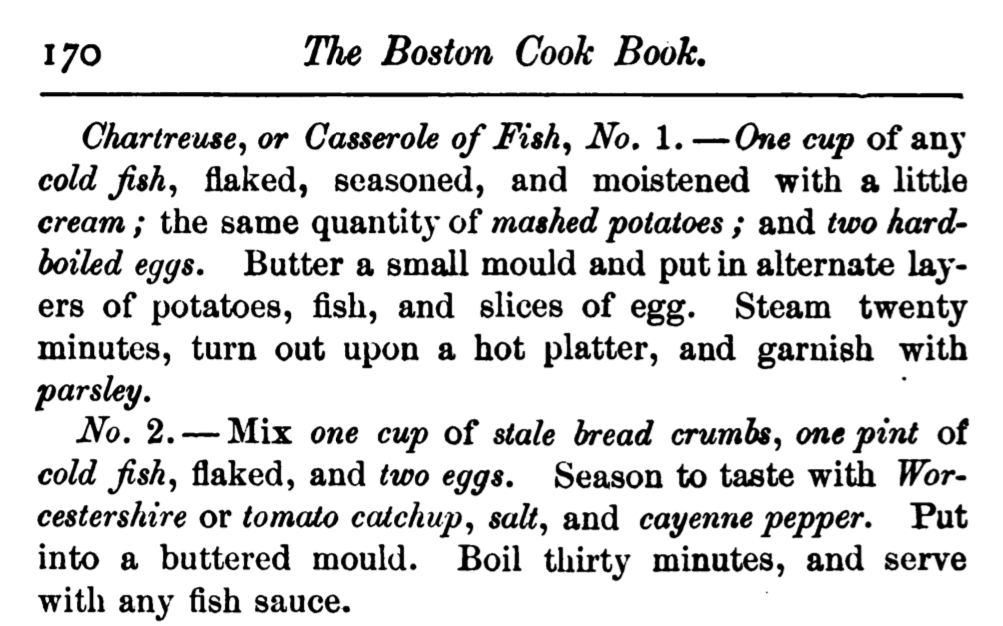
There was even a difference between breadcrumbs. In the two recipes below, it is seen that there are stale bread crumbs or cracker crumbs. They are the same thing essentially but symbolize one’s status. On top of that, there was another difference between using stock or hot water. The purpose of using stock instead of water was that less butter would be required and it would make the mould moist enough to make packing the meat easier. However, they both do the same job and the flavor does not differ significantly. (Lincoln 274) Yet, it did symbolize your wealth.

The Duo
Many of the ingredients that are popular in the recipes are due to the women. “It is the religious duty of every housewife to accomplish the art of cooking.” (Hulse 5) Women were expected to master the art of cooking because it was the only thing society saw they could do “which pertains to the practical concerns of life, – a fact that is already recognized in the cases of boys.” (Hill and Boston Cooking School 335) So many women found casseroles to be a blessing because they could use a variety of ingredients they had on hand, throw them in a glass casserole, cover them, and put them in the oven to cook for hours. They could go on about their other housewife duties and not worry about making dinner for their family. (Hulse viii) “There was no time lost transferring to another dish as it is both cooked and served in the casserole” (Hulse vii) Which allowed them to fulfill their moral duty of being compassionate and hospitable to others.
Last Thoughts
My inspiration for this research project was to understand why casseroles were symbolic. As I mentioned earlier, I am from Nevada and I always thought casseroles were fictional. I only saw them in movies. My family never cooked them, none of my friends cooked them, nor did anyone in my environment. So my opinion of casseroles were based on what I saw in the movies. I never understood the appeal of casseroles because it was just a bunch of things thrown in a dish. To me, it seemed a lazy way of cooking that created nothing flavorful. And it was always a friendly neighbor giving it to the main character. However, when I moved to the South I saw a casserole for the very first time. I even tried it and it was honestly disgusting. Yet people in the South made them all the time and they would bring them to family events, or school events. I was mortified. But also very intrigued. Why were Southerners so persistent in being hospitable to their community in the form of food, especially casseroles? Well, the simple answer is that it’s a part of their culture to show compassion and care for others and casseroles were inexpensive, efficient, and portable. It’s a home-cooked meal that physically and emotionally nourishes our bodies. You can use any ingredients you have in your house, expensive or inexpensive, throw them in a casserole, and pop them in the oven. And bam! You have food to provide for your family and others. Or to an event. Maybe even your neighbor because it is easily portable. As it’s all in the dish and has a cover. Even though I still find casseroles revolting, I now have more respect for the dish and the woman at my door holding one.
Bibliography
Alexia. “À Table! Take A Better Lunch Break The French Way.” Trello Blog, 20 January 2020, https://blog.trello.com/take-a-lunch-break-french-tradition.
Fine Dining Lovers Editorial Staff. “What a casserole is: definition and history.” Fine Dining Lovers, 28 April 2023, https://www.finedininglovers.com/article/what-is-casserole-definition-history.
Haines, Michael R. “FRENCH MIGRATION TO THE UNITED STATES: 1820 TO 1950.” Annales de Démographie Historique, vol. 1, 2000, pp. 77-91. JSTOR, http://www.jstor.org/stable/44385464.
Hill, Janet McKenzie. Cooking and Serving en Casserole and Things We Relish. Meriden silver plate Company, International silver Company, successor, 1910, https://books.google.com/books?id=FCsxAQAAMAAJ.
Hill, J.M.K, and Boston Cooking School. The Boston Cooking-School Magazine of Culinary Science and Domestic Economics. vol. 3, United States, Boston cooking-school magazine, 1899, https://books.google.com/books?id=xQIL-N_bvVMC. 6 vols.
Hulse, Olive M. Two Hundred Recipes for Cooking in Casseroles. Hopewell Press, 1914, https://books.google.com/books?id=dvRBAQAAIAAJ.
Lincoln, M. J. Mrs. Lincoln’s Boston Cook Book: What to Do and What Not to Do in Cooking. Roberts Bros., 1883, https://books.google.com/books?id=hm0EAAAAYAAJ.
Turner, Katherine Leonard. “Factories, Railroads, and Rotary Eggbeaters: FROM FARM TO TABLE.” How the Other Half Ate: A History of Working-Class Meals at the Turn of the Century, 1st ed., University of California Press, 2014, pp. 28–50. JSTOR, http://www.jstor.org/stable/10.1525/j.ctt5hjj23.6.
 digital Humanities studio