Cheesecake is a dessert that I grew up enjoying. My mother makes her version of a cheesecake for everyone holiday and occasion that she deems worthy. This decided what 19th century dish I would be deep diving into. Learning about early versions of a dish that I have been eating my whole life was very intriguing to me. I felt that in a way executing a 19th century cheesecake would somehow connect me and the people who would make this recipe for their families the same way my mom does for my family. But that is just it, food is something that weaves history together and it is just a matter of building from a food creation that someone has already made.
The cheesecake recipes that I found during my time scanning through 19th century cookbooks all seemed to have one thing in common. None of the recipes included cream cheese. This surprised me because cream cheese is quite literally a part of the dish’s name. However, cream cheese was not invented until the late 19th century, specifically in 1873 by a man named William A. Lawrence. This man was the first to mass produce the product cream cheese, so before this cream cheese was not readily available to the public. Also, cream cheese was first invented in the United States and an American addition to the historical cheesecake. This would explain why I was unable to find cheesecake recipes with cream cheese as an ingredient.
I was too invested in my research to not try and recreate one of these 19th century cheesecakes myself. The recipe that I decided to follow was one I found in “The Lady’s Own Cookery Book” written by Charlotte Bury and published in 1844. There were several cheesecake recipes in this cookbook to choose from, but I went with the recipe, Cheesecake No.2.
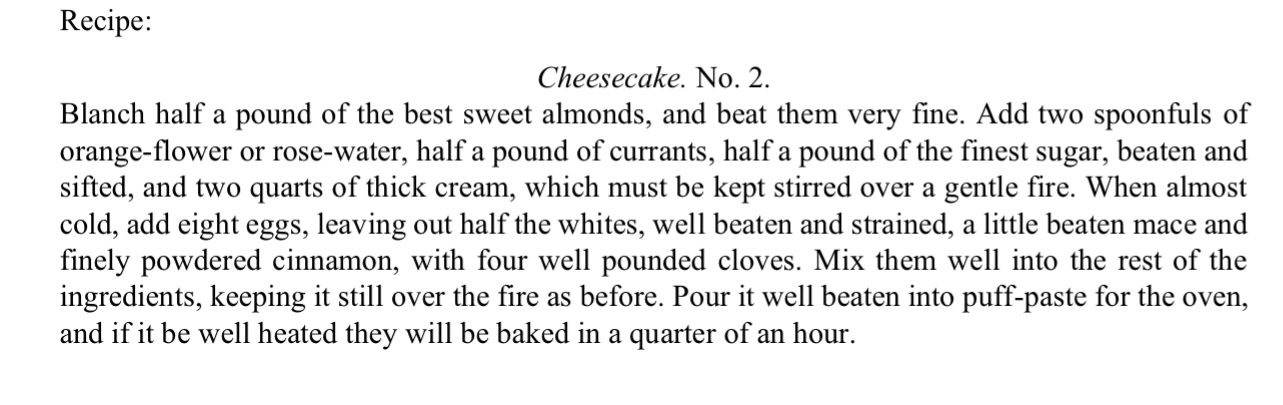
I was initially overwhelmed by this recipe. At first glance it seemed short and sweet, but I quickly realized I was going to have a run for my money with this one. Let us start by talking about the ingredients. Some of these ingredients I was unfamiliar with, such as currants and rose water. Rose water is used to enhance both the sweet and savory elements of dishes and in this case, it was used to elevate the sweetness of the cheesecake and give a subtle floral taste. This specific recipe originates from the United Kingdom, so I am assuming currants were included because they were a common ingredient in desserts from this region. Almonds are something that I have never seen in a cheesecake, but this idea was not completely startling. The use of eggs is something that is still used in cheesecake recipes today because it acts as stabilizer and aids in the overall texture of the dish. Thick cream is one of the most important ingredients because the thick cream mixed with the eggs is vital in making the custard/cheesecake filling. Sugar is used as a sweetener and spices such as mace, clove, and cinnamon are there to enhance the overall flavor. Puff-paste is used as the crust which I found extremely interesting because I have never seen a cheesecake with a crust made from puff pastry.

Now it is time to get baking. I tried to keep the process as authentic as possible, but I will say that I could not avoid modern technology and substituting some ingredients that I was unable to find. I used dried cranberries instead of currants and I used allspice instead of cinnamon, clove, and mace. I also decided to cut the recipe in half. I used a food scale to weigh out the ingredients because the measurements were provided in pounds.
Following the recipe, I started out by crushing up ¼ a pound of blanched almonds as fine as I could get them by hand. I then measured out 2 spoonfuls of rose water, which I used a teaspoon to measure and my sugar. I used granulated sugar, and I chose not to beat and sift it like the recipe calls for because I believed that since the sugar was going in the pot with the thick cream that it was going to be heated and dissolved anyway. I was right. I was confused by the wording of the recipe, so I added the sugar, almonds, and dried cranberries in the pot with the heavy cream and let that slowly heat on the stove. I then prepared my 2 eggs and 2 egg yolks in a bowl. The recipe says to let the cream mixture cool before adding the eggs and then add it back on the stove to heat once more. This is when I strayed from the recipe a little. Because I was aware that this was more like the cooking process of a custard and not the cheesecake that I am used to, I decided that instead of letting the mixture cool before adding the eggs I was going to temper the eggs into the hot mixture. I tempered the eggs and then added the eggs into the cream mixture and continued to heat it on the stove and added the allspice. Once the mixture began to thicken, I let it boil and then removed it from the heat. I used premade puff pastry dough because I can only handle so much. I poured the mixture into the puff pastry and baked the cheesecakes at 350 degrees for 40 minutes. The recipe says that it should only take 15 minutes to bake, but that was not the case for me.

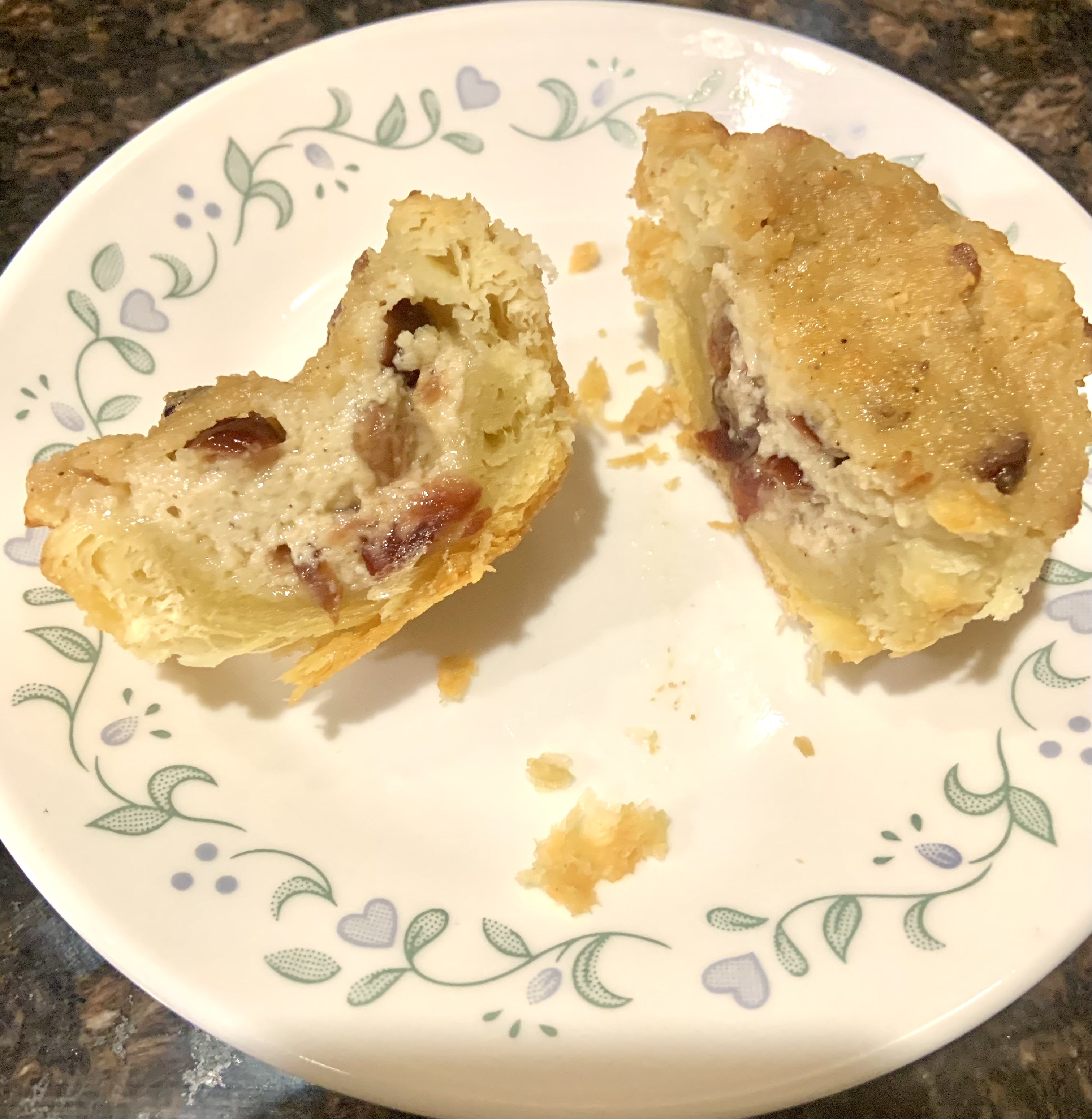
The taste of the cheesecake was unlike any other I have had before and certainly not like my mother’s, but that does not mean it was bad. I quite enjoyed the taste. The rosewater provided a sweet and floral taste and complimented the allspice very nicely. I will say that the texture was interesting. It had a loose custard texture and was not the smooth, bouncy cheesecake texture that you would normally see today. The almonds were chunky and very apparent in the mouth feel of the dish, but I will say that is my fault for not beating them fine enough. It was greasy and I am honestly not entirely sure why this is. I will say that it came out better than I expected, but I do not think that it was perfect, and I am taking full responsibility for this.
Overall, I found this experience very educational. Cheesecake may have been around since 2000 B.C. when they excavated the first cheese molds. Since then, various places and people have created cheesecake recipes and made them compatible with the times in which they lived. My research and execution of the 19th century cheesecake has shown me how something so normal at one time can appear so foreign in another. I am grateful for this experience and for getting to taste a part of history, but I will for sure be sticking to the 21st century cheesecake that I know and love.
 digital Humanities studio