Yeast plays a crucial role in baking bread, influencing its taste, texture, and overall utility. However, in America, the most popular types of bread make use of this special ingredient – yeast. The origins of bread are still moderately unknown, but it is inferred that the first types of bread were made in Ancient Egypt. Bread was a staple food in Britain and Europe, so it is not surprising that it traveled with the American colonizers and became a staple food product in the American colonies. The simplicity of bread’s composition, leveraging readily available colonial-era ingredients, ensured its ubiquity and positioned it as the cornerstone of countless meals. It is also hearty and filling, capable of adopting the flavor of whatever it is served with. As Thaysen discusses in his paper, Food Yeast: It’s Nutritive Value And Its Production From Empire Sources, what bread is “Added to soups and stews in proper proportions food yeast imparts a pleasing flavour to these dishes – a flavour which a group of pressmen described to me as chicken flavour, while an ardent vegetarian preferred the expression ‘nutty flavour’” (Thaysen, 355). It leaves room for creativity and variety when it comes to a meal.
To put it simply, yeast is a single-cell microorganism grown through the fermentation process that is used in bread. When yeast interacts with gluten, it creates carbon dioxide, allowing the bread to rise or leaven. This leavening is what creates the air pockets and ‘fluffiness’ of the bread. Until 1857, when Louis Pasteur observed yeast under a microscope, no one really had a complete biological understanding of the role played by yeast. In France, wild yeast was captured from the air along with other bacterias. This created a sour tasting bread. British bread, since the yeast was captured from the brewing process of ale, did not have a sour taste, but a bitter one. British colonists in America had to adapt to a new climate and land when it came to making bread. In the article by Linda Civitella, she states that “Without commercial breweries or bakeries, women had to make their own yeast” (Civitella, 7). Many women in Britain relied heavily on the local bakers to provide their bread or by getting yeast from breweries so without these resources American women needed to find a solution.
Yeast is a very sensitive organism and takes a long time to make, but many cookbooks during the 1800’s provided recipes for how to make yeast. One such cookbook is “Catherine Beecher’s Domestic Receipt-Book (1858) [which] contains two pages of recipes for making yeast for bread” (Civitella, 7). This cookbook contains recipes for potato yeast, home brewed yeast, milk yeast, and even hard flower yeast. Not only was yeast difficult to make, but it was also difficult to keep – it’s very sensitive to temperature, humidity, and cleanliness. American women were quick to switch to emptins instead of growing their own yeast. We can see this in Amelia Simmon’s recipe for emptins in American Cookery which is made from hops and the dregs of a beer cask. The hops that were used had the effect of making the bread more bitter since it took a higher quantity than yeast. Emptins was also in non concentrated liquid form and therefore needed even more in order to leaven the bread.
American wheat also proved to be a hurdle that the British Colonizers needed to overcome. In New England, wheat was hard to grow and maintain due to the climate and common diseases among crops. Many housewives turn to corn as the solution. American wheat was also different from British wheat, so many recipes that were brought over needed to be changed. Civitella states that “. . .women had to reinvent the bread recipes they brought with them from England or the recipes available to them in British cookbooks until American women started to write their own cookbooks at the end of the eighteenth century” (Civitella, 9). Since bread was already commercialized in Britain there were not many recipes to begin with. Many American women passed down their recipes and cookbooks to their daughters.
Bread was also difficult to bake during the colonial era since ovens were usually brick and built into the wall near the fireplace. The temperature of this brick oven was at the will of the fire and there were no thermometers during this time. Many cookbooks actually had sections specifically for how to know if the oven was ready. Times for baking also varied since the fire was difficult to control. Civitella references Eliza Leslie’s instructions in order to show the difficulty of preparing the brick oven: “‘Try the heat of the oven by previously throwing in a little flour. If it browns well, and you can hold your hand in the heat while you count to twenty, it is a good temperature for bread. If the flour scorches black the oven is too hot, so leave the oven open a little while’” (Civitella, 16). This way of testing the heat of the oven is obviously not very accurate and can also depend on the individual.
One of the most important developments with yeast came about in the early 1900’s when yeast was finally able to be produced and sold. One of the first discoveries of this process was in Germany. Thaysen writes that “By 1915 German workers had devised a technical process in which a certain type of yeast could be produced from inorganic nitrogen, provided sugar was supplied either in form of molasses or any other cheap form” (Thaysen, 354). Being able to produce yeast and sell it in stores meant that the bread making process was a whole lot easier. No more waiting for yeast to grow or having to use different types of yeast or emptins as supplements. In America, the first company to begin mass producing baking yeast was The Fleischmann Company. As seen in this news article from 1921. There is a strong emphasis on the “freshness” of the yeast and its benefits to the human diet. So not only is this yeast used for bread, but it has many other benefits. The beginning of The Fleischmann Company was in 1868 when the Fleischmann brothers left Austria-Hungary and came to America. In the hopes of making better bread that was comparable to the one from their homeland they started a yeast plant in Ohio and started to create these yeast cakes. Then at the beginning of World War II they developed an active dry yeast – no refrigeration needed. The Fleischmann Company had single handedly revolutionized baking with yeast in America.
In order to understand the effects of yeast, its importance in bread making, and how sensitive an ingredient it is, I decided to bake my own bread using a baguette recipe that has been passed down in my family. In order to understand the effects of yeast I decided to change the amount of yeast in each batch. The control batch (blue bowl) had the required amount of yeast (2 tsp), the red bowl had 1.5 tsp, the green bowl had 1 tsp and the clear bowl had a 1/2 tsp. The recipe consists of 6 ingredients: flour, water, milk, salt, and yeast. It is important to note that the milk and water will be combined and warmed before being mixed into the flour, salt, and yeast combination. You must keep the salt and yeast separated in the bowl until mixing with the flour. Since yeast is a very sensitive organism, letting it touch the salt for a long period of time can kill it and cause the bread to not leaven. Mixing in the milk and water mixture that is too hot can also kill the yeast. All ingredients were measured out and mixed then set aside to rise for an hour. After an hour you could see how the lack of yeast in the non control breads had caused there to be less air bubbles. Each dough was formed and put in the oven with water and baked for 20 minutes. The following images compare the doughs after proofing and the inside of the baguettes after baking. It is evident how the bread with less yeast is more doughy and has fewer air pockets, as it didn’t leaven as well.


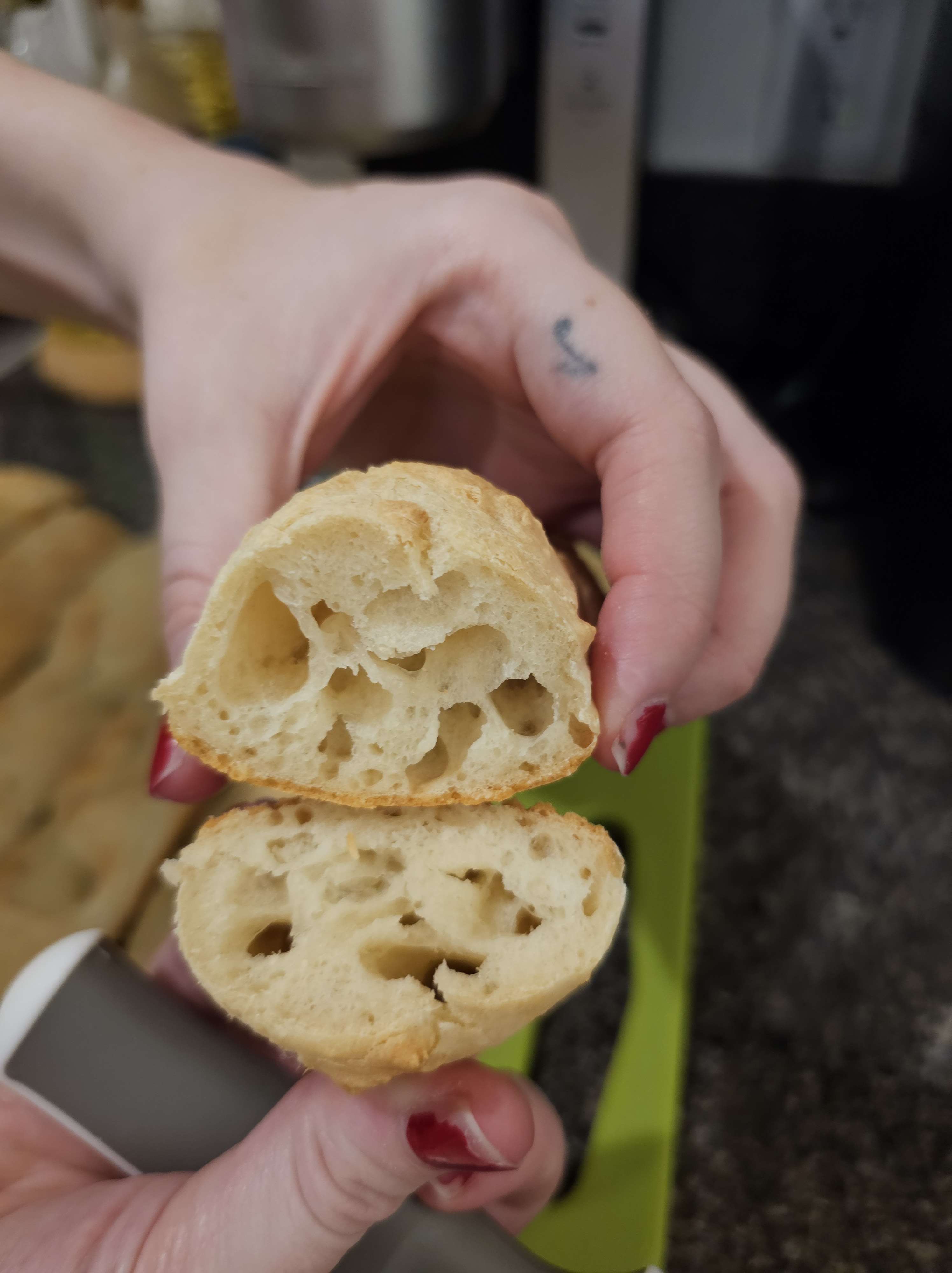
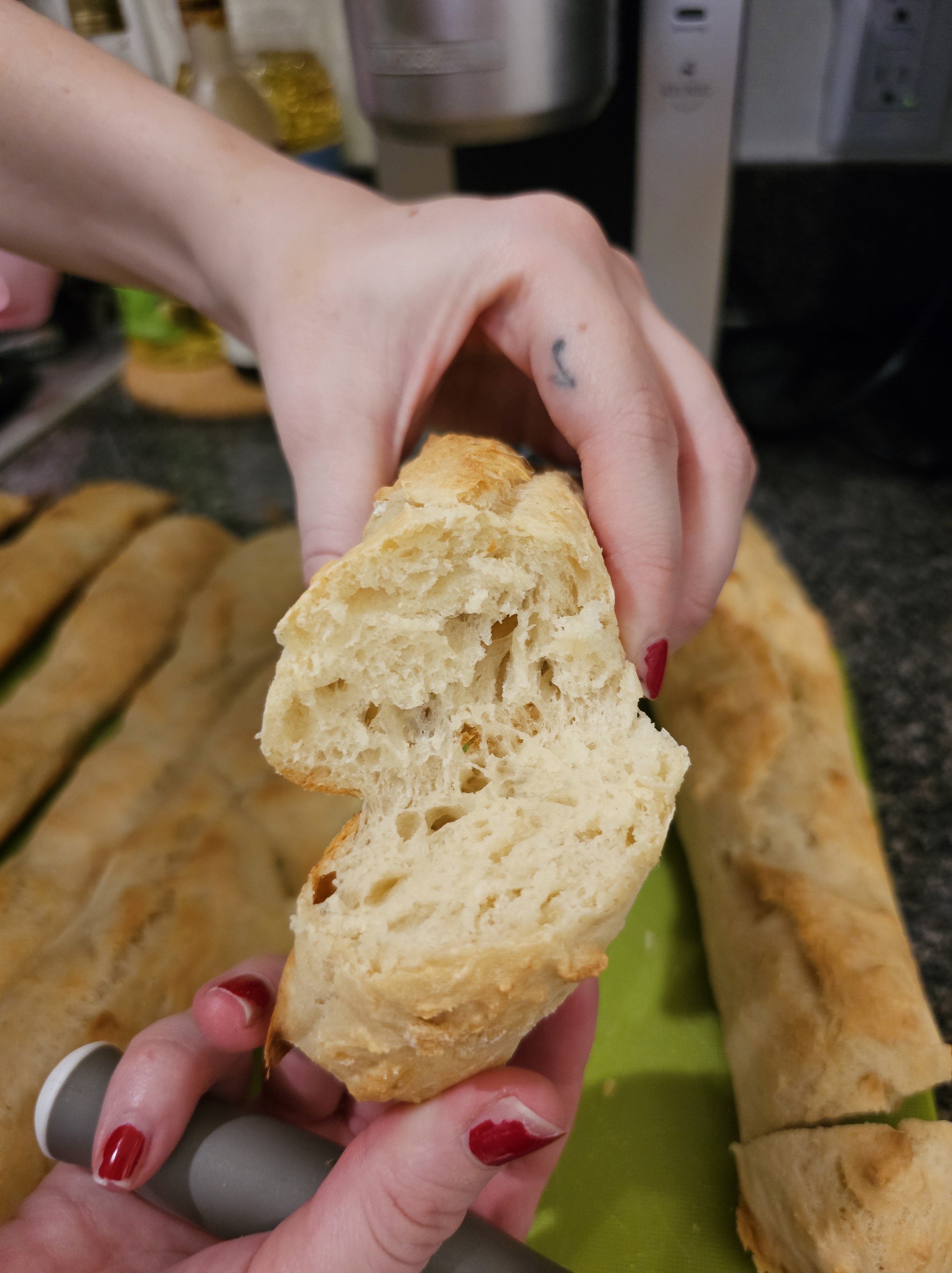
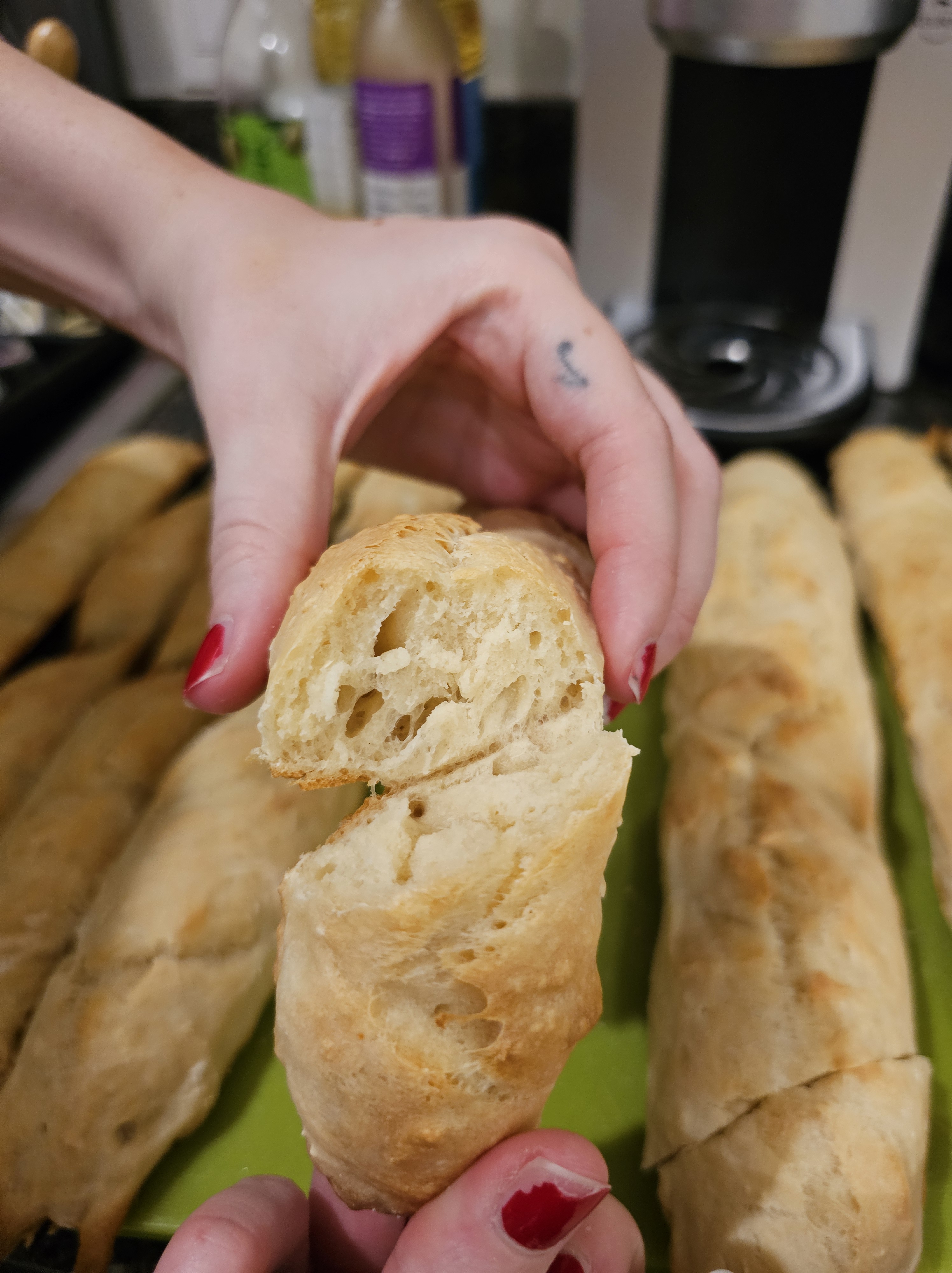


Right: Most yeast
Bread used to be a necessity, not a luxury. It was the basis of most meals and also played a role in keeping women in their place. Having good baked bread was a sign of a good wife and mother. Although yeast was not well understood and most probably created by accident, it was extremely important to the quality of bread. As trends shifted in the early 1900s towards quick and easy meals due to more women joining the workforce, it is not surprising that The Fleischmann Company contributed to this progress by making yeast production more accessible and simple. During a time when quick and easy food was the demand, having fresh instant yeast at your door cut the bread making time down by almost a whole day. Bread making was always considered a labor of love and something passed down from generation to generation, but that started to change as well when families were no longer having home-cooked meals all the time. Yeast will always remain an important ingredient in the bread making process and without it we wouldn’t have the popular American style white bread that is so popular today. Colonizers came to America not knowing what they would be able to use for cooking, and over time they started to use the resources available to create the bread that they knew and loved.
Works Cited
“A History of Bread in America.” Saveur, 18 Mar. 2019, http://www.saveur.com/article/Kitchen/Bread-History-America/.
“Bread for the History Lover.” Colonial Williamsburg, http://www.colonialwilliamsburg.org/learn/recipes/bread-history-lover/.
CIVITELLO, LINDA. “The Burden of Bread: Bread Before Baking Powder.”Baking Powder
Wars: The Cutthroat Food Fight That Revolutionized Cooking, University of Illinois Press, 2017, pp. 5–17. JSTOR, http://www.jstor.org/stable/10.5406/j.ctt1q31s7n.5.
Craft, Susan F. “Colonial Quills: Colonial American Bakers.” Colonial Quills, 25 Nov. 2013, colonialquills.blogspot.com/2013/11/colonial-american-bakers.html.
Humanities, National Endowment for the. “Chicago Tribune. [Volume] (Chicago, Ill.) 1864-1872, February 26, 1871, Image 1.” Chroniclingamerica.loc.gov, 26 Feb. 1871, chroniclingamerica.loc.gov/lccn/sn82014064/1871-02-26/ed-1/seq-1/#date1=1770&sort=date&rows=20&words=Fleischmann+Yeast+YEAST&searchType=basic&sequence=0&index=0&state=&date2=1963&proxtext=Fleischmann+yeast&y=0&x=0&dateFilterType=yearRange&page=1. Accessed 12 Dec. 2023.
“Public Ledger. [Volume] (Memphis, Tenn.) 1865-1893, December 15, 1871, Image 3.” Chroniclingamerica.loc.gov, 15 Dec. 1871, chroniclingamerica.loc.gov/lccn/sn85033673/1871-12-15/ed-1/seq-3/#date1=1770&sort=date&rows=20&words=Fleischmann+yeast&searchType=basic&sequence=0&index=1&state=&date2=1963&proxtext=Fleischmann+yeast&y=0&x=0&dateFilterType=yearRange&page=1. Accessed 12 Dec. 2023.
Thaysen, A. C. “FOOD YEAST: ITS NUTRITIVE VALUE AND ITS PRODUCTION FROM
EMPIRE SOURCES.”Journal of the Royal Society of Arts, vol. 93, no. 4693, 1945, pp. 353–64. JSTOR, http://www.jstor.org/stable/41362081.
“The Richmond Palladium and Sun-Telegram. [Volume] (Richmond, Ind.) 1907-1939, October 26, 1921, Image 12.” Chroniclingamerica.loc.gov, 26 Oct. 1921, p. PAGE TWELVE, chroniclingamerica.loc.gov/lccn/sn86058226/1921-10-26/ed-1/seq-12/#date1=1770&index=2&rows=20&words=yeast+Yeast&searchType=basic&sequence=0&state=&date2=1963&proxtext=yeast&y=0&x=0&dateFilterType=yearRange&page=1. Accessed 12 Dec. 2023.
Iannone, Olivia. “Bread-Baking Was Not Easy in Colonial Times.” Daily Record, http://www.dailyrecord.com/story/life/food/2014/07/02/bread-baking-easy-colonial-times/11963373/.
“Our History.” Fleischmann’s, http://www.fleischmannsyeast.com/our-history/#:~:text=The%20Fleischmanns%20had%20created%20America. Accessed 12 Dec. 2023.
topics, Beth Asaff Beth Asaff Beth has written about a wide variety of, and helping others to learn about topics ranging from yoga to healthy recipes Read More Learn about our Editorial Policy. “Information about Colonial Baking.” LoveToKnow, http://www.lovetoknow.com/food-drink/meal-ideas/information-about-colonial-baking#:~:text=Later%2C%20according%20to%20Colonialbaker.net. Accessed 12 Dec. 2023.
“Yeast: One of Humankinds Oldest Ingredients.” Explore Yeast, 5 Apr. 2022, http://www.exploreyeast.com/what-is-yeast/yeast-one-of-humankinds-oldest-ingredients/.
 digital Humanities studio