“People are so used to tenderloins that they just don’t realize that this food is part of Indiana history.” (Brosher, 2019) The hoosier pork tenderloin is a staple Indiana sandwich with its founding by restaurant owner, Nicholas Freinstein in Huntington, Indiana. It’s far greater than just a dish, as the sandwich is a representation of Indiana’s food industry and a nostalgic taste for Hoosiers of all ages. Residents of Indiana and most of the midwest have enjoyed this dish since the beginning of the 20th century. Its role as a cheap food option when it came to anyone is why everyone can have a fond memory of it. Through the work of German immigrants, the hoosier pork tenderloin is a simple, classic dish that has served the interests of the people in Indiana for over a hundred years.
Adapting to American Tastes
German immigrants are to thank for the introduction of the pork tenderloin as a response to the American public’s taste. During the nineteenth century, food critics would visit German restaurants and describe them to be “greasy and dirty” making the public think any ethnic restaurant was too gross for their standards. (Haley, 2011, pp. 96) Americans felt as if ethnic restaurants did not appeal to Americans but to the immigrants themselves. German restaurant owners needed to adapt the menu in order for them to attract more customers so they began to experiment with new dishes.
Realistically, no one knows when or where the pork tenderloin sandwich was first discovered or even created but it’s easy to find who popularized the sandwich into the mainstream. In 1907, the pork tenderloin sandwich was born in Huntington, Indiana from the hands of Nicholas Freinstein. The idea was to bring the German Wienerschnitzel to the masses. Historian David Stovall claimed that the Wienerschnitzel had various features working against it; The first being how it was served on a plate without a bun and covered in gravy which was not optimal for take out lunches. The second reason being how the meat inside was veal which Indiana folks did not enjoy. (Yates, 2014) The Germans would quickly realize the working class Americans are not interested in veal so they had to move on to pork. Another key difference the Germans had to make was the style of cooking they used to prepare the meat. Usually, the Germans would pan fry their Wienerschnitzels but then they switched over to the deep frying method which brought about more Americans. (Brosher, 2019) Feinstein, a son of German immigrants, would implement these changes and develop today’s pork tenderloin sandwich. Over the next century, the pork tenderloin would spread throughout the Midwestern states and it’s all thanks to the simple manner of how to prepare them.
Pork Tenderloin Sandwich
The recipe for the pork tenderloin is simple with its most important ingredient: pork. Early consumption of Hoosier-grown pork would have been seasonal and influenced by the ethnic traditions of the settlers, most of them being German. Fresh pork would have been eaten in autumn and early winter from September to December, when pigs were slaughtered on farms for home consumption on farms and driven to market. (Ledford, 2014) The German immigrant’s move from making Wienerschnitzel with veal to pork was essential for the creation of the pork tenderloin sandwich due to how important pork is to Hoosiers. Historians claim that Indiana’s settlement and economic development happened because of pigs. The state’s first settlers’ production of pork would be responsible for some of Indiana’s earliest food industries to grow. (Ledford, 2014) Now that the meat is set, how Freinstein prepared the meat would be the next step. He would slice the pork tenderloin and then beat it with a wooden hammer for it to flat out. The later competitors of Nick would adapt his use of the tendering process with the wooden hammer popularizing its use. (Mercuri, 2014) The next step would be to marinate it in buttermilk, egg, and flour mixture for over a day. (Brosher, 2019) That tasty feature would be the key to his success. After being left to sit for over a day, then he would bread them in cracker crumbs, deep fry the meat, and then serve it fresh between some hamburger buns.
For the sandwich part, hamburger buns or Kaiser rolls would typically be used. The toppings on the sandwich would usually be mustard, pickles, and onions but restaurants depending on the area can switch these up. (Mercuri, 2014) The versatility of the combinations of ingredients is also another factor to how almost anyone could enjoy the dish as they can customize it to their own tastes.
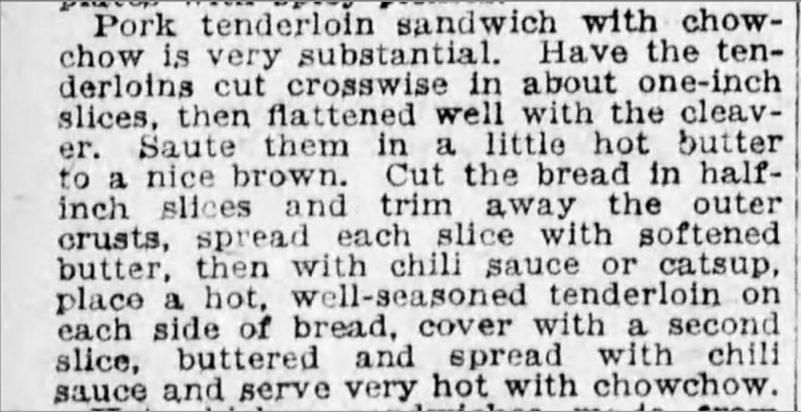
The advertisement above describes how to prepare the pork in the sandwich with another ingredient, chow-chow. Pork tenderloin sandwiches can be made in an abundance of ways so the addition of chow-chow will yield the same results of how to prepare the sandwich. For the advertisement’s example, one would cut crosswise on the pork slice and then battered it with a cleaver. Then one would fry it quickly or saute them in butter until it showed a brown color. This method is different from Freinstein’s as he would have left them to marinate in the ingredients while the advertisement is cooking them while they are frying. The various preparation methods for the pork tenderloin sandwich gave cooks freedom to experiment with the dish in new, creative ways.
Sandwich of Convenience
The reason for the widespread popularity of the pork tenderloin sandwich was because of its availability to working class people. The sandwich could be bought by anyone for their lunch break as since its preparation was rather simple, it could be sold cheaply. Before Nicholas Freinstein had a restaurant, he would peddle out the marinated meats in a basket with a cart that had a built-in grill and sell them on the side of the street. (Mercuri, 2004) The convenience of the sandwich allowed for a large number of restaurants to implement them into the menu.
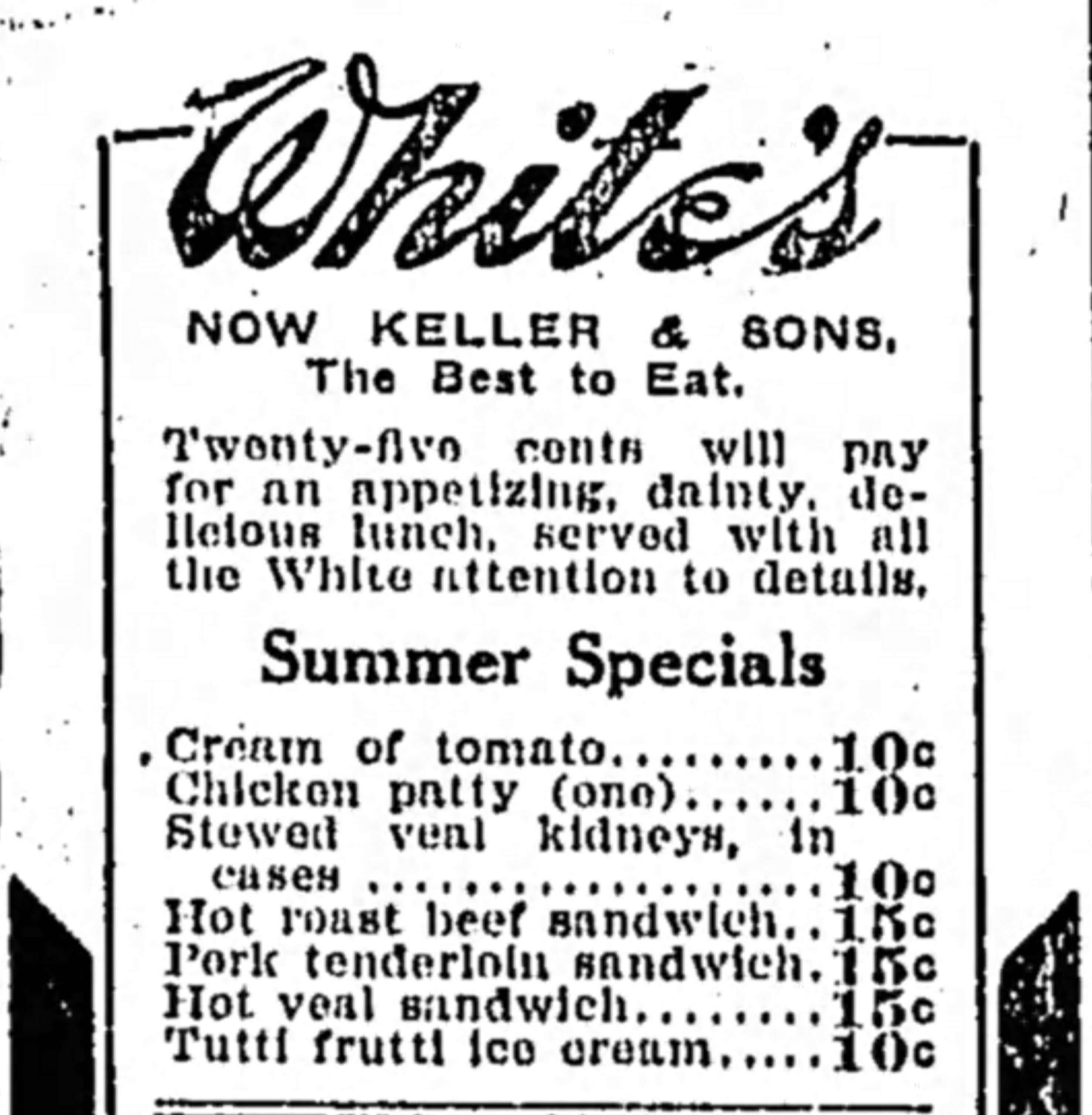
The advertisement above is the earliest record I found of the sandwich being on a newspaper menu and as seen with the price, it’s a cheap lunch option. Anyone who is on their lunch break can quickly go into one of these stores or grab one from off the street and pay for a frugal sandwich before heading back into work. The sandwich served the interests of all working Americans.
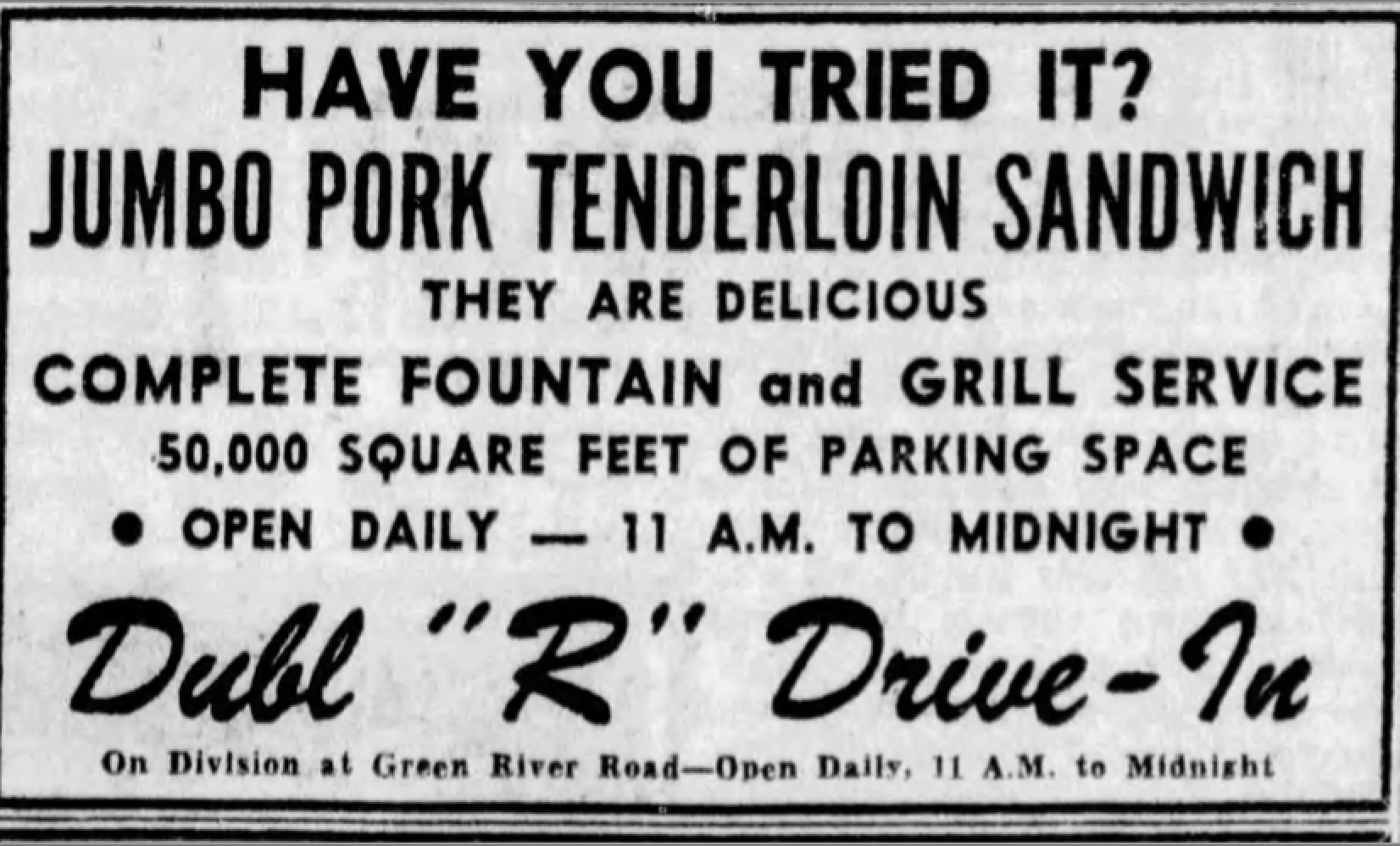
The size of the pork tenderloin was a huge deal for customers. The advertisement adding “Jumbo” to the sandwich name is not uncommon when promoting these sandwiches. Many described the sandwich to be extremely filling, not leaving anyone’s stomach to go hungry.
In contemporary times, the pork tenderloin has been spread throughout the midwest and the various states have adopted the sandwich to their own local tastes. “No two breaded pork tenderloin sandwiches are exactly the same. They are the road food equivalent of snowflakes.” (Yates, 2014) Even fast food joints have attempted to implement the pork tenderloin sandwich into their menus such as Burger King but customers complained it had the consistency of a hockey puck. (Yates, 2014) Its popularity has even warranted people such as Jean Anne Bailey (the owner of Nicholas Freinstein’s original restaurant) to ask Governor Eric Holcomb to make the classic Indiana pork tenderloin as the state sandwich. Bailey said she believes her proposal (Senate Bill 322) would solidify Nick’s Kitchen’s place in the community. (Sandleben, 2023) From a small town in Indiana towards having mainstream success, the Hoosier pork tenderloin has its mark in history.
Leaving An Everlasting Impact
From the hands of German immigrants, they were able to transform their ethnic speciality of Wienerschnitzel into the classic midwestern dish, the pork tenderloin sandwich. Nicholas Freinstein founded the dish that found its way into the hearts and stomachs of working class Americans through its origins in Huntington’s Indiana to the entire Midwestern part of the United States. The sandwich may even become Indiana’s state sandwich depending on the results of Senate Bill 322. Pork tenderloins are an important part of the food culture in Indiana and its legacy will only continue to grow.
Biblography
Brosher, Barbara. (2019, January) The History Of A Hoosier Favorite: Pork Tenderloin. WFYI. https://www.wfyi.org/news/articles/the-history-of-a-hoosier-favorite-pork-tenderloin
Haley, Andrew. (2011) Turning Tables: Restaurants and the Rise of the American Middle Class, 1880-1920. (pp. 96-99) University of North Carolina Press. http://www.jstor.org/stable/10.5149/9780807877920_haley
Ledford, Tony (2014, March). Indiana Chefs and Dig Indiana Focus on Local Food History. Basil Momma. https://basilmomma.com/2014/03/indiana-chefs-digindiana-focus-local-food-history.html/
Mercuri, Becky (2004). American sandwich: Great Eats from all 50 states. (pp. 43) Gibbs Smith.
Sandleben, Tony. (2023, February) WBOL News. 89.1 WBOI. https://www.wboi.org/news/2023-02-10/the-pork-tenderloin-sandwich-has-a-turn-in-the-spotlight
Yates, Jon (2014, December). High on the hog. Iowa Magazine. https://magazine.foriowa.org/archive/archive-story.php?ed=true&storyid=1487#:~:text=In%20fact%2C%20while%20some%20will,Wiener%20schnitzel%20to%20the%20masses.
White’s “Summer Specials,” The Indianapolis Star, 20 July 1908, p.10.
“Advertisement,” The Indianapolis Star, 14 February 1924, pg. 7
“Advertisement,” The Evansville Courier, 28 April 1956, pg. 3
 digital Humanities studio