My name is Alexis and both my parents are Vietnamese immigrants. They sent me to predominantly white private schools all my life. Growing up, I hated the holiday season because everyone around me would get excited about things I had no idea about. One of the topics I wanted to avoid the most was Thanksgiving. When it hits November, everyone in school starts talking about Thanksgiving and what they’re doing for Thanksgiving. In middle school, they always made us make hand turkey crafts and asked what we were thankful for. Teachers also used to ask us, “what is your favorite Thanksgiving meal?” I hated that question with a passion. I never really understood the traditional American Thanksgiving meal. I would always say some generic answer like “mac and cheese”. Honestly, I have never even experienced that kind of Thanksgiving myself. My family’s Thanksgiving meal looked a lot different from pictures and stories around me.
My mom came to America when she was around 8 years old. She came with her five siblings and my grandma. My family knew no English when they arrived in America. They first arrived in Chicago, but eventually moved to New Orleans to settle down. The seven members of the family all lived in a small beat up house in Algiers. We call this area “Woodlawn”. It was a small Vietnamese community around the Vietnamese Church, St. Joseph Mission. After getting enough money, my family got up on their feet and eventually branched out. My aunt and uncles got jobs. They started getting married and moved out of Woodlawn. My mom met my dad and moved out to New Orleans East. My aunt decided to stay in New Orleans, not too far from Woodlawn. She moved about five minutes away from Woodlawn into a nicer neighborhood. Two of my uncles decided to stay in New Orleans, as well. One of my uncles moved to Atlanta. The other moved to Houston. A lot has happened since this dispersion of siblings. My mom ended up moving back to the Westbank after having me. She decided to move back because she needed help watching me during the day while her and my dad went to work. My parents worked very hard to send me to private schools once I reached the age. At this age, I was finally old enough to remember Thanksgiving.
What My Thanksgiving Meal Looks Like
What my Vietnamese Thanksgiving looks like. Every time I talk about my Thanksgiving everyone tells me about how “chill” it sounds or how “cool” it is. Growing up, it just didn’t feel that way because my Thanksgiving table looked so different from everyone else’s. I would wake up around 10:00 in the morning on Thanksgiving to get ready to go to my aunt’s house. Thanksgiving at the Tran’s was very casual. I would wear something like sweatpants and a sweatshirt every year because our Thanksgiving consisted of eating, sitting on the couch, and watching football. From the outside, it sounds like a traditional American Thanksgiving meal; however, the dishes were so different. Every now and then for the holidays, my family would have nuong vi. Nuong vi translates to “grill”. This is when we would lay out a huge floor mat that would cover the whole living room. There would be a flat electric grill in the middle. We would grill thinly sliced pieces of beef, shrimp, squid, onions, and mixed vegetables in butter on the grill. Everyone would sit on the floor and all help in cooking. Once the protein was done cooking, anyone could take anything to wrap it in spring roll rice paper with rice noodles.

This was a great way for my family to bond and talk. Sitting on the floor also made us feel so much closer to each other. I also feel like this is a lot better than everyone bringing a dish because everyone is working together for this one meal. Another Vietnamese dish that was so common on my Thanksgiving is banh beo. Banh beo is a steamed rice cake topped with scallion oil, mung bean paste, and dried shrimp. This was then topped off with nuoc mam, a Vietnamese fish sauce. My family usually orders about five trays of banh beo from a local family that sells traditional Vietnamese dishes out of their home.

For dessert, we often have che. Che is a sweet dessert in liquid form. There are many different types of che. My favorite is che nhan nhuc. It is made from dried longan fruit. My other Vietnamese American friend said her Thanksgiving includes cha gio, heo quay, dua chua, and che ba mau. Cha gio is a Vietnamese egg roll that usually has a mixture of vegetables and pork. Heo quay is crispy pork belly eaten with a banh bao. Dua chua is a Vietnamese pickled cabbage that is eaten as a side dish along with rice. Che ba mau is another liquid dessert that is named after its three ingredients with three different colors. Che ba mau contains colors red, green, and yellow. It is a layer of mung bean, a layer of pandan jelly, and a layer of red beans in a coconut sauce served over crushed ice. All these Vietnamese dishes made my Thanksgiving certainly unique.

Introduction of Vietnamese Cuisine in the U.S.
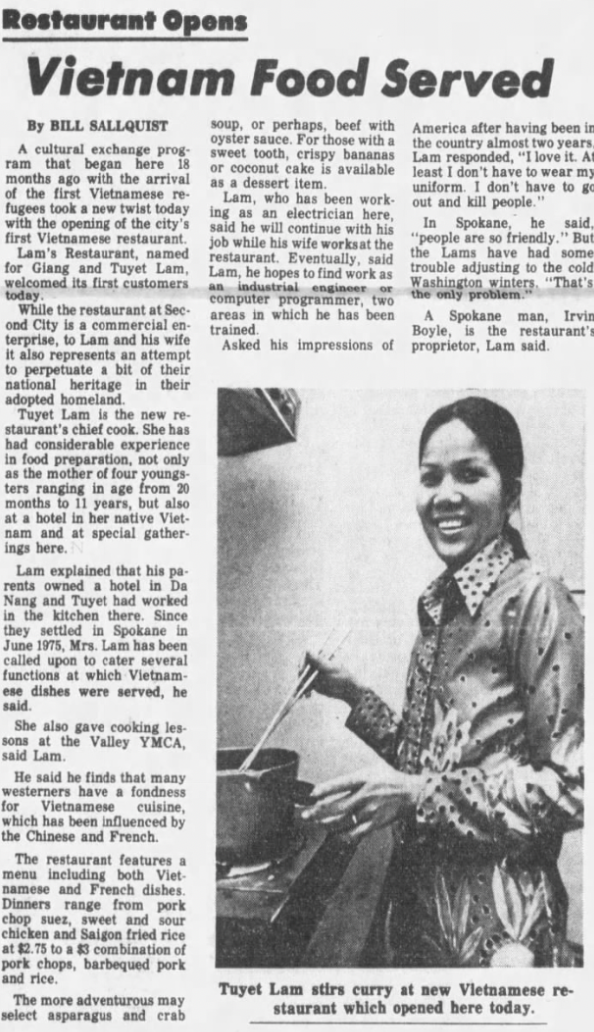
When did Vietnamese cuisine enter into the states? The Vietnam War lasted from 1955 to 1975. It was a conflict between the communist government in Northern Vietnam against the government in the South. The United States, Australia, and Thailand supported South Vietnam. The war ended in about 3 million casualties. About 11 million Vietnamese refugees fled to the United States. The first wave of refugees entered into the United States right after the fall of Saigon in 1975 (Trinh). In 1975, nearly 140,000 Vietnamese refugees arrived in the United States (Kuebel). There was a second wave during 1977 to 1982, which this wave was referred to as the “boat people”. The third final wave was during the 1980s and 1990s (Trinh). As Vietnamese refugees got to the states, they brought their culture and cuisine with them. They introduced a few different spices when they arrived such as lemon grass and the roots of ginger (Kuebel). These spices are still seen in Vietnamese dishes today. According to Trinh Lilly Vuong, co-owner of Lilly’s Cafe in Uptown New Orleans, her father was a French chef in Vietnam. It was logical for many Vietnamese immigrants to open up restaurants in the states “partly because that’s how Asian culture is commodified in this country” (Trinh). Early newspapers showed that the first Vietnamese restaurants started popping up in different parts of the country in the 1970s.


My Family’s Traditions
My grandma came to the United States with no sense of the language or the culture. One thing she did bring with her is her recipes. She did not know how to read or write, so it honestly surprised me how her recipes got passed down to where I can have these delicious meals on Thanksgiving. My mom, aunt, and uncles learned how to cook traditional Vietnamese dishes through watching my grandma cook on weekends. My grandma’s cooking constantly reminded me of my roots because sometimes as a Vietnamese American trying to make it in the real world it is easy to forget where you came from. I love how food is a constant reminder of my family’s home country. My family always talks about recreating Vietnamese dishes in America to try to make it just as perfect as it was in Vietnam. One thing I hope to pass down to my kids are my grandma’s recipes of traditional Vietnamese food. It is a little difficult to keep those recipes alive since nothing has ever been written down, so I have to start paying attention and taking notes whenever my family cooks.
My grandma passed away just last year. It was an eye opening time for me because I regretted not asking her questions about Vietnam before she passed. There was so much more that I wanted to know and learn about. I should have asked her more about her recipes and how she cooked certain dishes. Sadly, I came to the realization too late. As I continue to grow up, I am continuously learning how to embrace my roots. I always thought I had to fit in with everyone around me, until I realized that’s just not possible. Once I reached a certain age, I accepted that everyone has their own unique story. I started embracing my Vietnamese culture and stopped feeling ashamed. I am so grateful that I get to eat traditional Vietnamese dishes on Thanksgiving because it is a reminder of where my family came from and how they came to the United States. It tells a story of how they came to the states for better opportunities for their future families. If I could talk to my younger self, I would tell myself to be proud of my Vietnamese heritage. It is what makes me me and what makes me unique. There is no reason that someone should hide that. My family added a Vietnamese twist on Thanksgiving to really make it their own, and there is nothing wrong with that. Today, I would gladly talk about nuong vi or the banh beo that my family and I have on Thanksgiving. My biggest wish is that my family’s traditions and recipes continue to pass on.
Bibliography
Du. “Recipe: Banh Beo Chay – Vegan Steamed Rice Cakes.” Tra Vinh Networks, 29 Apr. 2017, travinhnetworks.wordpress.com/2017/03/04/banh-beo-chay-vegetarian-steamed-rice-cake-with-mung-bean/.
Kuebel, K. R., and Arthur O. Tucker. “Vietnamese Culinary Herbs in the United States.” Economic Botany, vol. 42, no. 3, 1988, pp. 413–419, http://www.jstor.org.loyno.idm.oclc.org/stable/4255092.
Thai, Thao. “This Refreshing Vietnamese Treat Is Pure Bliss in Summer’s Heat.” Simply Recipes, Simply Recipes, 12 May 2023, http://www.simplyrecipes.com/che-ba-mau-recipe-7495370.
Trinh, Jean. “Vietnamese Immigration and Its Culinary Influence on the United States.” PBS SoCal, 6 July 2022, http://www.pbssocal.org/shows/the-migrant-kitchen/vietnamese-immigration-and-its-culinary-influence-on-the-united-states.
“Vietnamese Beef Spring Roll Party (Bo Nuong VI / Bo Nhung Dam).” No Limit Cooking, 5 Dec. 2012, http://www.nolimitcooking.com/2012/12/05/vietnamese-beef-spring-roll-party-bo-nuong-vi-bo-nhung-dam/.
 digital Humanities studio
You must be logged in to post a comment.